
Each week, the church I work at includes some sort of contemporary reading as part of our worship service. This is perhaps not a particularly orthodox choice, but it means that we get to hear voices like Martin Luther King or Wil Gafney or Mary Oliver alongside our more traditional scripture readings and prayers.
Though this is always labeled a contemporary reading in our bulletin, there are occasional weeks when the word “contemporary” is a stretch. For example, we’ve read from Hildegard of Bingen, who was born in 1098. If you don’t yet think this was a strange choice, wait until I tell you this: the reading from Hildegard was a cookie recipe, or, at least, something very close to one.

Hildegard was a German mystic and nun who was elected the mother superior of her community while only in her late thirties. She wrote prolifically across a broad range of topics, including accounts of visions of God; reports on medicine, natural science, and the elements; the composition of a cycle of songs and hymns; homilies; and even the construction of her own language. Not only was she canonized as a saint in the Roman Catholic Church, she is one of only four female Doctors of the Church. If you ever want to go down a research rabbit hole, her life and writings are the place to do it!
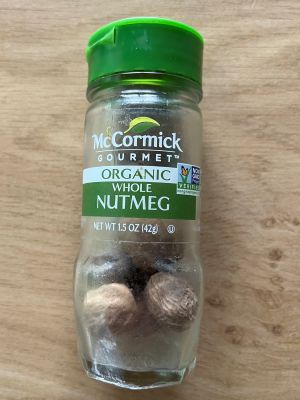
One of her works, Physica, contains a section about healing plants, including the following passage on nutmeg:
“If a person eats nutmeg, it opens the heart and purifies the senses and brings a good disposition. Take some nutmeg, an equal weight of cinnamon, and a little cloves. Grind these to a power, add a similar amount of whole wheat flour and a little water, and make a paste from this. Then eat it often. It will calm all the bitterness of heart and mind, open the heart and clouded senses, and make the mind joyful. It will purify the senses and diminish all the noxious humors; it will contribute good liquid to the blood and make one strong.”
Though perhaps not a cookie recipe with exact proportions, that has not stopped food bloggers (and even the National Catholic Reporter) from creating and publishing suggested recipes to make Hildegard’s “cookies of joy.” And it certainly didn’t stop the three of us on staff at my church from making these cookies during our meeting the week we read Hildegard’s “recipe” in our Sunday worship.
We ground our own nutmeg and cloves to a powder and added in flour, water, and cinnamon. (I believe we also added some butter and sugar, though they weren’t included in the original recipe.) Although I’m not sure how to determine whether these cookies “open[ed] the heart and clouded senses,” certainly the process of baking them added some much-needed joy and levity to my week.
I was ordained in the United Church of Christ just a few months ago, and figuring out how to be a pastor feels very complicated. The church is changing, our political landscape is fraught, Christian nationalism is ever-present and must be reckoned with, and all the while we are still called to care for the vulnerable in our own communities, to work for justice in our contexts, and happily perform day-to-day tasks like keeping markers stocked for the children’s program and proofreading the bulletin. I’m very fortunate to have co-workers and friends who are kind and incredible ministers (ordained and not ordained), who I am always learning from. But the questions ministry brings are hard, even when the opportunity to wrestle with them is a gift.
The questions are hard for all of us, for everyone reckoning with what it means to be a Christian, to follow the way of Jesus here, in this time and place, whatever our work is.
But there is a difference between taking this world and this work seriously and taking ourselves too seriously. Even if it seems unorthodox, maybe there is an appropriate time and place to read a thousand-year-old recipe for “cookies of joy” during a worship service.
I’m still not quite sure what Hildegard believed nutmeg did, scientifically. But I can certainly recommend making nutmeg cookies during a church staff meeting and serving them on Sunday after church to an amused and delighted congregation. It may not be the exact sort of “mak[ing] the mind joyful” Hildegard was thinking of, but I’ll take it.

4 Responses
I delight in your main point, and a board of elders making Hildegard cookies together would also be a great thing. Here’s what strikes me, though, about the recipe: nutmeg, cinnamon, and cloves were expensive spices, imported from what is now Indonesia (and the practical motivation for the Dutch “empire”). Can the expense perhaps be part of the virtue? I do not mean in any way to detract.
My mother added nutmeg to every vegetable she cooked. Since I learned from her, I do also. I can’t say everyone is always cleansed from bitterness of heart and mind. Very interesting article. Thank you.
My mother also had a nutmeg ball in a little wall hanger that had a grater as part of it. She would always grate some nutmeg on the green beans she was cooking. That was Dutch cooking at its best!
Bethany. Maybe your old Auntie should try making these. the ingredients sound awfully close to Santa Claus cookies made by a well known Dutch cookie Co in town!