
It is a remarkable sequence to come upon in a contemporary film—or any film ever, for that matter—and words don’t begin to conjure the half of it. An ordinary youngish mother cavorts with her three young sons, all exultant in a backyard romp. A delicately festive piano bathes the sequence. The camera leaps everywhere, near and far, from mother to boys to blooming lilac and then around again. In earnest voiceover, a character known only as Mrs. O’Brien (Jessica Chastain) extols ordinary random gifts in being alive, seeing the world, it seems, as only God sees it, beguiling and resplendent, soaked in love, first breath to last.
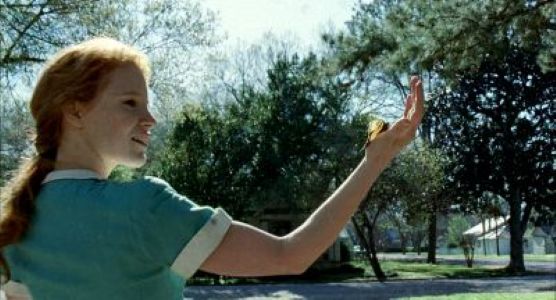
She prays earnestly that her boys and all creatures, might “Help each other. Love everyone, every leaf, every ray of light” (The Tree of Life, 2011, the lines adapted from Father Zosima in Dostoevsky’s The Brothers Karamazov [1879]). All of this echoes the film’s enticing (and vexing) epigraph, interrogatives that summon audiences to mull this mother’s take on what matters most: “Where were you when I laid the foundations of the earth? When the morning stars sang together, and all the sons of God shouted for joy?” Wild and heavy, indeed.
Readers of Job know these questions (38: 4, 7) compose part of God’s response (such as it is) to Job’s queries about his profuse personal loss–of family, respect, and fortune. Perhaps the only thing unique about Job’s circumstance is that this time, for Job, God bothers to respond at all, a courtesy that even the cross-nailed Jesus does not get in response to his question about forsakenness. In the films of Terrence Malick, these eternally vexing questions replay over and over in innumerable varieties of inexorable wrestle, struggles full of sound and fury, blood and death, and tears and groaning. Still, despite the woe, in Malick film after Malick film, beginning in 1998 with combat film The Thin Red Line, there emerges a sort of luminous splendor, wondrous and revelatory, a counter of sorts to an ever-lurking, predatory evil that randomly devours all, including, horribly, children.
The ways of grace and nature, as The Tree of Life names them, contend within individual lives, families, and world wars. The aching thorn in flesh, and soul, is this: whatever resplendent majesty does abide in life, as also the mere fact of life itself, evil unceasingly consumes in more excruciating ways than anyone can imagine or count. The late Leonard Cohen put it simply: “darkness drove the light away” (“Anthem,” 1992). It is ever the Fall ever over again, a continuous loop that plays like flagellation. Devastations of natural and personal evil consume exquisite, dearly-loved beauty and goodness. That exultant mother will suffer a lifelong plague of grief, anger, and doubt after the death of a shining young son. In the same family, a merciless father hounds and demeans, and brother loses brother. From these grim tides of woe there is, for very sure, no easy exit, no matter life’s occasional prettiness. Indeed, such is “the question mark turned like a fishhook in the human heart,” as novelist Peter De Vries put the matter in his wrenching novel of the loss of a child to leukemia (The Blood of the Lamb, 1961).

For the celebrated writer-director Terrence Malick, that bone-deep wrestle defines the central riddle of humanness: on the one hand, God, love, goodness, delight, and splendor (grace), and on the other, evil, enmity, suffering, and relentless bloody carnage (nature). With these wonders of one kind or another, people (and creation) perennially grapple, whether they are religious or otherwise. This inescapable collision at the core of being alive is nothing new, as old as Homer and Genesis. The great American author of Moby-Dick Herman Melville, Dutch Calvinism coursing through his veins, wrestled his whole long life, arriving finally in a condition of “protest theism,” as Stan Goldman has put it.* Among contemporary filmmakers, Malick is singular in his long focus on these sorts of deeply personal cosmic riddles. Beginning in 1973 with his first film, Badlands, a take on infamous 1950s serial killer Willie Starkweather, this theme has steadily become more and more prominent, culminating in 2011 with his Cannes Film Festival winner, The Tree of Life. Since then, Malick has completed a highly experimental (and star-studded) trilogy, steadily upping the stakes for what film can do as a medium: To the Wonder (2012), The Knight of Cups (2015), and Song To Song (2017), variously set in Oklahoma, Hollywood, and the Austin music scene. The heavy-duty questions posed in all those films also lie at the center of an amply philosophical natural history documentary, The Voyage of Time: Life’s Journey (narrated by Cate Blanchett, 2016). In A Hidden Life (2019), Malick ventures an upfront religious vision of a world devoured by evil, based on the story of obscure Austrian farmer Franz Jägerstätter (1907-1943), a devout Roman Catholic whose refusal to serve in Hitler’s army cost him his life. Entirely obscure in his own time, Jägerstätter has since been beatified within the Roman Catholic church, though it spurned him when he sought its guidance. (A brief and moving tribute to the farmer is found in “Franz Jägerstätter, a Quiet Martyr.”)
Film after Malick film has displayed facets of this timeless grapple, and these he has made surprising and enticing with a deft and innovative (and controversial) storehouse of cinematic tools, from camera, setting, editing, sound design, and music, to name only the most obvious. Indeed, Malick’s restless stylistic ingenuity has steadily moved toward a uniquely full-bodied cinema that does not so much engage viewers as envelop them. Few filmmakers ever, save perhaps for Ingmar Bergman and Krzysztof Kieslowski, have approached his measure of “thick description” of the complex perceptual and psycho-religious innerness that catches the depths and complexities of the personal self in motion, as it lives its own life [there is, though, much Bergman in Joachim Trier’s Sentimental Value (2025)]. Remarkably, with Malick, viewers immerse in another’s being, whether a mystical GI at Guadalcanal (The Thin Red Line, 1978), the thrice-exiled Pocahontas in The New World (2006), the mid-life lostness of a successful architect in The Tree of Life (2011), a God-starved priest in Oklahoma (To the Wonder, 2012), or an off-the-rails comedy writer in The Knight of Cups (2016). And of course, desolate farmer Franz Jägerstätter who lost his all to bloody Hitler.
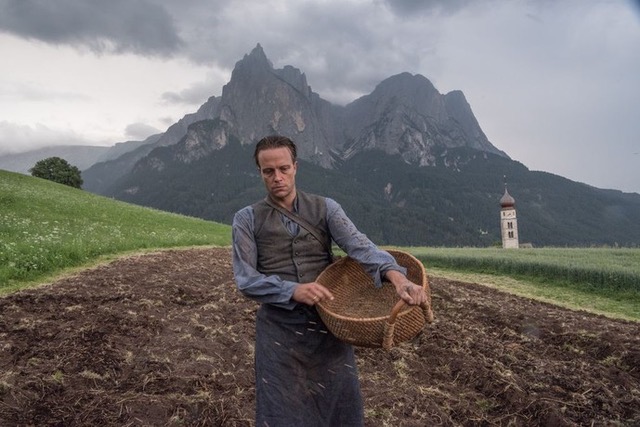
The philosophical and religious term most often used these days to describe this immersion into felt experience is “embodiment,” and because of Malick’s adroit use of cinema’s multiple registers of evocation, his stories quickly plunge viewers deeply into what it is like to live not only in the flesh, the body itself, but also, simultaneously, within something like a soul. So that mother in 1950s rural Texas exults in—indeed, seems to inhabit the full sensorium of being alive–light, color, flesh, heat, and water, as also then do viewers as the camera watches her hose cool her legs on a hot Texas afternoon. And the same striving for immediacy makes palpable the horrors of warfare—blood, jungle, terror, dismemberment, loss, and, in Jägerstätter’s case, decapitation. All of this is to good end. Malick’s lush style never seems present simply to parade the filmmaker’s panache. Rather, Malick finds means—even once outmoded ones like voiceover—to induct viewers into the complex, often paradoxical reckonings with this world’s fearsome ambiguity, a domain shining one moment and devouring the next. Such is the alchemy of art (and life).
For Malick, that deep ambiguity of things sooner or later accosts just about everyone. There, though, comes the great surprise, or at least a promise thereof. This story arc lies at the center of Malick’s films since his return to filmmaking in 1998. In the 1970s young Malick, summa from Harvard in philosophy, wrote and directed two films, Badlands (1973) and Days of Heaven (1978), that brought him, if not fortune, much fame, and that amid the glory days of American cinema, the heyday of Coppola, Scorsese, Spielberg, and Schrader. Those two early films end in the dark, so to speak, though amid abundant signals of some encompassing “Other” that might, potentially at least, counter the unrelenting grimness of human behavior and experience. And then, after his considerable success, Malick abruptly not only stopped making films but disappeared–for two decades. Malick, a resolutely private person, moved to France, where he on occasion taught philosophy at the Sorbonne (after Harvard, Malick had pursued a doctorate at Oxford until a dispute with his advisor).
And then, surprise, in the mid-90s, he returned to moviemaking to adapt and direct a masterful version of James Jones’s 1962 novel of Guadalcanal, The Thin Red Line, a film that remains the favorite of many Malick devotees. Unlike the novel, Malick’s film attests that even amid the devastating toll of a brutal war zone, even in one of the very damnedest places the humans can contrive, there remains the remarkable persistence of Light. Deeply skeptical soldier Witt (James Caviezel) has unexpectedly “seen the Light,” as he tells nihilist Sergeant Welsh (Sean Penn), a soldier who can smother neither his own kindness nor his God-thirst. Happily, viewers come to see what Witt sees, seemingly the very Light that he sees, infused and lambent in the ordinary world all about him. In short, in the damnedest of places, Witt runs into resplendent beauty and delight he never imagined possible. That there is beauty of such measure seems to warrant the soul’s conjectures on what more life (and death) might avail. Away from, and even amid, the war machine, in the film’s last words, indeed, “all things” shine. Indeed, alone among filmmakers, Malick seems to display the same elusive penumbra of being that novelist Marilynne Robinson describes as a “sweet savor… rising from this earth, every part of it—a silent music worthy of God’s pleasure” (The Givenness of Things, 118).
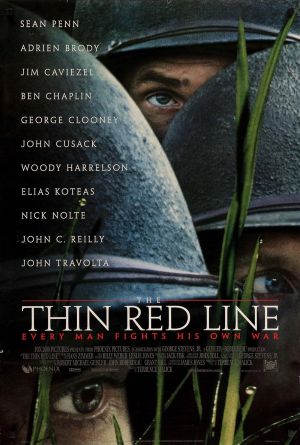
Such is Witt’s demeanor that he brings nihilist Sergeant Welsh to yearn for whatever it is that has encompassed Witt: “If I never meet you in this life, let me feel the lack. One glance from your eyes, and my life will be yours.” It is fitting that Penn later plays the middle-aged Jack in The Tree of Life, a weary, wandering soul who at last suddenly arrives amid his mid-life slog at a radically new sense of what life affords. For him it is hope for the radical beauty of forgiveness and reconciliation, one that leads as well to a re-awakening to beauty and delight of the actual world all about him. He wakens from his vision to see the world as if for the first time—indeed, as God made it in the first place, delight and amity soaking the whole of it. What was made in the first place comes again in wonder and intimacy.
All of which is good preparation for what promises to be Malick’s magnum opus and very likely his last film (he is now eighty-two, though still a workhorse). The Way of the Wind tells the story—get this—of the relationship between fisherman Peter (Matthias Schoenaerts) and an itinerant teacher-preacher from Nazareth, and even the Evil One himself shows up (Mark Rylance). Indeed, it will be more than interesting to see what Terrence Malick, an ordinary aging Episcopalian, makes of the old, old story. The one sure thing, it seems, is that it will be unlike anything anyone has ever seen. Indeed, hang on.
*Goldman, Stan. Melville’s Protest Theism: The Hidden and Silent God in Clarel. DeKalb: Northern Illinois UP, 1993.

8 Responses
O Roy!
What a comprehensive overview of Malick’s legacy.
Beauty and the beast. Entangled, ever playing out.
Reminds me of what Blaise Pascal did (Thoughts) for his generation. Humankind to the heights of glory and the depths of hell.
Even Pope Leo in the encyclical published today. AI as possible for bane and blessing, the return of Babel or the reconstruction of Jerusalem.
Professor Anker: what a contribution to cinema lovers. Malik at 82 with one more chapter in his book. Thank you!
Many thanks, Roy. Your blog convinces me that, given so much schlock in film, I need to make an effort to see more rich films such as Malick’s.
Thanks, Prof. Anker. Although these are words on the screen, it’s great to hear your voice in them. It’s been a long time—but full of God’s goodness—since I sat in your class at Northwestern College, learning about western civilization and literature from you and Prof. Murphy.
This is rich, Roy! A keeper for more than one rereading, especially when becoming immersed in the life and soul of Malick’s “vexing” characters.
This is great stuff, Roy. I look forward to seeing your good work between 2 hard covers.
This is great stuff, Roy. I look forward to seeing your good work between 2 hard covers.
This is really good work, Roy! I look forward to seeing your thoughts expand between two hard covers.