
A former Marine officer, Fred Johnson would often tell me and our students the importance of “completing the mission.” He had many missions: teaching, scholarship, public speaking, leading international trips, and being a good father and friend. He died on February 27, 2026, after suffering cardiac arrest in his 9:30am class on February 24.
I wanted to write this memorial to him this spring, while completing my final semester of teaching, but I didn’t. All faculty must balance teaching with other professional activities, and for Fred, teaching always came first. As the urgency of the semester’s tasks increased, I found myself putting this writing project off until my teaching and grading were done. I think Fred would have liked that. I did my job and completed the mission. Now I can honor my beloved colleague.
I am writing this without references or sources. This is simply my recollection. Fred the historian would probably not like this approach and please accept an advanced apology if memory errors eclipse some factual accuracies. Since much has already been shared on our college’s website and spoken at Fred’s on-campus memorial and Maryland homegoing services, I wanted this to be my own memory of the person whom I have referred to for many years as my best friend on campus.
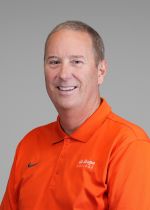
Although not Reformed by birth or upbringing, Fred was introduced to the Reformed tradition by Robert Swierenga, one of Fred’s graduate school professors at Kent State University. Fred told me many times he had “never heard of Hope College” before Swierenga encouraged him to apply for a faculty opening. Fred joined the Hope faculty in 2000 and ended his career as the Guy VanderJagt ’53 professor of history. Along the way, Fred earned a Master of Divinity degree from Western Theological Seminary while carrying full teaching, scholarship, and public-speaking loads. His commitment to Reformed institutions extended more recently to his teaching in the Hope-Western Prison Education Program. He was a beloved teacher at the Muskegon Correctional Facility, where the students selected him as their inaugural commencement speaker last spring.
He was in a different department, division, and building than I was. I honestly can’t remember the first time we met, yet he had an oversized presence in my life. One reason was because we spent time on important things. Our relationship wasn’t built on committee meetings and corridor conversations but rather on activities we both valued. My two fondest memories of him connect to two of Fred’s passions—politics and teaching.
Politics
In 2005, I met with the chair of the Ottawa County Democratic Party, a small but stout group. He queried me about my interest in running for office in 2006. After some discussion, it was decided that I was best suited as a candidate for District 30 of the Michigan State Senate. I ran and lost, as did every Democrat in the area. Political organizations can’t afford to wallow in defeat, and despite the lopsided losses, efforts moved quickly to the next election. The county chair approached me again in 2007, this time for ideas about who might run for Michigan’s 2nd District U.S. House seat in 2008.
“Do you know anyone who would be good?” he asked.
“Actually, I do. His name is Fred Johnson.”
I proposed to Fred that the three of us gather at a restaurant to discuss my idea. After some cajoling on our part and contemplation on Fred’s, he decided to enter the campaign. I proudly introduced him at the train station in Muskegon to kick off his campaign: “So please welcome to the podium the professor, scholar, speechmaker, Marine, businessman, author, and our next congressman, Dr. Fred Johnson.” (William Jennings Bryan or Mario Cuomo I am not.) After losing the U.S. House race in 2008, he ran again in 2010. After the party asked him to consider another run in 2012, he told the party leaders, “I gave you four birthdays.” He wasn’t bitter, but needed to move on.
We knew our chances of winning were small when we entered our races, which formed a sort of brothers-in-arms bond. When people would make David vs. Goliath jokes, Fred would firmly remind them that David won. Not in our cases, but it was still a great zinger. He would tell me stories from the trail about his door-to-door campaigning. He would meet people in towns like Custer and Free Soil. He spoke of the agony he felt as they told him their stories of poverty, job loss, and despair. Sometimes he would sit for 10 or 15 minutes with just one voter on their porch, an act of selflessness that runs against the political expediency that candidates need to have. But Fred would not have done it any other way.
It was an honor to be on the college’s Deans’ Council when Fred was selected as the Guy VanderJagt endowed professor of history. To have a Democrat who ran for MI-2 hold a chair named in honor of a Republican who held that seat for 13 terms had a sort of healing quality. It reminded me of a time when we didn’t, to quote Bruce Springsteen, have a “leader who says he wishes nothing but ill upon the people he disagrees with.”
Among other things, Guy VanderJagt (who died in 2007) was known for his public-speaking skills. So was Fred, who was prominent in Toastmasters International and several times advanced to the finals of its world tournament. I never knew Mr. VanderJagt, but he strikes me as a peaceful man with a heart for service. After the Deans’ Council made its decision, one colleague who did know VanderJagt told me, “Guy would be happy. He would have really liked Fred.”
Teaching
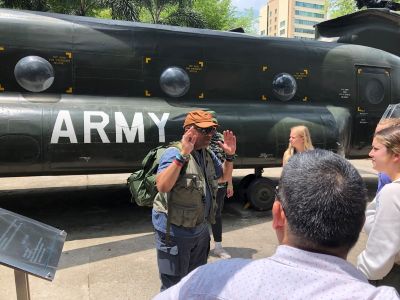
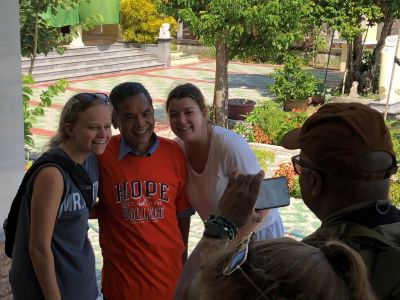
In 2016, I had the privilege of accompanying student-athletes from the University of Michigan on a trip to Vietnam. My goal was to explore a similar trip to Vietnam as a May Term class for Hope students. After getting the course approved, I needed a second professor. There was only one choice. Just like with politics, I wrangled Fred into something he wasn’t planning on doing. And just like with politics, he was excellent. Our trips together through Vietnam, from Ha Giang on the China border to the Cu Chi tunnels and Saigon in the south, were powerful experiences. Former students from our Vietnam May Term drove hundreds of miles to honor Fred at his on-campus memorial service.
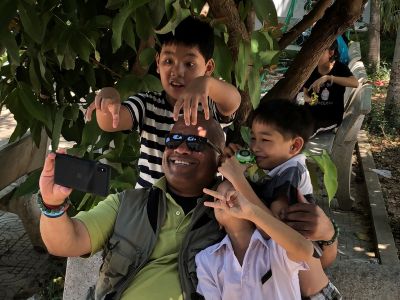
I always claimed that I was the muscle and he was the mind on our Vietnam trips. Although our course had a cultural psychology component that I taught, it largely became a class in American and military history, Fred’s specialties. As a result, I did most of the legwork and Fred did most of the teaching. Short-term international courses are exhausting, and I found myself relying on Fred’s sturdy demeanor to energize and focus me. Fred relied on me, too, mostly for details and strategies to give our students the best experience. At the end of a long day, Fred and I would gather with a finger of Jack Daniel’s to process the day and prepare for the next. It was not uncommon for Fred to say, “Stoep, remind me what we’re doing tomorrow.” His lack of concern about trip details was as endearing as it was vexing.
“Well, remember tomorrow we have an early flight to Dien Bien Phu.” He would stare away for a moment, “OK, Dien Bien Phu; 1954; General Henri Navarre; last stand of the French against the Viet Minh, which would re-emerge in the American war as the Viet Cong. I’ll be ready.” He would retire to his room and prep for the next day. I would get us to the site—General Navarre’s underground bunker, the Cu Chi Tunnels, the Hanoi Hilton—and Fred would teach. What a treat to watch the king of the classroom ply his craft in such unique locations.
One night sitting on the top floor of a Da Nang hotel overlooking the beach near where the Marines first landed in 1965, he asked about the next day.
“Tomorrow is My Lai, right?”
“Yeah,” I said. “Are you ready?”
“I won’t have to say much,” he said quietly.
The next morning, we drove three hours from Da Nang to My Lai. Neither of us had been there before and did not know what to expect. We watched the documentary film prepared by the Vietnamese government, saw the memorial wall where 504 dead are listed, and stood in the empty fields where American soldiers did their killing. Most grippingly, we met a survivor, who was only seven years old at the time of the massacre, who welcomed us to his home and told us his first-hand account of the horrors of that day. As we struggled to take it all in, he showed us the drinking well where he found his mother, aunt, and baby sister murdered.
It was the most powerful educational experience of my career. It hit everyone hard. Our American students wept. Two of them turned to Fred and asked, “How come we never learned this in high school?” As the sun began to lower on a scorching day, we climbed back in the 20-passenger bus and began the trip back to Da Nang. Our Vietnamese partner and dear friend, Mr. Tuan, was exhausted from translating and seeing firsthand what had been done to the women and children of his country. It was also his first time to My Lai. He collapsed in his bus seat and was asleep within minutes. The students chatted in the back of the bus for a bit before they all dozed off. Fred and I sat in the front row quietly. After about 10 minutes, he turned to me and remarked, “Hey, Stoep. I told you that I wouldn’t have to say much.”
“How did you know?” I asked quietly.
“Some things teach themselves,” he said.
Fred and I didn’t talk about much about the My Lai visit beyond that day. Maybe for some things, words cannot match the moment. Along with our Hope students and our friend Tuan, I was blessed to share that day with Fred. I wish he were still with us for many reasons, not the least of which is that there aren’t many people with whom I can share the emotions of that day. We probably should have talked about it more.
About a month before he died, I told Fred that I was retiring. He seemed puzzled. I could tell he was not ready to make a similar move, not ready to give up his craft. We weren’t ready for him to give it up either. We needed him on campus in so many ways. I retired partly because after 17 years of administrative work, my teaching skills were addled and I believe my department deserves someone with newer training. But Fred was at the top of his game, even though he was four years older than I am. He brought energy and excellence like no other. I would tease him by paraphrasing the way I once heard someone describe a former president: “Fred, you’re just like Ronald Reagan. We plug you in and you give a great speech.”I think he liked to hear that.
Fred gave his heart to everyone—his students in Holland and Muskegon, family, friends, voters. It’s hard to absorb the tragedy of someone who gave away his emotional heart and then lost his physical heart. His regalia was draped over the front seat at our most recent commencement, where Fred would sit after he marshaled the graduates to their seats. The loss is so great because the hole he left is so big. So much talent and energy gone without warning. And he still had gas in the tank. I remember his phrase: “Complete the mission.” Everyone who knew him believed that his mission was not complete, leaving us angry, empty, and struggling to understand this great loss. Thank God we had Fred as long as we did. We wanted more.
10 Responses
Powerful. A testament to the power of a good teacher. And a good friend.
Scott,
What a moving tribute this is. Your stories make me wish I’d known him, while at the same time giving me a vivid sense of who he was and what an extraordinary friendship you shared. Thank you.
Such a fine remembrance makes me think of Emily Dickinson’s poem: “We learn in the retreating/ how vast a one/
was among us….”
Scott, thank you for this! I have been a bit of a Fred Johnson groupie in Grand Rapids. I have signed up to hear him wherever he was speaking. I have served on the program committee of Grand Forum, a program for adult learners at GVSU, and we loved to hear Fred talk — on any area of history that we requested! The last time we had him on, he seemed tired, but he was still full of knowledge. I’m very grateful that you have shared your Fred Johnson story; it helps me to appreciate him even more.
Thank you, Scott, for sharing ‘soul-thoughts; about Fred, and about you and Fred. Obviously, he was a man you loved and respected, and rightly so. I had the privilege of serving with Fred on Hope College’s Presidential Search Team. His sharp intellect and tender heart served us well. He is missed by many.
Thank you so much for this moving tribute to Fred. I met Fred when we served together on Hope’s Board of Trustees and later in several classes that he taught for HASP. He was engaging, inspiring, thoughtful, exceptionally knowledgeable, and kind. Any class Fred taught for HASP would sell out quickly—a true Rock Star! How fitting that the HASP classroom will be named in Fred’s honor.
What a beautiful tribute; the picture of him in what I’m assuming was his office, surrounded by the many people who made history, speaks that he knew our history must be wisely told again and again, just as he let your collective witness at My Lai speak for itself. Thank you for sharing not only your relationship but also the man that he was.
Scott, such a beautiful remembrance. Fred was a giant. He embodied so much of Hope’s mission and vision.we were lucky to be part of his life.
Fred was a man of profound impact and an extraordinary teacher and friend. I used to tease him affectionately about his overscheduled life, a testament to his boundless dedication. His courses in the Calvin Academy for Lifelong Learning radiated with relentless passion and energy. The way he welcomed us with, “scholars of CALL,” never lost its magic. It reminded us every single time of the deep, shared joy we all found in learning together. Fred was a truly remarkable person, and he will be deeply missed.
Hearing this article shows a man who lived out this purpose, exercised his talents served up his gifts and through his love and passion for humanity built legacy.
Inheritance is what you leave to someone while legacy is what you leave inside someone.
May we all be inspired by his life and be encouraged to find our purpose, gift and passion and serve it up to the world with love and excellence encouraging others to do the same.
I too loved being in his CALL classes and was privileged to hear him speak at a rally in Muskegon. Thank you for your fitting tribute to a giant of a man who challenged us in every class to view our history a bit more deeply and honestly. He is surely missed!