
Today, Sara is joined by her husband, Jeff.
Gas prices just hit a national average of $4.57 per gallon. Yikes! When I hear people talking about the price of gas, I jokingly say, “What is this thing you call gas?”

I don’t remember the last time I stopped at a gas station. My husband and I drive electric vehicles (EVs). I drive a Tesla Model 3 (with a sticker that says: This vehicle does not endorse Elon Musk) and my husband drives a Rivian R1T. We’ve been driving EVs for three years. We still own a gas SUV but find ourselves with fewer and fewer reasons to drive it.
We love our EVs but the motivation to purchase them and what we find most compelling about driving them differs.
What we love about our EVs
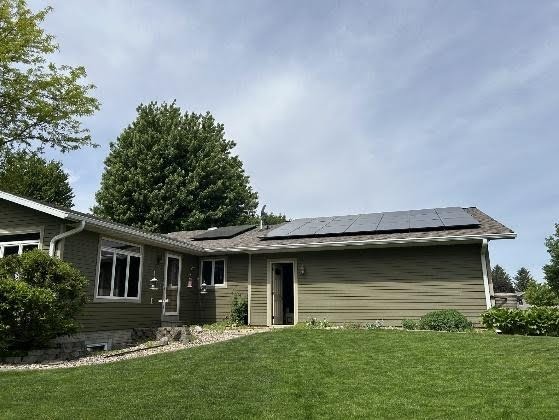
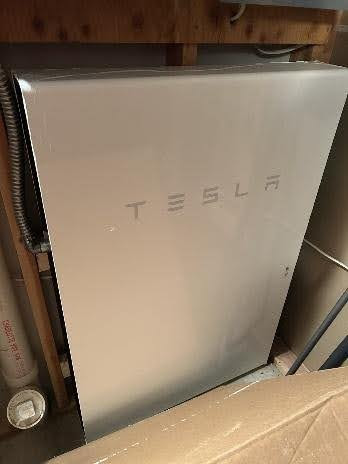
Sara: Taking care of God’s Creation matters deeply to me. It is the most important reason I choose to drive an EV. EVs have a smaller carbon footprint than gas vehicles. This is true even when you take the environmental cost of electricity and battery production into account. Around the same time we purchased our EVs, we installed solar panels and a Powerwall on our house. The solar panels produce more electricity than we need to power our home and charge our two EVs almost every day of the year. The Powerwall stores energy to use after the sun goes down. I can even set my car to charge only to a certain percentage unless it is charging on solar. We drive on solar energy!
Jeff: I love our EVs for the driving experience. You really should experience the acceleration/Instant torque at least once in your life. They are rocket ships. The performance/handling, due to a lower center of gravity, is unbelievable! And all of it with virtually no noise. The enhanced or full self-driving takes the stress away from longer commutes.
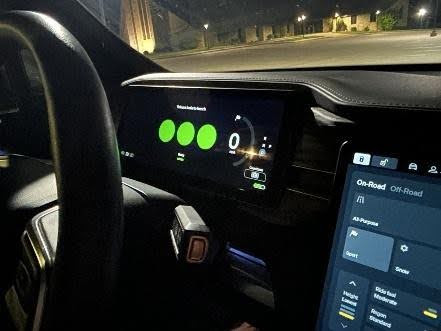
Sara: Our EVs are quiet vehicles. I can have a conversation with others in the car without having to shout over engine or tire noise. I can listen to my audiobook without having to crank it to the loudest setting.
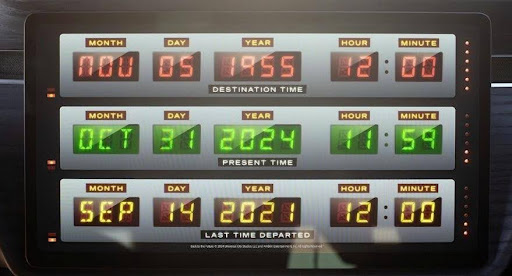
Jeff: The technology in an EV is incredible and is regularly updated via free upgrades/downloads sent directly to the vehicle, similar to updates on your cell phone. This provides for a safer, more fun, and enhanced driving experience. For example, every year Rivian sends a Halloween update and Tesla sends a Christmas present that you can choose to modify/enhance your internal display and/or external sounds. Occasionally these companies will partner with other companies to enhance the technology tied to media events (ie. – big blockbuster movie releases) to modify/enhance your internal display and/or external sounds.
Sara: Initial investment (which was significant) aside, we are saving money. Jeff commutes 100 miles a day. When he was driving a gas vehicle, we spent a lot each week to fill his tank. Now, the only time we pay for driving is when we take a trip long enough to require charging somewhere other than home. When we do charge on one of these trips, it is much less expensive than filling a tank with gas. For example, driving from Orange City to Kansas City in my Tesla to visit our kids costs less than $20.
Jeff: The environmental impact is important to me. I feel good that our vehicles do not burn fossil fuels or contribute to air pollution.
Sara: I know the “word on the street” is that charging EVs takes more time than filling a tank with gas and that’s not wrong. When we drive from Orange City to Kansas City to visit our kids we spend about 30 minutes charging. More if the weather is very cold. However, neither of us stop regularly at gas stations to fill our tanks anymore. Because of his commute, Jeff stopped twice a week to fill up. I drive less but filled my tank twice a month. That also takes time. Now we drive into our garage and plug in. I’m guessing that the time we save not filling our tanks because of daily driving more than makes up for the extra time we spend charging on longer trips. Plus, we’re getting old and stopping for bathroom breaks on those longer trips is increasingly welcome!
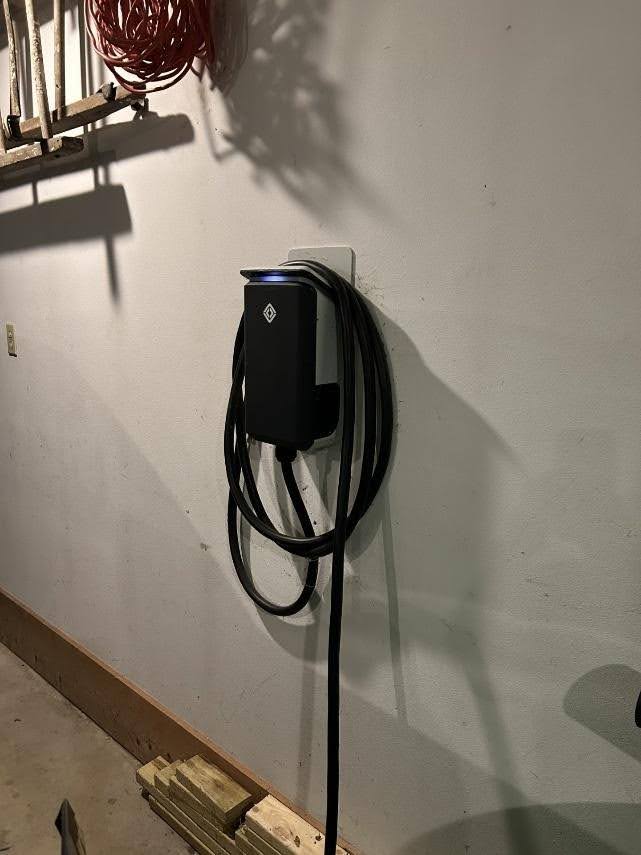
Jeff: The ability to charge in our garage at home is so convenient. My work commute is about 100 miles round trip. When I get home, I plug in and am fully charged by morning, regardless of season. No more stopping at gas stations twice a week. Charging at home means lower operating and maintenance costs. The savings for our family are significant. I don’t pay for gas and maintenance only consists of having to replace windshield wipers, windshield wiper fluid, and tires. Plus, with the solar panels we installed on our home a few years ago, we pay virtually nothing to drive daily. A bonus is that our vehicles can serve as back-up power if we happen to have a situation where we need it.
A few additional comments
The United States is behind when it comes to EVs, but sales are climbing in spite of the Trump administration’s attempts to stunt the EV charging network. “Globally, one in four new cars sold in 2025 was electric. In Norway, almost all new cars sold (97% of them) were electric. In China, over half (53%) were.” CEOs of the major US car manufacturers are deeply concerned about China’s clear advantage on EV technology. China is reported to make an EV with a 1300 mile range at a cost of under $15,000!
We’ve had people ask what we would do if we ran out of charge. I respond by asking what they would do if they ran out of gas. The answer to both questions is we don’t. Our vehicles tell us where we will need to charge and for how long to ensure we complete our trips. The charging network is getting better. Charge while you drive technology is already being tested in Michigan.
We have been accused of stressing an already strained electrical grid. When we bought our EVs, we got rid of a hot tub. Before installing solar panels, we were able to compare our electric bill. Charging both EVs was about equivalent to running our hot tub. And our solar panels make this accusation baseless.
Our range is affected by weather. If we are heading into a strong wind or it is very cold, we lose range. Gas mileage is also affected by wind and temperature.
EVs aren’t for everyone. . . yet. We wonder, however, if that day is coming.

12 Responses
We got a hybrid for similar reasons, but may consider EV next time around (if there is a next time around – our Honda is a thoroughbred performer).
Our son, who is in the auto industry, however, is less a fan. He has made note of the environmental impact of EV batteries if we ever get to a large scale use. They cannot be recycled nor destroyed. They themselves represent an environmental threat of another sort.
This may not be the answer we think it is.
Actually there is a company in NC that recycles EV batteries using them for stationary electric storage or breaks them down and claims to recover 98% of the heavy metals. There are, however, many variables determine whether those metals can be reused. It is an evolving industry with changes on almost a daily basis.
Take 2. The impact my son derided may not be as dire as he had assumed even though there are still environmental consequences:
EV batteries hurt the environment. Gas cars are still worse : NPR https://share.google/5a1TtMfB8OcCUTp7L
I believe they are working on recycling batteries. They might not be there yet but there is no reason we should say it could never happen. Most batteries are now recyclable
Thanks for this article! Same happening in our family.
DITTO for us in NJ. We love our Tesla Y and will rent a gasoline vehicle for very long trips. Excellent car for our local commutes.
We recently rented an EV in France. It was definitely a learning experience as our french is nominal and the charging network seemed to sometimes require “membership” and we never had driven or used an EV before. I suspect once you are in the habit of recharging away from home you find your favorite spots to stop — We stopped at a tourist site — a castle — and charged in a public parking lot that we located in an app. We were forewarned by the rental company that charging stations could be difficult to secure and it did cost us a little bit of stress but once we figured out where to charge it on the app in an open network, we felt confident after that we could do it. Would I do it again? perhaps I’d get a hybrid in France next time– but in the US or Canada — yes! Thanks for this post. It confirms that long distance travel is possible on an EV.
We love our EV for most of these reasons. The next big hurdle in their development is the batteries. They take rare metals and minerals, they are difficult to dismantle or recycle, and their range leaves something to be desired. Our Hyundai Ioniq 5 is great for around town (Chicago), and our home charger makes life easy. For visits back to Michigan, however, we have learned the location of every fast charger enroute. What we hear is coming, however, is solid state batteries, which are made from common material (ceramics), charge fast, and have maybe twice the range. If this all proves out in production cars, I’d say “game over” for piston engines. Norway, by the way, has actually decreed that, and now over 97 percent of their new car registrations are for EVs.
I fail to see what this subject has to do with theology.
I do see two people with three cars, while others in your country cannot afford to run even one.
A point well made. EVs are still cars for the well to do, especially Teslas and Rivians.
My spouse and I own and love our Chevy Bolt. The Bolt is more affordable than most other e-cars in the U.S. As the Trump Administration continues to undermine our country’s efforts to understand and slow climate change, driving an e-car is one thing we can do as individuals to reduce use of toxic fossil fuels.
This issue IS theological as humankind is called to care for God’s creation. And let’s be clear: rising sea levels disproportionately affect the poor. Reading through Luke this summer, I am again struck by how purposefully Jesus attended to the needs of the least of these. So yes, the topic of e-cars is theological.
My spouse and I own and love our Chevy Bolt. The Bolt is more affordable than most other e-cars in the U.S. As the Trump Administration continues to undermine our country’s efforts to understand and slow climate change, driving an e-car is one thing we can do as individuals to reduce use of toxic fossil fuels.
This issue IS theological as humankind is called to care for God’s creation. And let’s be clear: rising sea levels disproportionately affect the poor. Reading through Luke this summer, I am again struck by how purposefully Jesus attended to the needs of the least of these. So yes, the topic of e-cars is theological.
Thank you for sharing your motivations and experiences, Sara and Jeff.