
Tomorrow, of course, marks the 250th anniversary of the declaration of American independence. What should be the watchwords for so momentous an occasion?

Celebration, joy, solemn remembrance, gratitude, a bit of amazement—some or all of the above, and more like them. But these have to struggle for air in our current atmosphere and sound at most a muted cheep.
To me, boring and ominous seem the better choices. Boring for the present, ominous for the future. We can add lament for past virtues lost. But, then, also virtue for the path ahead, for Christians and other citizens of good will.
Boring
You might feel the “ominous” in your bones, gentle reader, but puzzle over “boring.” This we owe to the Reformed Journal’s fearless leader Jeff Munroe, who at our recent annual gathering (super-low cost and courtesy of your contributions! Thank you!) mused that for all the upheaval on the national, global, and denominational scenes, he felt bored with it all. Not apathetic, not at all blind to the stakes at hand, still determined to fight the good fight, but bored nonetheless.

It comes from the dull repetition of the daily news. (My words now, not necessarily Jeff’s.) The ceaseless string of lies from the White House, intertwined with one ironic strand of truth—accusations that serve as projections, confessions of a hollow heart that must out. Then there’s the excruciatingly bad taste, now threatening to swamp the entire Capital. The butchering of every good program, the funding of every bad one. The tidal wave of corruption, the gross incompetence in management, the viciousness, the hatred, the joy in other people’s pain.
On and on it flows, protests to the contrary usually unavailing, and powers designed to thwart the same largely supine. Yes, here a feeble protest from a Republican senator on his way out and there a Supreme Court decision not to overturn the explicit language of the 14th Amendment (though three “originalist” justices found their way around that). But we—well, at least I—sit back at home, sick at heart. Indignant for so many years, one can finally get tired of it all. Weary, flat, numb, says the thesaurus. Yup.
Burlesque
Well, there is occasional—more than occasional—laughter, rueful though it be. For me one outburst came last week when the Trumpian terms of surrender to Iran were unfurled just as the hastily pasted blue liner on the bottom of the Lincoln Memorial reflecting pool came unglued. Some moments perfectly capture the big picture.
And then there’s laughing till you cry, or crying till you laugh. Ten years ago, in the Before Times, Congress established a commission to organize a bevy of events to celebrate the Semiquincentennial (I had to look it up). America250, it would be—a nifty brand. But of course The Leader had to corral it all for himself and replace the plans with a Great Fair on the National Mall, the BIGGEST, THE GREATEST, THE MOST STUPENDOUS EVER SEEN IN THE HISTORY OF THE WHOLE HUMAN RACE!!!

It debuted last weekend to a crowd of 1,000 people who ambled around vacant space to the sounds of silence, the announced musical acts having all canceled. It turns out that the real commemoration began with a select crowd of 5,000 taking in gladiatorial combats on the White House lawn to celebrate the emperor’s birthday. The event destroyed the lawn, nicely matching the adjacent shambles of the East Wing. That’s a picture for the time capsule to be opened on a national Quincentennial, should one ever arrive.

Lament
“Boring” has obviously given over to “lament,” and lament admittedly is vulnerable to nostalgia. Indeed, the good old days often weren’t so good. But memories of the 1976 Bicentennial are still alive for some of us and call up a moment and mood remarkably different from the present. Then too hard, divisive moments loomed in the recent past: 1973-74 saw the OPEC oil embargo, Roe v. Wade, Watergate, and the feckless American military withdrawal from Vietnam.

But the reigning if unelected president, Gerald Ford, was a decent man who could preside over festivities far and wide with the right combination of solemnity, honor, hope, and humble pride. The enduring pictures from the occasion are of the Tall Ships gathered in the New York City harbor and Johnny Cash leading the parade down Constitution Avenue.
Yet some ominous portents lurked in the background, for the aforementioned landmark events each struck at a pillar of American identity and self-esteem. Together with the flatlining of working-class wages that began at the same time, they laid the groundwork for the polarization that bedevils us today.
Ominous
So we turn to the unsettling auguries of our own moment. Besides the abject surrender of the members of Congress who have failed to restrain our wannabe Caesar, the Supreme Court has just now further expanded his powers. At the same time, a clueless and unauthorized war has exposed the weaknesses of the American military whose supposed power has held open the lanes of global commerce since World War II.
That was part of a world order supposedly built on the rule of law and an American regime of institutions and alliances. That world order is now succumbing not just to an accumulation of hypocrisies and inconsistencies but to the allure of strong men promising safety behind might and swagger and personal intimidation. Spoiler alert: this did not work well in its most recent iteration, the 1930s.
And then there’s the economic front where the United States has thrown all its eggs into the baskets of finance and technology, leaving behind, unmourned, the ranks whose anger The Great I Am of Retribution has been deft to channel. Yet his compulsion to return to the economy of the 1950s has handed over leadership on the cutting edge of the world economy to the much-reviled Chinese.
In sum, gentle reader, the world we have known and assumed is gone or fast fleeting. What’s a Christian to do?
Virtue
Here’s one option. Join with the Founders of yore and the thundering preachers of my childhood and present-day homeschoolers and patrons of classical academies, all calling us to “virtue.” The preachers had “worldliness” in their sights, and the academies the various depredations of “liberalism.” But for the Founders, virtue was the very foundation of a republic.
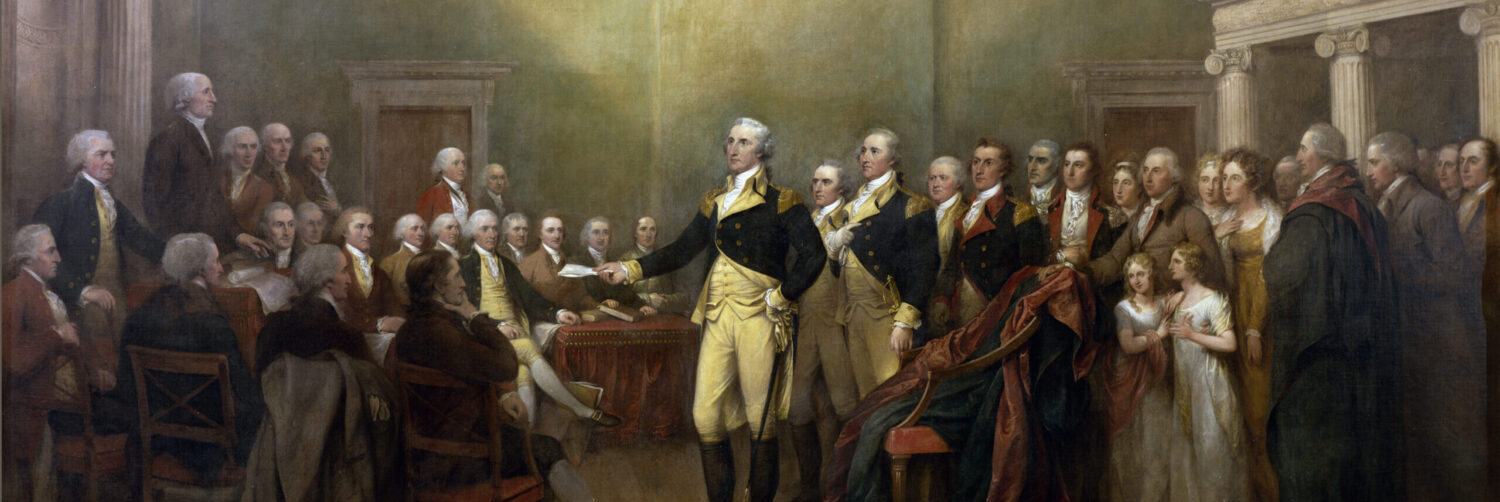
painting by George Trumbull, 1843
They were borrowing from ancient political theory, recovered and reaffirmed by the Renaissance. If rule by the one required an ethos of fear and rule by the few a veneration of courage, the theory went, then rule by the many, a democratic republic, required an ethos of virtue. This “virtue” did not signify first of all the sexual chastity that Evangelicals took over from the Victorians. It demanded above all the constraint of two desires, of two raging lusts all too common among those who would rule: avarice and blind ambition.
That is to say, the Founders of the American republic feared above all a man such as Donald Trump and tried to structure a government that would prevent his rise or, failing that, rein in his devices. Republics fell, they knew from history, (1) when greed drove leaders and those whom they could corral away from pursuing the common good toward advancing their own self-interest, (2) when that pursuit hardened into a factionalism that demoted opponents into enemies to be driven out of public life, and (3) when vanity impelled ravenous egos to stamp their image on everything in the public realm, for current glory and in dreams of a lasting fame that might replace lost hopes of eternal life.
Civil Religion, Rightly Remixed?
I remember being taught that American Civil Religion was at best a dubious thing, and I passed along that lesson in my own classrooms. Indeed, the flag-worship and tub-thumping of Cold War Yankee nationalism deserved Christian skepticism. But with our mutilated public square, our vanished sense of the common good, I wonder if we should bring back a chastened version and raise a couple cheers for the red, white, and blue.
There is significant overlap between the Founders’ premises 250 years ago and what Christians may properly work for today. The virtue of the republic required self-control, the quality that caps the fruits of the Spirit listed by the apostle Paul. The rest of the list goes on to define a climate diametrically opposite our own: love, joy, peace, patience, kindness, goodness, faithfulness, and gentleness.
Embodying such an ethos, genuine Christians might offer a community attractive to the bored and anxious and lamenting. Who knows? Perhaps beneath our present haze of gilt and gladiators, mendacity and meanness, the fields are white unto harvest.

21 Responses
Bracing and bold in description and diagnosis. Deftly rendered. Applause.
Indeed.
Heartfelt gratitude. Thank you for being a voice of intelligence, reason, and hope.
Jim,
You absolutely nailed it! Thank you.
Thank you, Jim, for this articulate analysis of what’s happening to the vision and hopes of the founders of our democracy.
This needs to be read widely. Submission, perhaps with some alterations, to the Atlantic?
And a happy holiday to you too, Jim!
Thanks for your assessment of our current era.
I’m recalling Dave Ryden’s distinction (HASP class) between “Civil Religion” (in parts OK); and Christian Nationalism (not OK).
My fear is that civil religion too easily slides into the merging of God and Country, a current idol.
Without “virtue” our version of democracy is doomed. Avarice and Ambition will never get us to the common good.
His attitude is either you are “with me/us” or you are the enemy to scorned and erased. Where is civil dialogue when that attitude prevails?
Selfishness is diametrically opposed to the Selflessness embodied by our Founder.
Dying to Self; living for Others must surely be our goal, if we are to live Christianly in the current or any era.
Thanks again for your assessment, Professor.
Truth bombs bursting in air!!!
From north of the border, thank you for such an eloquent and bold analysis. May those trying to bring an end to the current shameful situation be emboldened and empowered by your words and those of so many others speaking truth.
Thank you, Jim. Boring is a good addition to the mood of the times. Sin may appear exciting, but ultimately, it’s boring. Bruce Cockburn sang this toward the end of the 70’s: “So I find out what the luxury of hate is, as exciting maybe as doing the dishes.” With regards to civil religion, it would at least be good to promote religion that is civil toward others. As you note, I tend to think of virtue as best defined by the fruit of the Spirit. None of fruit of the Spirit could remotely be attributed to our current president.
Thank you for such a brilliant, concise account of what so many of us feel. We need a day of mourning and repentance as well as a day of celebration. Any people out there willing to organize such an event?
Thank you for this. Beautifully and clearly stated.
If I may, I’d like to add one additional suggestion to the list of good options under “What’s a Christian to do?”
Support, help, reward and vote for candidates for elected office, and incumbents, who embody and promote generosity, compassion, and humility – the opposite of avarice and blind ambition.
Thanks, Jim. Not frivolous and boring, but deep and inspiring. As always!
Your view and prejudice thoughts are so sad. You talk as if the current administration is so bad & wicked.
How about writing an article about previous administration’s of both parties and things they have done incorrectly
Is there nothing you can say about the good that has been done in the past year & half. My frustrations & sadness come not from the current administration but from biases people who are blinded by there ignorance
Jim, you absolutely nailed it in this essay. Happy Fourth!
Sadly, both parties are not overflowing with virtue. Both parties are seriously flawed. We need to pray that God will send us good statesmen and stateswomen. Maybe it’s time for a third party? Still, I’m very thankful to be living in America. But for the grace of God, I could be sitting in North Korea, China, or Russia. A big THANK YOU to all those veterans who have given their last full measure of devotion to make it possible for us to live in a free country where we can say what we want without being thrown in the gulag.
Thank you for giving voice to what so many of us are feeling. Very pertinent words!
Speaking of boring, it is sad to read yet another rendition of Trump Derangement Syndrome, this time from academia. Where does this phobia come from? How can people think and speak as though only the one side of the coin they choose can be used to render a final judgement? Our President is obviously flawed, but one-sided and prejudiced judgments are not useful. Check out the many good things he has done and is doing, and pray for him.
Please tell me these “good things” of which you speak?
I appreciate Jim’s analysis, but I think this present moment is full of emerging positive possibilities. The Democratic Party through its primaries is finally have a set of necessary discussions over its top agenda items, its assertiveness, and the rest, finally aware of its many disfunctions and that a new majority is out there waiting to be formed. And for the Republicans, in only 4 months the 2028 presidential race will start, days after what is likely to be dismal election night. Partisan tumult seems right for the moment, and whichever party can have a bona fide platform that attracts the broad working class has an advantage. Too, I see the Supreme Court as standing up on key points against the President’s pet ideas of tariffs, birthright citizenship, and the like. I’m not a fan of the Court continuing the expansive view of executive power, but that’s really been across party lines. I wish Congress were more assertive, but I have a feeling that is just a half year away. And more locally, I’m encouraged about the recent RCA synod and its pronouncements on Christian nationalism and the like, and excited about what my birth and likely new-home denomination can do when the best and brightest from the Grand Rapids region complete their journey back to that denomination. I do think re-thinking the notion of civil religion is a place to start. For readers who’ve made it this far, my colleague Amy Black (of Wheaton) and I describe American civil religion as a “table” around which the “chairs” of deistic religions can sit. A sound bite is that “in America, civil religion lets deistic religions be civil” by guaranteeing free expression as long as the accept those rules of the game for all faith tradition. I wouldn’t describe myself as optimistic, but certainly with some Christian hope.
Oh, my! I did not expect, that by posting a comment, I would find myself on the firing line. But it’s a good question, and I must admit that I do not have a definitive list readily at hand. At my age, events happen and then fade quickly. But I will make an attempt. One good thing that I can remember are the new Trump Accounts. I have 18 great grandchildren, so that, to me at least, is a significant, good thing. And seeing as how it is a fair question, perhaps while I’m working on my list, we could ask James Bratt what are the specifics of his accusation of President Trump‘s “corruption”? One last comment, do you really not know one good thing President Trump has done?
Hello, Judie-
The list of “good things” that the Trump administration accomplished is too long for my one-finger typing, so here are two web sources- first for his current term and then one for his first term. Hopefully this works. Likely too positive for your perspective, but I’m trying.
https//www.whitehouse.gov/achievements/?utm_source=copilot.com
https//www. whitehouse.archives.gov/trumpadministration-accomplishments/?utm_source=copilot.com