
(Editor’s Note: This is the first of a two-part series. Part two will run next Monday.)
A Fire on Bradford Street
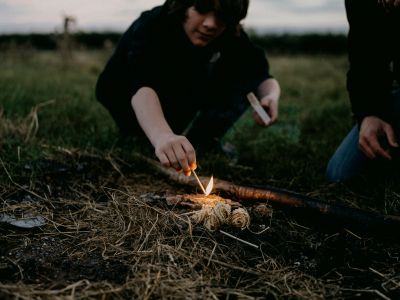
I was seven years old, and my brother Peter was eight. We were playing in a grassy field tucked between our grandma’s house on Bradford Street in Grand Rapids and her neighbor Mrs. Wendt’s house. We gathered dry grass and twigs into a pile, and Peter reached into his pocket and pulled out a box of matchsticks that Grandma used to light her ancient Detroit Jewel gas stove and oven. After he struck a match and lit the pile, it smoldered for a few moments and suddenly burst into flames. Kneeling on the ground, we watched the fire blaze upward, marveling at the vibrant colors, feeling the heat, and listening to its crackling. We were enraptured. Out of nothing, something. Fire: a mysterious and glorious manifestation of power.
Our state of rapture ended abruptly when Mrs. Wendt rushed towards us with a pail of water and extinguished our fire. “Ruby, Ruby, come quick!” she yelled. “Your grandkids are playing with fire. They’re gonna burn down the whole neighborhood.” Grandma came running from the house and calmed Mrs. Wendt: “I’ll make sure this never happens again.” Taking us into the house and sitting us down at the kitchen table, she scolded, “Don’t you know that playing with fire is dangerous. If you play with fire, you’re gonna get burned. Promise me that you will never do anything like this again.” We promised, but I don’t remember feeling guilty about it. We had experienced the latent power of nature and the possibility of transfiguration, a transcendent encounter, in the words of Rudolf Otto, both fearsome and fascinating. It felt like we had stood on holy ground.
A Fire in the Scriptures
Our spiritual ancestors inhabited an enchanted world of latent power. God was the one in whom they lived and moved and had their being, yet they experienced God’s being as mysterious and God’s presence in the world as elusive. Over many generations they appropriated a limited number of root metaphors in order to discern the mystery of God’s character and to align themselves with God’s work. A few of these metaphors continue to have great significance for believers today. In the Reformed tradition, for example, we have embraced the metaphor of God the Sovereign, who sits on a throne and whose words create and sustain the world. To a lesser extent, we have celebrated the metaphor of God the Fountain, whose living water cleanses us of sin and sustains our lives.
One of these root metaphors, however, is largely overlooked. Our spiritual ancestors testified that God had appeared to them as a burning fire. God appeared:
-to Abraham as a smoking fire pot and flaming torch in a late night, covenantal ceremony (Genesis 15)
-to Moses as a burning bush (Exodus 3)
-to the people of Israel as a pillar of fire in the wilderness (Exodus 13), as a billowing fire on the peak of Mt. Sinai (Exodus 24), and as fire on the altar of the tabernacle and temple
-to Elisha as a fiery army of horses and chariots surrounding and protecting him (2 Kings 6)
-to Ezekiel and John in a vision as a fiery visage (Ezekiel 1; Revelation 1)
-to the apostles as flames of fire dividing into tongues and resting on each of them (Acts 2)
God was not immutable and self-contained: like fire, God, burned, flared forth, illuminated, and energized everything in the world. In the words of an ancient Celtic prayer, the fire that was in the beginning burned still in the brilliance of the world. The line between the visible material world (earth) and invisible spiritual world (heaven) was thin. At times this line became so thin that the world of matter yielded to a world of fiery energy and revealed a pathway to God. The world was dazzling and bedazzling.
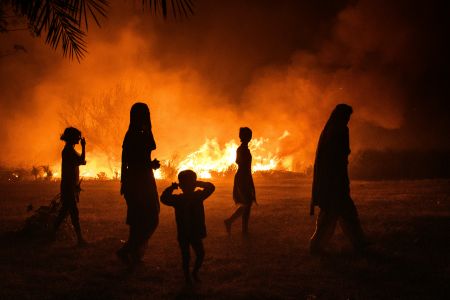
Our ancestors did not regard the burning bush that Moses encountered in the wilderness as an episodic appearance of the Holy One but a revelation of a world burning and not being consumed. They imagined the world’s various ecosystems as branches on an ever-burning bush.
Just as Moses knelt before a burning bush, our ancestors knelt before a burning world. Moses heard the voice of God from the midst of a fiery bush, they heard the voice of God from the midst of a fiery world. The whole world was holy ground. Their hearts would have been strangely warmed by these lines from Elizabeth Barrett Browning’s poem, Aurora Leigh:
Earth’s crammed with heaven
And every common bush afire with God;
But only he who sees, takes off his shoes—
Our ancestor’s word for the fire in all things was “glory,” and their oft-repeated refrain was: “The whole earth is full of God’s glory.” Believers today frequently use the word glory in sermon and song but struggle to define it. Scriptural words like “glory” are like beached whales: they swam freely in the ocean of the ancient world but expired on the shores of the modern world.
Our spiritual ancestors inhabited a glorious world of latent power. The air they breathed, the water they drank, the food they ate, and the various canopies they constructed were not inert commodities; they were infusions of life-giving power and were received as gifts from the hand of God (cf. Heidelberg Q & A 27). Wherever they would walk in the world and whatever danger they would encounter, nothing could separate them from the fire of God. Their name for this omnipresent God was Immanuel.
Growing up in the Reformed tradition, I was told that omnipresence was one of the attributes of God. Rightly or wrongly, I saw omnipresence as a way of thinking about God, not as a way of living in the presence of God. I was told that the material world was inert raw material for human consumption, not a confluence of glorious systems infusing me with life. I was told that I met God in my head and not in my body.
I did not realize it at the time but the Reformed tradition of my upbringing was disenchanting my world. Over time, I began to feel the tension between what my mentors were saying about the significance of the material world and what my spiritual ancestors were saying. They invited me to look for glory and challenged me to teach in such a way that my students could answer the call to cherish the created order.
Believers today are generally confused about accounts of ever-burning bushes, fiery armies of horses and chariots suddenly appearing, and fire flaring forth from the presence of God. There is no thin line between earth and heaven for us, we tend to assume a thick, nearly impenetrable line between the material and spiritual worlds, and to regard our ancestors as primitive and superstitious when they attributed spiritual agency to material phenomena.

Indeed, our ancestors were primitive in the sense that they knew nothing of a universe 14 billion years old and an earth over 4 billion years old. We know much more about the age and expanse of the universe and the evolution of life on planet earth than they did, but that fact does not preclude the possibility that they had insights into the deeper patterns of our world and offered root metaphors that are worthy of our consideration. In fact, the metaphor of the fire of God flaring forth and sustaining the world corresponds in interesting ways to the modern idea of a Big Bang, a singularity of infinite density and energy flaring forth, cooling, and congealing over 14 billion years into the materiel systems that sustain the universe and life on our small planet.
Playing with Fire Is Dangerous
My grandma warned me and my brother Peter that playing with fire was dangerous, and I can see our spiritual ancestors shaking their heads in agreement. Our scriptures are full of references to fire raining down from heaven and consuming those who profane the word and work of God. In the words of Nahum 1:6, “Who can endure the heat of his anger?
His wrath is poured out like fire.” Modern believers are flummoxed by references to fire and the wrath of God, which seem at first glance to portray God as arbitrary and cruel. We find it difficult to reconcile references to both wrath and love flowing from the heart of God and resort to a version of the Marcion heresy, setting a God of wrath in the Old Testament against a God love in the New Testament. This is not what the scriptures intend to teach.
Soft Religiosity
Abraham Joshua Heschel calls the tendency to ignore the wrath of God “soft religiosity.” There is a section in his remarkable book, The Prophets, that convicts me every time I reread it:
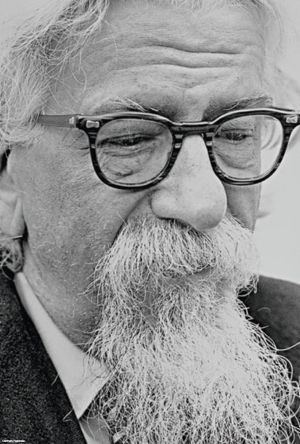
“Our embarrassment in reading the harsh expressions of divine wrath is also due to the general disposition of modern [believers]….We are moved by soft religiosity, and would like to think that God is lovely, tender, and familiar, as if faith were a source of comfort, but not readiness for martyrdom….To our minds the terrible threats of castigation bespeak a lack of moderation. Is it not because we are only dimly aware of the full gravity of human failure, of the sufferings inflicted by those who revile God’s demand for justice?”
Only dimly aware of the full gravity of human failure. These words are like a two-edged sword cutting deep and discerning the thoughts and intentions of the heart. Heschel sees both the wrath and love of God as expressions of God’s inexhaustible and indescribable passion for the world. The wrath of God is not cruel; it is love in action. At various places in his writings, Heschel points out that those who are suffering and dying under the oppression of greedy tyrants do not call the wrath of God cruel; they call it salvation. The wrath of God is an expression of God’s broken heart over both the suffering of the innocent and the indifference of those who oppress them.
The modern prophet Flannery O’Conner takes seriously the fiery wrath of God. She too challenges soft religiosity, and in her writings tries to awaken Christians to the depth and emotional range of existence. She highlights the fire of God that burns away the false and dangerous inclinations of the heart and brings believers face-to-face with profound truths about sin, suffering, and sacrifice.
One of the characters in her novel The Violent Bear It Away is Old Tarwater, a prophet who proclaimed the destruction of a sinful world that had abandoned its Savior. He announced that the sun would flare forth in fire and burn the world clean; yet day after day, month after month, and year after year, the sun rose and set as if the Lord had failed to hear him. One day, all that changed:
“Then one morning he saw to his joy a finger of fire coming out of it and before he could turn, before he could shout, the finger had touched him and the destruction he had been waiting for had fallen in his own brain and his own body. His own blood had been burned dry and not the blood of the world.”
No soft religiosity here. O’Conner confronts believers with the painful reality that the fire of God refines us before we refine the world.
Fire and Sanctification
Hearts are refined in the fire of God. Refining is a two-step process. First, the fire burns away the dross of the human heart. Dross is the scriptural metaphor for our seemingly intractable inclination to exclude and dehumanize others, our intractable inclination to justify violence and cruelty, our intractable inclination to ignore human frailty and seek self-glorification in the accumulation and consumption of material goods. This dross, this depravity, is the cause of the pain, suffering, and death in our world.
Second, the fire of God tempers hearts. Fire makes hearts stronger and more resilient in order to bear disappointments without breaking. Tempered hearts find the courage to acknowledge the full gravity of human failure and the conviction to restore the goodness of creation and the human community.

Abraham Joshua Heschel and Flannery O’Connor have been living rent-free in my head for a long time. Along with our spiritual ancestors, they point to a God who is a refining fire and whose purpose is not our elimination but our purification, not our destitution but our reconstitution. We have been reconstituted so that we can love not only our neighbors but also our enemies, so that we can expand our circle of care beyond family and church, so that we stop and care for the victims who lie broken and robbed on the side of the road paved by our exploitative political and economic practices.
In the Reformed tradition we have traditionally called the two-step process of refining “sanctification.” We find the classic summary of the meaning of sanctification in the Westminster Shorter Catechism: “The work of God’s free grace, whereby we are renewed in our wholeness after the image of God, and are enabled more and more to die unto sin, and live unto righteous.” Although this was never mentioned in the Reformed communities of my upbringing, sanctification comes at a cost. It is playing with fire. Once drawn into the presence of a fiery God, we die, and then we live again; we lose a part of ourselves, and then we find our better selves. We hurt, and then we heal. And we do this again and again through the course of our lives. As stated in the catechism, God’s purpose in sanctification is to restore in us the image of God, in other words, to instill in our hearts the love of Jesus and temper us for the work of renewing the created order.
In the second part of this essay, I will turn my attention to a passage in which we learn of the fire of God burning not in the heart of a world, but in the heart of a particular individual. It is one of the rare examples in the scriptures of what we call today “spiritual autobiography.” Jeremiah describes in vivid detail how the fire of God tempered his heart, how God sanctified him.

8 Responses
O Tom, this so resonates with my heart and mind.
The metaphor of God as “a consuming Fire” has seized my imagination.
It has brought forth scores of pages of reflections on how God’s “Fire” can destroy what is unworthy in us, and refine the “Faith” that is our heritage, leading to a New Creation.
I’ll be in touch. Can’t wait for next Monday and the second installment.
Where there’s fire, there’s smoke—
Close up, billowing, choking, suffocating, blocking out everything else; and yet hundreds of miles away, dissipating into the atmosphere but still noticeable by a faint aroma, a hazy horizon, affecting eyes and lungs of all, not to be ignored or dismissed.
Perhaps a God-image there as well?
Thoughtful, thought provoking! You took us on quite a journey from that boyhood experience of playing with fire. Thank you for these thoughts I too look forward to part two.
Harvey
Thanks for this, Tom. Deep stuff. You present material here for an enlightening (pardon the pun) series of sermons on the theme of God and fire.
Well said, Tom. When you describe how we ignore God’s fiery presence, I immediately thought of a line from a song by the contemporary Christian group, Dogs of Peace. The singer laments, “I beat around the burning bush.”
I gladly join the chorus of gratitude for this piece, Tom. Your persistent attentiveness to the prophets, ancient and modern, who witnessed – and bore witness to – God’s glory burned bright in your teaching those of us blessed to be your students, inspiring in not a few of us a cherishing of this beloved, sacred, and beleaguered world still aflame with glory! Thank you.
Thanks so much. Woulda been nice to have you as one of my OT/Hebrew instructors!
And here’s a sort of whimsical biblical paradox: “Baptism by fire.” Both are needed for life. Both can kill.
I wonder if that paradox was playing in Robert Frost’s “Fire and Ice”?
I any case, Hugh Cook is right. Maybe I’ll suggest your essay to our new pastor as seeds for a sermon series. If she decides to do such a series, maybe she’ll even let me work up a sermon to give her a break!
Now on to Part 2.
Thank you Tom. On a rather local (Croton) note, The folks who manage the Coolbough Natural Area off Croton Dr. spent the day preparing a burn break to contain a prescribed fire this fall. Fire has ‘purifying and healing’ benefits in a fire dependent ecosystem.
And if you are up this way, Gene’s has received some amazing sweet corn.
Chuck