
On a muggy August morning, I drove into the South Side of Chicago to discover if I still believed in democracy. Yes, that’s an overwrought way of putting it. But it’s impossible to visit the new Obama Presidential Center, or even contemplate a visit, without sensing the jarring contrast between the idealism of the Obama presidency and the corruption and cynicism of the current administration.
This was an intergenerational family outing, involving my parents and two skeptical youngsters who were missing out on a lazy summer morning. We tried listening to presidential speeches in the car, which didn’t go over well. I tried a promise of lunch in the city, which improved things slightly.
Truth be told, I have no trouble subjecting my sons to an educational outing and accepting some grumbling in return. It saddens me that they were too young to remember much of Obama’s presidency. I want them to know more of his story and what it means to people.
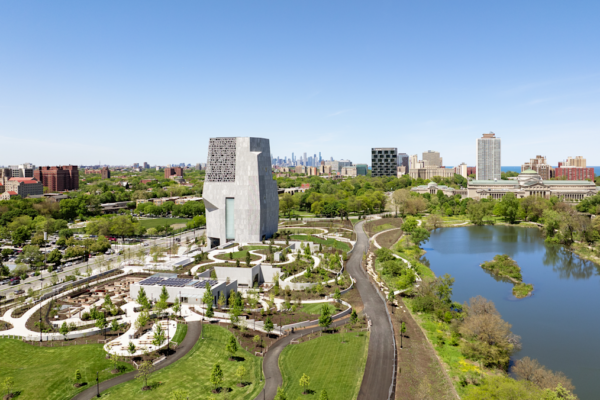
And it was clear right away, arriving at the site, that this place is significant to people. Tickets were sold out months in advance. Out-of-state plates lined the surrounding streets. There was an unmistakable sense of occasion to the crowds gathering in the central plaza, dedicated to John Lewis. Families were decked out in matching t-shirts for birthday parties and reunions. Others were resplendent in all-white for family portraits. I felt underdressed.
Above us, rising like a fist, stood the centerpiece, a 225-foot granite-clad tower, unofficially dubbed the “Obamalisk.” The symbolism of this striking piece of architecture is, of course, contested. Some see a symbol of strength and hope. A New York Times architecture critic criticized it as cold and forbidding, out of step with the welcoming vibe of the rest of the center’s grounds—a collection of gardens, playgrounds, winding pathways, community basketball courts, and a public library branch.
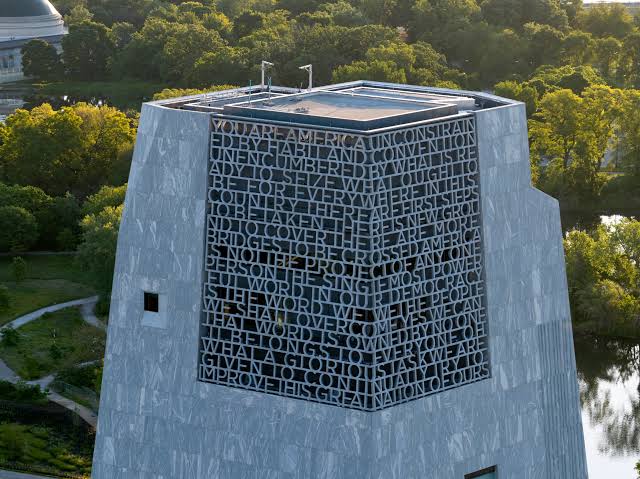
At the top of the tower, a block of tightly spaced letters runs around the corner, unreadable except for the first few words: “You are America.”
We didn’t have tickets, but just taking in the art and architecture of the un-ticketed spaces was more than enough to fill a morning. The Sky Room on the top floor, free on a first-come basis, offers stunning views of the city. You could see the Obamas’ story written into the landscape: Michelle’s childhood neighborhood of brick bungalows. Shuttered steel mills along the lakeshore, whose economic fallout first drew Barack to the city as a community organizer. The gothic rooflines of the University of Chicago, where he taught constitutional law.
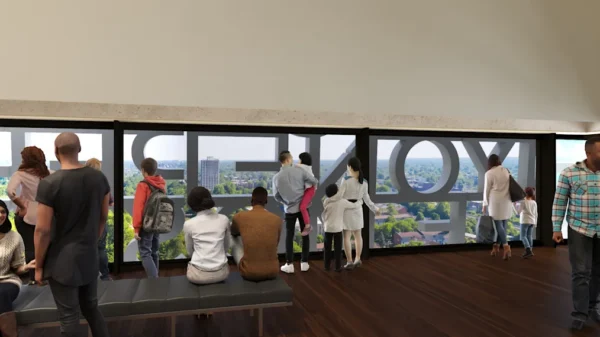
Unlike most viewpoints in Chicago, which are oriented around the downtown skyline, this one faces primarily south and west, into working-class neighborhoods. You look out through the large concrete letters, the swooping shapes drawing the eye to different stopping points: the university, the lakeshore, the endless blocks stretching out to the horizon.
Just out of sight, I could imagine my own family’s landmarks: My parents’ childhood homes just beyond the city’s edge. The complicated web of white flight and ethnic community. The museums and cultural spots where we went on weekends, where they taught my sister and me not to fear the city, like too many suburban families, but to explore its riches and complexities.
Outside, the words on the tower are perplexing, unreadable in full. Inside, the meaning becomes clear: They are a lens for viewing. Drawn from a 2015 speech in Selma, Alabama, on the 50th anniversary of the Selma to Montgomery marches, they are what Obama considers some of the most important words of his presidency:
You are America. Unconstrained by habit and convention. Unencumbered by what is, ready to seize what ought to be. For everywhere in this country, there are first steps to be taken, there is new ground to cover, there are more bridges to be crossed. America is not the project of any one person. The single most powerful word in our democracy is the word ‘We.’ ‘We The People.’ ‘We Shall Overcome.’ ‘Yes We Can.’ That word is owned by no one. It belongs to everyone. Oh, what a glorious task we are given to continually try to improve this great nation of ours.
You can hear a central dilemma of the center in that passage: Is this a celebration of one man, or of the movement he represents? “America is not the project of any one person,” he says, while also inserting his own campaign slogan alongside historic American “we” statements. It’s a tension.
I could have stayed in that room for hours, watching the woman in ornate silver sandals and the man in the embroidered guayabera shirt pose by the windows, wondering what the visit meant to them. But, this was a family outing. There were lunch plans to figure out.
The most moving piece of air I saw wasn’t part of the center collection at all. On the way out, we saw a family of nearly 30 arranging themselves for a portrait. A row of elders sat in front. In front of them stood laminated block letters spelling the family name: “FLOYD.” The three-foot letters were a composite of portraits. I can only presume the photos were other loved ones, deceased or unable to join the trip. I didn’t get a chance to talk to the family; we were on a rooftop garden, they were in the plaza below. But the story their arrangement told—our identity comes from our relationships to other people—felt unmistakably fitting.
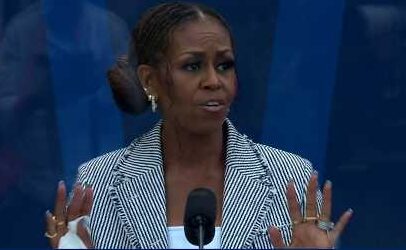
“Hope is a choice,” Michelle Obama said at the center’s opening in June. “Whether or not we use our voices to speak up is a choice. Voting is a choice. Being a decent human being is a choice. Believing that we still hold the power to build a country that reflects us all is a choice.”
Hope is a set of practices, too. Gathering, educating youth, and even posing for selfies can be a part of that work. The risk is that the Obama Center becomes a sort of progressive Disneyland, a place to escape and take solace in unfulfilled promises. The meaning of the place, I think, depends on whether it inspires a deeper engagement in the work of democracy. The real work takes place back at home, back at ground level. But, wow, that view.
3 Responses
Thank you for this inspiring account of your visit. I need to get my tickets. It is so much more than a Presidential Library.
We had a similar recent visit. A woman approached me and said, “Isn’t it wonderful? Everyone is smiling and is happy.” Another, overhearing her, turned and said, “Take it with you.”
Thanks for your thoughts. Whatever one concludes about the Obama presidency, and there is plenty of disagreement about that, your essay highlights a biblical truth: words are more important than votes. What we say and hear is more important than whom we elect. Brute force, the foundation of every Presidential administration, is not the way of the kingdom. The way of the kingdom is serving others and highlighting this service with words, mostly the words of good news. According to your testimony, this is what the Obama Center does, and ideally this is what the Body of Christ does even better.