
One of my best teachers at Calvin College was Harry Faber. He was my boss, the Director of Campus Safety. I was a part-time security guard who toured the bowels of the buildings. Late at night and during the day I wrote parking tickets.
I wrote them righteously. I was strict. I was the enforcer. I was indignant at the violators. Did they think they could get away with it? There are reasons for those No Parking signs. How dare they ignore them? One particular faculty spouse was a repeat offender. Did he expect to just get off?
I liked Harry Faber very much. He was genial, thoughtful, and had a deep and quiet sense of humor. But gradually I got the impression that he excused some of the tickets I had written — more than I liked.
One day he shocked me. He told me that next week there was going to be a big event on campus that would draw many visitors, so I should write a lot of tickets to start clearing the roads.
What shocked me was the realization that he saw function where I saw righteousness. Parking tickets were for management, not for correcting offenses. It threw me for a bit, but it opened my eyes. He was a retired cop, and I supposed that his long experience gave him wisdom on enforcing laws.
This came to mind recently as I was watching a podcast produced by a Christian Reformed minister whom I respect. I always learn from his unique take on things. (Plus, he grew up next door to my grandmother.) He was replaying parts of a Zoom consultation from 2024 in which I had been a participant, and offering his commentary. The consultation was to introduce Christian Reformed pastors to my own denomination, the Reformed Church in America (RCA).
An RCA colleague and I were discussing potential changes to the RCA church order, and she said, “which we submit to, but there are no police.” The podcaster snickered and paused the playback. He repeated her words with a smirk, “Which we submit to, but there are no police.” As if what she meant was that in the RCA you can get away with stuff. . . hint hint.
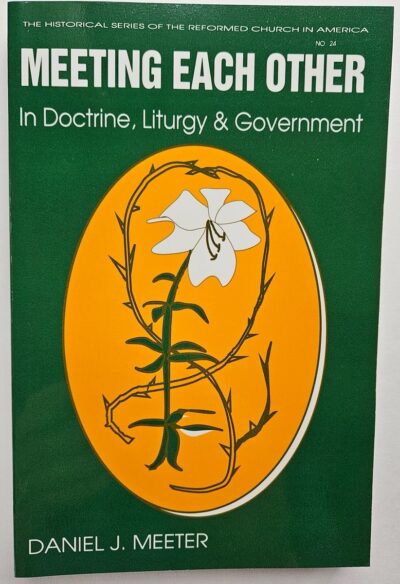
The podcaster, being Christian Reformed, would not have recognized the RCA maxim that my colleague was quoting. Since 1993 RCA seminarians have been reading “the church has no police” in a textbook on Church Order which I wrote. It’s not so much a principle as a motto, a shortcut to deep convictions on how the RCA orders discipline, authority, and power.
Those convictions go back at least to the Synod of Dort, and you can learn about them here in a Reformed Journal post from 2013. The convictions express, first, a Christocentric theology of power, and, second, the belief that church discipline must always be done as locally as possible.
What to CRC eyes might look like leniency or an avoidance of responsibility is actually an issue of who does discipline, and when, and how. CRC synods have long assumed the authority to exercise discipline top down, recently even to limiting permitted public discussion by office-bearers on the interpretation of the Doctrinal Standards.
In the RCA, synods are not authorized for discipline. They are only ever final courts of appeal for disciplinary cases that had to have begun at the most local level, and were initiated by the persons directly involved. Only boards of elders are authorized to discipline members, deacons, and elders, and only classes are authorized to discipline pastors. And no synodical agent or process is mandated to monitor their compliance.
The church has no security guards.
Furthermore, church discipline is exercised only for those matters that are sinful. It is not a sin to disagree with the Standards, and certainly not a sin to disagree with a synodical regulation or interpretation. In the case of pastors, discipline is not only for sin but also for misconduct and for violating their Declaration (formerly the “Subscription”).
The RCA does not believe that the Doctrinal Standards have to be enforced. We trust pastors when they sign the Declaration, and then we leave them to their consciences, and to supervise them we leave our classes to their collective consciences and local judgments. The attendant risks are worth it. It is important to let people try things, and to let them make mistakes. The church does not write parking tickets.
The RCA does not defend the Doctrinal Standards. But it keeps them Constitutional, requiring each new generation to come to terms with them and make themselves accountable to them. It has to be an exercise of love. And, ultimately, a denomination has to be genial, thoughtful, and have a deep and quiet sense of humor, especially about itself.

18 Responses
Again, Daniel, you’ve accurately and clearly articulated how underlying tendencies differ between CRC and RCA folks. Those of us immersed at one time or another in our lives in both traditions often detect those. This was a fun read for me. Thanks.
Oh Daniel if only our denomination understood this article we would have never split,
There is a big difference between not enforcing parking tickets at Calvin and not enforcing doctrinal standards. Not enforcing parking tickets at Calvin affects traffic flow on the Calvin campus and perhaps loses Calvin a bit of revenue. Not enforcing doctrinal standards is a heaven and hell issue and has eternal implications. That is a serious enough implication to give a synod oversight and a voice.
Good grief, of course there’s a big difference.
I’m pretty sure Pastor Meeter never said anything about the doctrinal standards not being enforced. The difference was at what level. I presume the Holy Spirit can work through whatever bureaucratic structures denominations construct as they work together to seek God’s will.
“Heaven and Hell issue” So I wonder, will there be anyone in heaven who does not hold, “without reservation” to everything in the reformed confessions. Is the Belgic Confession correct when it implies that anyone who receives a second baptism is in danger of losing his/her salvation? Will reformed folks be the only ones in heaven? I know a lot of people who lean Arminian, no heaven for them unless they repent?
Thank you for this. And the humble reminder that God is God and we are not.
Thanks for this, Abuna. I wonder how much easier it is to is to write parking tickets rather than to trust people, let them make mistakes, and then respond holding accountability and grace in tension with each other.
As a CRC refugee wounded by its absolutist addiction to perfection (doctrinal purity), to have top-down authority regarding doctrinal interpretation is spiritually disempowering. It ignores the lived experiences of its members and dismissed the vitality of dialogue based on conscience. Those at the top in the CRC appear to be in the sway of today’s culture wars. Hardly a basis for sound theology.
Thank you for this observation.
For many years I felt the CRCNA, as represented by its synods, to be “genial, thoughtful, and have a deep and quiet sense of humor.” I don’t feel that any more. I miss it and wonder where it’s gone.
Thank you, Daniel. Your comments, as always are wise and helpful when heeded. I have always felt that Reformed order in the way the Reformed church in America practices it anyway, values engagement over enforcement, relationship over rules, and conversation over compulsion. (Hey, I’m a preacher. I can’t avoid alliteration.) Well do I remember the trial, probably 30 years ago, when your sense of the minister who was charged was that he had brought a hockey stick to a baseball game. Unfortunately, he kept welding that hockey stick for another 25 years. Our discipline can do a lot for a lot of things, but I lament that it has never been particularly effective in bringing “jerks“ to account. But, every system has its flaws. And we do our best to maintain relationship, even with the “jerks“, for the sake of the gospel.
Amen!
Thank you for this, Daniel.
This is excellent. As a student, I had a few run ins with Harry Faber and I had the highest respect for his understanding of the uses and abuses of authority. Too few followers of Jesus reflect on the use and abuse of power, and the kind of power that Jesus uses and gives to his followers. If we are obsessed with politics, either in the country or in the church, we need to reassess our understanding of the reign of Christ. Your examples from the CRC and RCA help us to see what is going wrong within the CRC.
Thank you so much for this! One consequence of this “addiction to perfection” is the loss of a sense of humour, something I’ve been missing in the CRC leadership for several years.
Thanks Daniel,
This is a wonderful example of different kinds of power
Power over or
Power with.
I believe one of these reflects the Way of Jesus, but that’s a choice a denomination needs to make.
Once it does, its structures will take a shape that uses that power and seeks to build it up into everything (in both forms of power). Not surprisingly to me, power over tends to consolidate into a very few hands. And wouldn’t you know it, inside and outside the wider church those hands tend to be white and connected to men.
Neither form of power is perfect in our hands. They both have pitfalls. The question is which will we choose given the inevitable shortfalls we will encounter.
This has been a deeply compelling dialogue. Thank you, Daniel. As I reflect on it, I am left with the conclusion that, as spiritual leaders, we are not in the compliance and enforcement business. We are in the spiritual formation business. Transformation comes from inside-out. One cannot (en)force “personal salvation,” nor is a forced or threatened profession of confessional loyalty one that brings glory to God.