
In this post, I’d like to do two things. First, I introduce the Rev. Carolyne Adhola, a priest ordained in the Anglican Church of Kenya, now serving as rector of an Episcopal church in Arkansas. Her story is both shocking and thrilling: shocking because of what she had to endure; thrilling because of how she overcame. Second, I ask that we reflect on our own – and the church’s — responsibilities when traditional values and human rights clash.
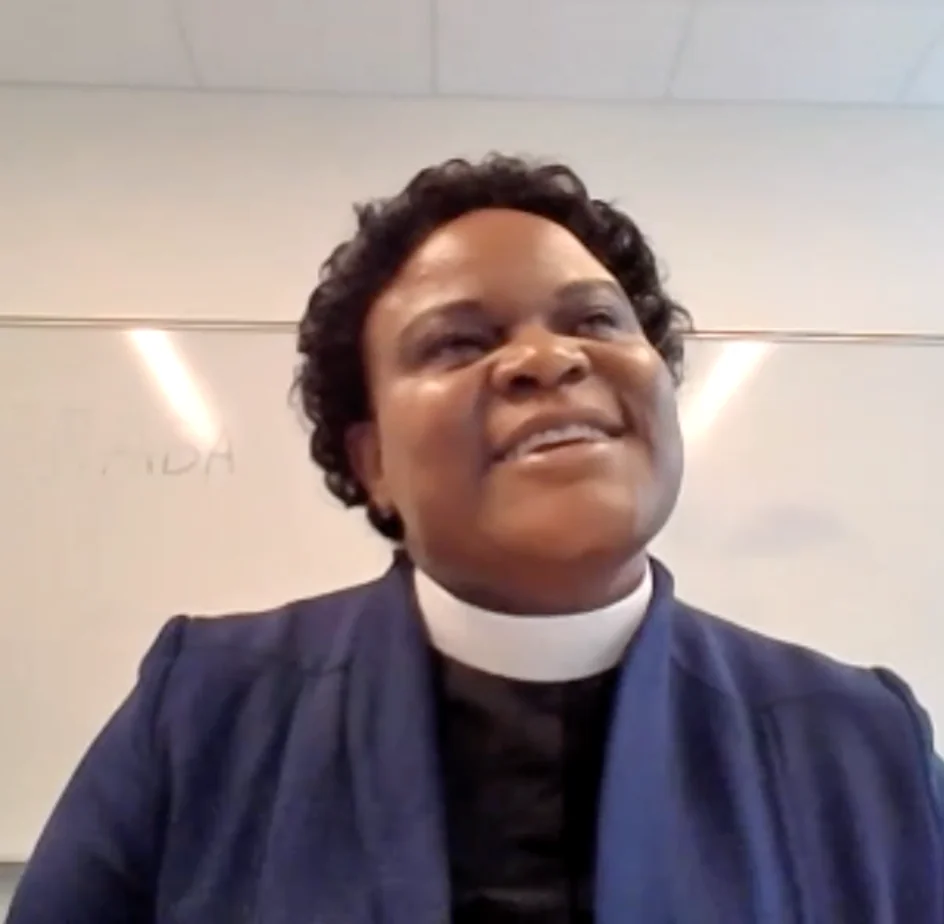
Carolyne was born and grew up in the part of Kenya where the Luo are the dominant tribal group. The traditions and customs of the tribe are deeply felt and fiercely enforced. Rev. Adhola knows very well about that because she was brutally treated in Luo society. She developed her own Christian faith, in her family circle, following the faithful example of her mother. She married a bit younger than she wanted because of her father’s insistence, following the expectations of Luo culture. But she reckoned she did well in her marriage because her husband supported her in her desire to have a role in organized church life.
Carolyne’s problems began after her husband died after only a few years of marriage. As both a young woman and a recent widow she had next to no social standing, and she was expected to adhere to strict customs — customs, she says, if or when she returns to Kenya, she wants to work to abolish.
According to traditional Luo customs, a widow must stay in the house because if she passes a man on the road, he will die. Carolyne could only return to normal life if she would be “cleansed.” As unbelievable as it might seem to us, the cleansing can only take place if she has sex with the brother of her deceased husband.
Carolyne resisted, and all hell broke loose for her. She was repeatedly beaten by her husband’s family, who also destroyed most of her furniture. She was forced to remain in the house to protect, it was alleged, the men she’d pass on the road, who would then die in her presence.
She was only 24 when all this happened. She survived because of the courage of two mature women in the church, who offered protection and showed her love and compassion. After many dark nights of the soul, she credits the visitation of an angel in a dream who set her on a new course. She persevered, and with help from the church, especially the mature women, Carolyne discerned a call to the clergy.
In due time she became the first Luo woman ordained in the Anglican Church of Kenya — and, “uncleansed,” as far as we know. While now a woman liberated to pursue her vocation, she nevertheless still identifies as a Luo person. She affirms that some Luo customs could be retained, but, importantly for her, only if they are practiced within the love of Christ. Moreover, she insists, those customs meant to control women and call for violence should be abolished.
We now move to our second part of this post: what we are to do with the clash of traditional cultures and human rights.
When the Christian gospel was introduced into the Roman Empire, the churches mainly adapted to the customs of the societies into which it was introduced. Unsurprisingly, they were dominated by men. The laws of those societies reflected its customs. This was also true in the great expansion of Christianity in the eighteenth and the nineteenth centuries, into the southern hemisphere, especially Africa, that accompanied the political/economic expansion of the British Empire, and, to a lesser extent, those of the French, Belgian and Dutch. Evangelism and colonialism went hand in hand.
In our time, colonialism has a bad reputation, and rightly so, when one recalls the patronizing attitudes and racist bullying that went on in establishing colonial political structures and the churches that went along with them. But that changed markedly in the post-World War II era, when first world leaders yielded control of political and religious institutions, especially in Africa, to local people. The leaders who emerged reflected the social norms of their societies. Thus, men were mostly in change and were leaders who found women’s leadership and same sex marriage unacceptable. They presented their opposition on issues of gender and sexuality on, they claimed, their reading of the Bible and on the accepted norms of their cultures. They insist that Christians from North America and Europe are forcing “modern” ideas and practices onto people who are content to be “traditional” in all aspects of their culture
They are correct, of course, because the notion of tradition is precisely anti-modern. It is only in the modern era that humankind has discovered (what Jefferson famously wrote) the “self-evident truths” that all humans are created equal, and that their rights are embedded in their humanity; they possess human rights, that is, rights given to them, as Jefferson said, by their creator, not their governments.
Church people in our time who say they have traditional views on gender, marriage and sexuality seem unaware that, as Eric Hobsbawm wrote a generation ago, traditions are “invented” by those in power – people who benefit from the subordination of others (Hobsbawm, The Invention of Tradition, 1992).
This is not the place to rehearse all the arguments about the “deconstruction” of biblical and social views on gender, marriage and sexuality. I would only offer a brief thought from the work of the redoubtable Neal Plantinga. He said that a fully-orbed Chistian life obtains when we stop merely quoting Bible verses but look for what he called “the grand sweep of Scripture,” that is, looking for where the biblical story is heading. So, we thank God for the story that begins with a special covenant with a small tribe in what we call the Middle East that is now expanded to all people.
Does anyone who looks for where the whole story is headed believe that at the end of time, when the trumpet blows, and when the saints go marching in, that white people, or men, or straight people will necessarily enter first. Really?
For my part, I am going to look for people like Carolyne Adhola, and other folks with whom I hope to spend that first ten thousand years.

10 Responses
Great lady and a former student at St Paul’s University in Limuru and then a staff member here.
Thank you my Professor and my Colleague at St. Paul’s University, Limuru-Kenya.
I am a proud St. Paulian.
Pass my regards to Jane Van Es.
I am glad that God has continued to use me to transform the Luo retrogressive cultural practices used the gospel of Christ. Widows in my community now have a voice to decide what they want after the death of their husbands. Currently, by God’s divine grace , I direct three different widows groups in Luo Nyanza. Registered as ‘“Daughters of ZionWidows and Orphans group”
God allowed my situation for a a good cause.
Thank you.
Ron, It is interesting to see how African-Americans have adopted Christianity in higher numbers than the white people of the USA. I certainly see a trend toward Christianity in Africa. In Ethiopia the people are Muslims but more so they are Christians. The Lord surprises us many times and I thank the Lord for that joyful experience of meeting so many Christians in both the US and Ethiopia.
I suspect you may have pushed Eric Hobsbawm towards appearing to say more than he claimed. His argument is less “traditions are imposed by the powerful to enforce subordination” than “traditions often are.” His examples tend towards fashions, ceremonies, formal liturgical and parliamentary practices and such like. Not every practice received from the past would qualify. It would not necessarily apply to things like, say, planting crops in the spring or paying workers a just wage.
THANK YOU! Great perspective! The second last paragraph nails it.
Dr. Wells is drawing a false comparison and therefore a false conclusion. The societal beliefs and expectations of the Luo are based on human-derived societal customs built up over the centuries. The belief in male headship and God’s opposition to homosexual sexual acts and same-sex marriage is based on the Divinely inspired word of God, not societal tradition. The way Rev. Adhola was treated by her community was clearly reprehensible and not Christian, but you cannot draw the conclusion as Dr. Wells does that belief in male headship and opposition to same-sex marriage is therefore wrong.
Regarding the “grand sweep of Scripture,” the “grand sweep of Scripture” beautifully presents God’s arc of salvation, but the grand sweep of Scripture is not an on-going obviation of God’s moral law. Obviation of Jewish ceremonial law yes with the coming of Christ, but not God’s moral law. As Jesus said in Matthew: ““Do not think that I have come to abolish the Law or the Prophets; I have not come to abolish them but to fulfill them.”
I’d offer that what Dr. Wells sees in “tradition” is somewhat similar to what other Christian traditions see in “natural law” and “orders of creation.” There may be something to them, but it is far more certain that they have functioned as retrogressive forces, tools used by those on the top of the heap to justify the status quo.
Are you sure about that “far more certain”?
Almost every day I read folk who are (rightly) lamenting the breaking of norms and traditions by the Trump administration–from the rule of law to international comity to respecting election outcomes to the Constitution and on and on.
But among many religious folk, it’s like it’s still 1975, and all they can think about is shedding whatever they inherited.
It’s one of the liabilities of being raised in a conservative tradition that’s gone a little sclerotic. People think all you need to do to be free is to slough off that dead hand of the past. But, as Chesterton reminded us, don’t go tearing down fences until you know why they were put up.
Traditions, which sometimes become de-facto laws, can serve as influences of both good and bad. Jesus reinforced some traditions, ignored some others, and redefined( or fulfilled) others according to the divine principle (moral law) undergirding them. The moral law or arc of scripture always advances the greatest commandment, ” Love God, love your neighbor.” Do customs help or harm? Traditions must be respected, but also scrutinized, as Carolyne Adhola courageously testifies here.
The “sex with your deceased husband’s brother” sounds an awful lot like the Onan story or even the Ruth/Boaz story, which may well have roots in ancient paganism, superstition, or pragmatism. The law itself gets refined throughout the OT. The tradition may have helped some widows, but the imbalance and application of power certainly corrupted it and harmed others.
I enjoyed this essay and the example!
I’m from that small parish in Arkansas and she is a true blessing! I’m so thankful she was sent to this community. She is an angel with a beautiful voice.