
I love the Reformed tradition, and it only gets better when we admit when we’re wrong or are missing something. So, dear reader of the Reformed Journal, I’m here to suggest that we Reformed folks have a grave hole in our Holy Week observance: We’re missing Holy Saturday.
It’s not just that we’ve missed Holy Saturday, like forgetting to get ice cream on National Ice Cream Day. No, I’m pretty confident we’ve never even stopped to consider it, at least not as a fixture for congregational worship during Holy Week. And from what I’ve learned about Holy Saturday and experienced in its observance, we’re missing out. We’re missing out on a particularly deep dimension of the gospel of Jesus Christ: a profound pastoral gift for those who find themselves in a wilderness of grief, in-betweenness, or a living hell.
That’s because a worship service centered on the biblical and traditional themes of Holy Saturday would acknowledge our bewilderment in the miseries of life, and let God lovingly speak a good word into the midst of it.
So, what is Holy Saturday? At its very simplest, it’s the Saturday right before Easter Sunday. However, biblically speaking, it’s two clusters of themes:
- Having been crucified and died the day before on Good Friday, Holy Saturday is the day Christ’s truly dead body laid in the tomb, awaiting resurrection on Easter Sunday.
Probably the clearest reference to this is Luke 23:50-56, specifically when “the women…saw the tomb and how Jesus’ body was laid in it, then they went away and prepared fragrant spices and perfumed oils. They rested on the Sabbath [Holy Saturday], in keeping with the commandment.” Christ’s body also rested that day.
This “lamentation of Christ” always makes for stunning art:
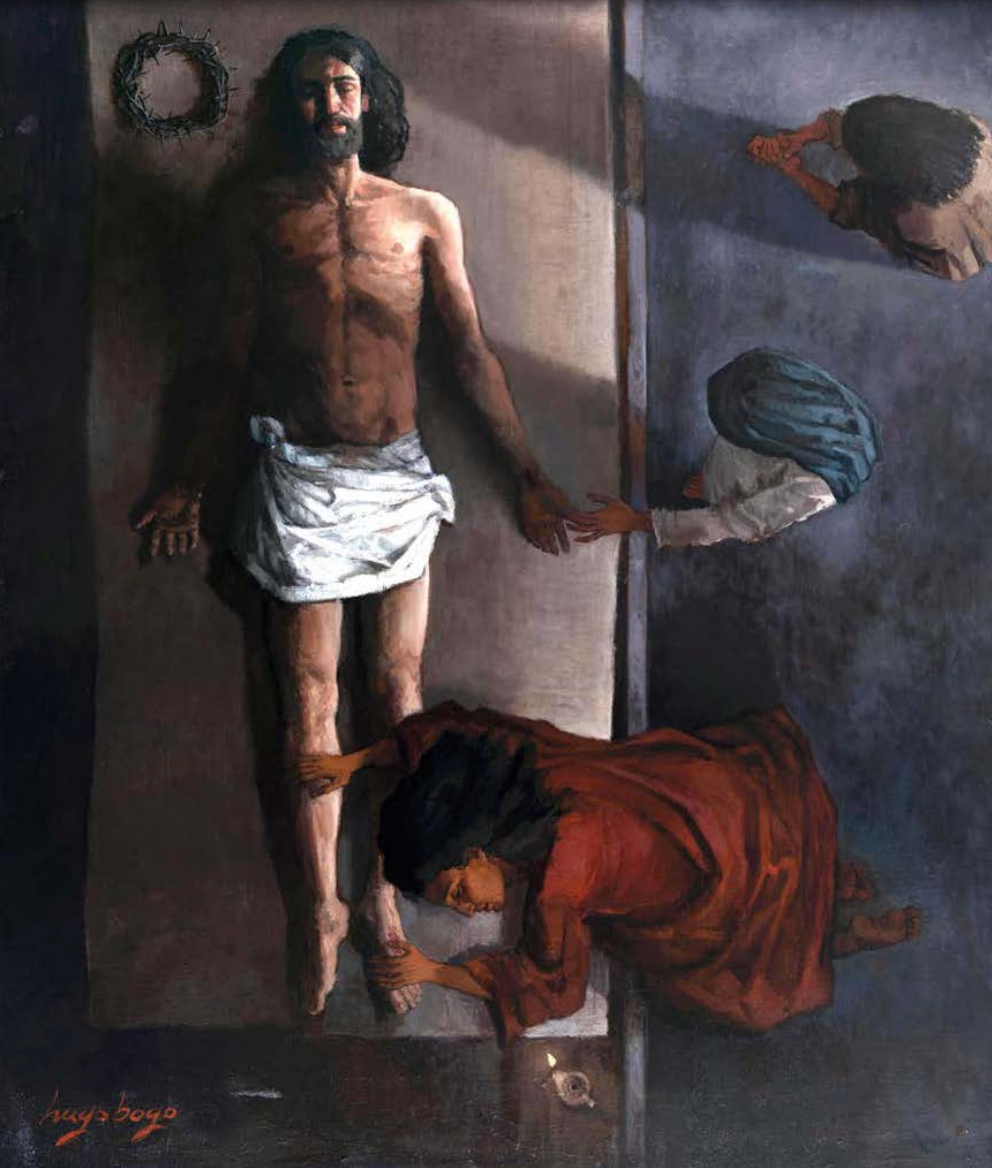
in Sainte-Réparate Cathedral, Nice
Holy Saturday is also, probably, the day when, according to 1 Peter 3:19 and 4:6, as well as Ephesians 4:7–10, Jesus—dead in his body but alive in the Spirit—descended to the dead, preached the gospel to those trapped there as “prisoners,” and then “climbed up” out of it.
Now, Christians throughout the centuries have interpreted this as Christ “harrowing hell.” That is, Christ not only defeats death, but hell or Hades, too, and does so by preaching the good news that the ransom for sin has been paid. Afterall, Christ did say “…and the gates of Hades will not prevail against [the church]” (Matthew 16:18b). Maybe this is why many Christians believe that if Christ preached the good news and then climbed up out of hell, maybe some folks went up with him, too?
Now, having been raised Baptist and evangelical, I was genuinely stunned to encounter these words in Scripture and also discover this aspect of the Christian tradition. And yet, it grows directly out of these biblical passages and this line from the Apostles’ Creed:
…was crucified, died, and was buried.
He descended to the dead.
On the third day he rose again…
In the traditional English translation that one line is, “He descended into hell.”
At the very least, this descent makes for great art, too. Here’s a painting from 1442, attributed to someone working in the style of Fra Angelico, titled Raising of Hell: Adam and Abel. It depicts Jesus bursting through the gates of hell, crushing a demon beneath the gate, preaching the gospel to the dead, and then, with an outstretched hand, leads Adam and Abel out of hell, all while demons cower in the corner.
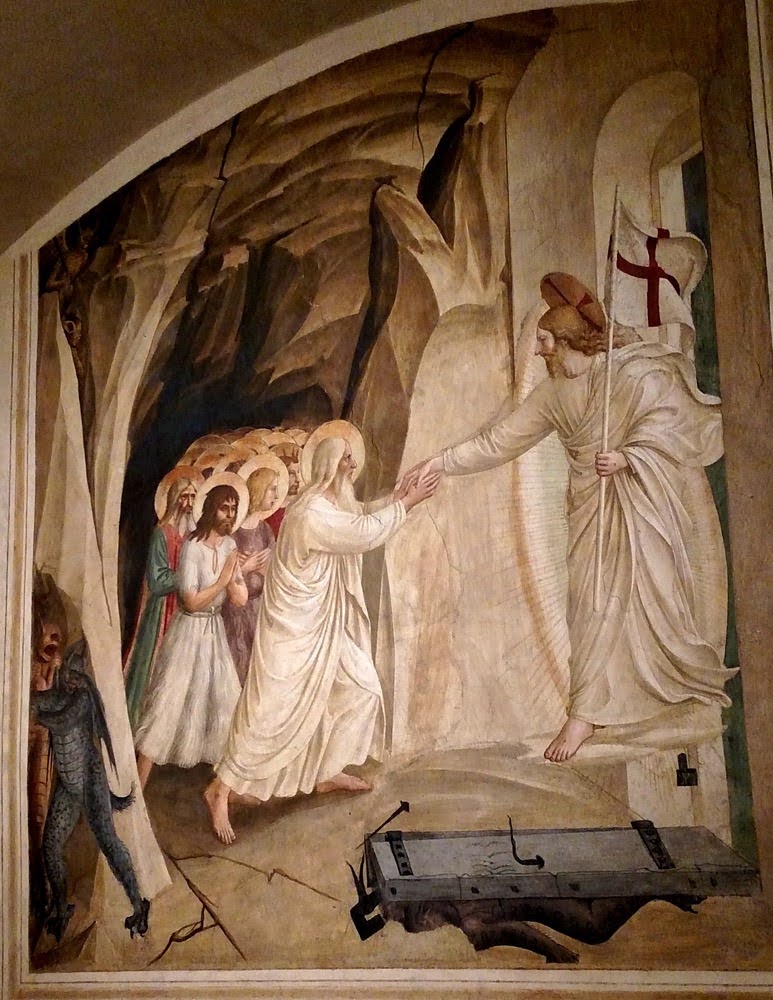
by “School” of Fra Angelico
Now, I share all of this partly because it’s just plain beautiful. But, I mostly share about Holy Saturday because who among us hasn’t experienced the bewildering reality of being alongside a deceased loved one, or felt like we were in a wilderness of our own—a hell of our own—longing for a good word and way out?
And, maybe there’s also good news in the reality that the first preachers of the gospel are also the women who the Bible shares as actually lamenting and processing their bewildering grief, too?
And, maybe it’s life-giving to hear “hell” understood differently than a common understanding: Not as a place God abandons or tortures us, but yet another place God will go to reach us?
Could you imagine how pastorally profound such a worship service could be: That, between the horrors of Good Friday and the exuberant joy of Easter Sunday, we stopped and acknowledged our bewildering realities and let God speak to us in the midst of it?
So, Reformed folks, what could this look like? How would you write a service for Holy Saturday? What would you focus on?
It’s hard for me to choose what to focus on, but I do know that there’s a lot of bewilderment and wilderness out there, and as the Church, we have a special opportunity to let God speak into it. So, why don’t we?
P.S. Practically speaking, this service would be on a Saturday, so for those who can’t make a Maundy Thursday or Good Friday service, it might offer another opportunity to gather during Holy Week, not on a weekday. It could also be ecumenical!
P.S.S. In past Holy Saturday services, I’ve tried connecting the banishing of a goat that had the sins of the people on it into the wilderness (Azazel) in Leviticus to Christ going into the “wilderness” of Golgotha (outside the city) AND also the wilderness of death. But, to be honest, it always felt like a stretch.

6 Responses
…“In the traditional English translation that one line is, “He descended into hell.”
Thank you for pointing out this distinction between “descended to the dead” and “descended into hell”.
For me it is a powerful distinction.
My own conversion story involves my profound awareness of the sins I had committed and falling into the depths of despair (my own hell) only to find Jesus there to catch me in His loving arms and save me.
I agree, not spending time reflecting on Holy Saturday is a missed opportunity in the power of the Easter story.
Bless you Trey, on behalf of a long list of people I care about who need a place to name and share their pain this is a pastorally savvy corrective measure. And just for the record Eugene Peterson, of blessed memory, would agree with you, which is why he wrote a poem about it simply called “Pain.” And on top of that “Black Sabbath” isn’t just a heavy metal band it’s holy day on our liturgical calendar? Thank you for reminding us to observe it!
In case anyone’s interested 🙂 — I wrote these words to be sung to Black Sabbath’s song “Iron Man.” Maybe I could revise them to incorporate Holy Saturday.
Seeks the lost to find – Meets our needs and heals the blind
Jesus, Lord of all – Cornerstone that makes some fall
Raised up from the dead, we were bought when blood was shed
Won’t you say a prayer – Christ the Lord He really cares
Did the Father’s will – by His stripes, we have been healed
Died once for all time, for the future of mankind
Nobody wants Him though He came to the world —
Bought our forgiveness – all this was long foretold
Now the time is here, the Son of Man erases fear
Risen from the grave, seeks the people he can save
Nobody wants Him, they just turn their heads —
All those who trust Him, now they can be His friends
Risen from the dead, He’s the Victor as He said
Coming as quick as He can, Son of Man lives again
I find myself in favour of just resting on the Sabbath of Holy Saturday, as I believe Our Lord did, when he was fully, absolutely dead. Just plain dead. Then at sundown we can begin to celebrate the Great Vigil.
I guess this is also a function of my belief that no one has ever gone to hell. People just die. That’s the wage of sin. Their souls do not remain alive in some infernal prison, whether fiery or dank and damp. Not once in the Torah does God ever command imprisonment as a punishment.
But I do see the pastoral need you address, and the need to address it liturgically.
Yes, the need is very great for us bewildered humans to hear the good spell repeated during pastoral care.
I can imagine the body of a violently killed human in its fully dead mode, not at rest though. Unjustly plain dead. I also imagine the spilled blood from that body, which carries the Life-Breath, getting down to work, soaking into the soil, maybe seeping into an underground cavern which living humans have long imagined to be a realm of the dead.
And then the lifeblood, when it enters that realm, starts casting spells and verdicts toward the living or the other dead. Abel’s blood’s spell was directed toward the alive: a plea for a blood-avenger to seek repayment for his murder. Over the years, that bloodvengeance spell got exponents tacked on to its original balancing math of repay 1life for 1life : avenge 7 fold, avenge 7×7, avenge 7x7x7. They say the blood of Zechariah wouldn’t stop bubbling out from underground screaming its “repay my death 7x7x7x7!” spell until the body count for retributive justice was so high that the Invader Butcher in the temple got overwhelmed by bloodshed and invoked a deity of mercy.
I imagine Jesus’s own blood was working and preaching a better word in that cavern, a good spell, ..maybe a reprise of Ezekiel’s bone rattling sermon? Look at new math energy entering the soil, allowing the aboveworld to forever cease its labors of calculating the math of just retribution which could achieve equipoise after every unsettling violation. The underworld wilderness becomes a fruit-bearing zone, and grave hole portals can now bring on the equipoise by birthing dead creatures back into the land of the living.
Long ago, English speaking women-haters thought it was cute to label a woman’s privates with the slang term “hell,” but the Fertile Earthsoil has a belly laugh about that irony. And we all can laugh with her, ever since the day she delivered her own firstborn out of her hellhole, gestated in a once-barren cavernwomb.
On Hellhole Saturday, or any Sunday, humankind can hear gospel invitation to enter a new and permanent rest, because the blood of Jesus had wonderworking power to harrow the ground into a magical comic task of birthing resurrection body fruit out of a desolate place.
“And, maybe it’s life-giving to hear “hell” understood differently than a common understanding: Not as a place God abandons or tortures us, but yet another place God will go to reach us?”
This statement in your article was the most profound for me, because it so beautifully voices what I have wrestled and struggled with for many years regarding the concept of “going to hell” as a punishment or consequence for choices made on earth. This has never made sense to me. I feel a cognitive dissonance about this common belief, and yet I am made to feel like a heretic if I bring it up in certain Reformed circles. Death has been defeated. Separation from God has been erased. The veil is torn. How is this only for people who have made “good choices”? None of us is able to save ourselves, this is why he came. Why is this not more widely discussed? Are we afraid of cheapening God’s grace? God made it free! And Scripture demonstrates repeatedly that he pursues us and rescues us. Is it even possible for us to deny this?