Thirty years ago Eerdmans published my first book, The Riddle of Grace. In the book I looked at different aspects of God’s grace toward us and how it intersects with our lives.
The Riddle of Grace
One chapter that drew a bit of attention—including some negative attention from people who embraced free market capitalism as the most Christian form of economics ever seen—was titled “Grace and Capitalism.” I argued that particularly in the United States, our fierce love of rags-to-riches, Horatio Alger narratives by which all of life is about personal achievement and pulling ourselves up by our own bootstraps had infiltrated the church and infected our theology. The ethos of everything being about effort and rewards undercut our appreciation for grace and perhaps also our need to be Christ-like humble servants who put others ahead of self.
So as I look back on that three-decades-old book, this month I am led to Paul’s Letter to the Philippians. In this month’s Sunday blogs I want to look at each of the four chapters in that epistle to highlight all the ways by which Paul incarnated and called others to incarnate a selfless willingness to give up achievement or any selfish “me first” attitudes.
We begin naturally enough in the first chapter. Paul was aware that this friends in Philippi knew he had been put into jail. So he strives to tell them the reason why. Paul had done nothing wrong, had committed no crimes, had violated no civil laws. Paul had been put in prison because of his proclamation of and defense of the holy Gospel.
But then in an arresting passage, Paul writes this:
Now I want you to know, brothers and sisters, that what has happened to me has actually served to advance the gospel.As a result, it has become clear throughout the whole palace guardand to everyone else that I am in chains for Christ.And because of my chains, most of the brothers and sisters have become confident in the Lord and dare all the more to proclaim the gospel without fear.
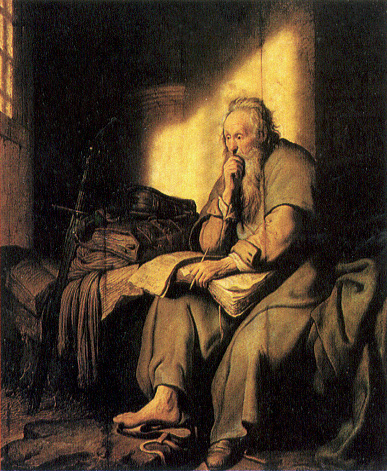
“Paul in Prison” by Rembrandt
It is true that some preach Christ out of envy and rivalry, but others out of goodwill.The latter do so out of love, knowing that I am put here for the defense of the gospel.The former preach Christ out of selfish ambition, not sincerely, supposing that they can stir up trouble for me while I am in chains.But what does it matter? The important thing is that in every way, whether from false motives or true, Christ is preached. And because of this I rejoice.
As ever when we read someone else’s mail—which is what we are always doing with the various epistles in the New Testament—we have to infer some things that get mentioned. Here, we cannot know precisely what Paul means when people “preach Christ out of selfish ambition.”
Were some mocking Paul by imitating his (to their minds) silly preaching? Were some trying to top Paul, to “out-preach” Paul? Possibly. Were some just trying to take some of the spotlight off Paul as a famous prisoner for Christ so as to get a bit of the limelight for themselves? Possibly again.
But what is striking here is that the words Paul uses to describe the motives and actions of these people are some of the same words you can find in Paul’s various vice lists of behaviors that cannot characterize followers of Jesus. Envy. Rivalry. Selfish ambition. These are the things these other preachers were guilty of.
So how in the world could Paul find it within himself to say, “What does it matter?” I would think Paul would deem this to matter very, very much. I can certainly think of preachers—mostly people who have had their own TV shows past and present—whose vainglorious preaching has bothered me a lot.
Yet Paul says it does not matter, at least not compared to having Jesus preached and the Gospel proclaimed no matter how shoddy the proclamation vessel may be. He even rejoices over it!
As I have noted when preaching on this passage, this is the humble, servant-like posture of a man who is head over heels in love with Jesus and with his Gospel. If along the way to getting the Gospel word proclaimed more and more Paul is ridiculed, made fun of, or made to put up with odious behavior from unkind people, so be it. When Paul wrote “What does it matter?” he meant it.
Adopting such an attitude is a challenge for most of us. But if a man who was already in prison as it was could put up with people who were intent on making his situation even more miserable, surely we can too. We also should find it in ourselves to display as much grace and humility as Paul did. Or at least we keep trying!
When faced with certain people and situations, rejoicing may well be the last thing we think we could muster. Yet the Gospel calls us to put Christ first and self last as Paul so clearly did.
Related
Share This Post:
Facebook
LinkedIn
Threads
Email
Print
Scott Hoezee
Scott Hoezee is Director of the Center for Excellence in Preaching at Calvin Theological Seminary.
Welcome back. Good stuff. I look forward to next week. In the course of decades I have become head over heels a fan of St. Paul’s radical passion and crazy love. And Philippians is full of it.
Brilliant. I’ve been obsessed with Philippians the past few weeks, since that is what the lectionary gives me to ponder and preach. I keep wondering what precisely it could mean to “preach Christ out of selfish ambition.” You’ve helped me to see what kinds of things it might mean, but also pointed me to Paul’s irrepressible joy in Christ. Thanks.
So….I wonder. What if Jesus Christ had not taken on “the attitude of a servant even to the point of death”? Where then would our gospel find its power? Sometimes I wonder just when Paul is being pastoral, when he is being angrily authoritative, and when he is being reflective, debating with himself over the mysteries of tje gospel. Those who sit in prison can be wisely patient and meditative. Humans tend to portray their god(s) as angrily reactive, impatient, and short-sighted… a warrior god. Scripture describes a very long-suffering God, content to let us figure it out, stumbling through. The church has a long history of misguided apologists. Who doesn’t sometimes “preach Christ out of (some degree of) selfish ambition”?
Thank you for these valuable insights, Scott.
Thank you, Scott. Paul’s attitude is wonderful. I figured that he was well-aware that many things (if not all) that a sinner/saint does are done from mixed motives. Nearly all preachers want Jesus to be proclaimed, the lost to be found, the love of Jesus lived out…and also they want to be admired, be regarded at least as good if not better than other preachers, and feel good about themselves. Hopefully, the good motives are more prominent in our hearts. But Paul rejoices that God excels at using broken tools and Christians with mixed motives. I don’t want to give excuses for bad motives, but it’s important to know that we don’t have to wait until our motives are absolutely pure before we can be a witness of God’s grace. The gospel is stronger than the one proclaims it.
Thanks pastor, I need pastoral voices, especially in these times. May I note “some preach Christ …”? Some do not preach Christ, not those who matter (too much?) to me. Some preach division, some preach a message that is antithetical to that preached by Jesus. May that matter? Are we called to preach truth to power? What about grace to the graceless?
The important thing, according to the quoted passage, is that Christ and the gospel is preached. I don’t underdtanding why progressive Christians criticize Evangelical Christians so much when Evangelicals are about the only group of Christians left who highlight preaching Christ and the gospel message of salvation and forgiveness of sins through Christ as the focal point of faith.



8 Responses
Welcome back. Good stuff. I look forward to next week. In the course of decades I have become head over heels a fan of St. Paul’s radical passion and crazy love. And Philippians is full of it.
Brilliant. I’ve been obsessed with Philippians the past few weeks, since that is what the lectionary gives me to ponder and preach. I keep wondering what precisely it could mean to “preach Christ out of selfish ambition.” You’ve helped me to see what kinds of things it might mean, but also pointed me to Paul’s irrepressible joy in Christ. Thanks.
This is really really good. Scott. Thankyou. I’m going to have to look up that old (now) book. I hope it’s still in print.
So….I wonder. What if Jesus Christ had not taken on “the attitude of a servant even to the point of death”? Where then would our gospel find its power? Sometimes I wonder just when Paul is being pastoral, when he is being angrily authoritative, and when he is being reflective, debating with himself over the mysteries of tje gospel. Those who sit in prison can be wisely patient and meditative. Humans tend to portray their god(s) as angrily reactive, impatient, and short-sighted… a warrior god. Scripture describes a very long-suffering God, content to let us figure it out, stumbling through. The church has a long history of misguided apologists. Who doesn’t sometimes “preach Christ out of (some degree of) selfish ambition”?
Thank you for these valuable insights, Scott.
You just caused me to pull The Riddle of Grace (signed copy!) off my bookshelf for a re-read.
Thank you, Scott. Paul’s attitude is wonderful. I figured that he was well-aware that many things (if not all) that a sinner/saint does are done from mixed motives. Nearly all preachers want Jesus to be proclaimed, the lost to be found, the love of Jesus lived out…and also they want to be admired, be regarded at least as good if not better than other preachers, and feel good about themselves. Hopefully, the good motives are more prominent in our hearts. But Paul rejoices that God excels at using broken tools and Christians with mixed motives. I don’t want to give excuses for bad motives, but it’s important to know that we don’t have to wait until our motives are absolutely pure before we can be a witness of God’s grace. The gospel is stronger than the one proclaims it.
Thanks pastor, I need pastoral voices, especially in these times. May I note “some preach Christ …”? Some do not preach Christ, not those who matter (too much?) to me. Some preach division, some preach a message that is antithetical to that preached by Jesus. May that matter? Are we called to preach truth to power? What about grace to the graceless?
The important thing, according to the quoted passage, is that Christ and the gospel is preached. I don’t underdtanding why progressive Christians criticize Evangelical Christians so much when Evangelicals are about the only group of Christians left who highlight preaching Christ and the gospel message of salvation and forgiveness of sins through Christ as the focal point of faith.