
If you came of age in white Evangelical America in the 1960s and 70s, you probably read the stories of Jim Elliot and David Wilkerson. Elliot was one of five missionaries murdered in Ecuador while contacting the isolated Waorani tribe. His wife, Elisabeth, tells their story in Through Gates of Splendor. Wilkerson was a small-town Pentecostal pastor who felt called to proclaim the gospel to teenage gang members in New York City. His bestselling autobiographical account, The Cross and the Switchblade, was later adapted into a movie starring Pat Boone.
Both books, which read as heroic adventures, helped generate the genre of memoirs by white pastors serving in cross-cultural situations.
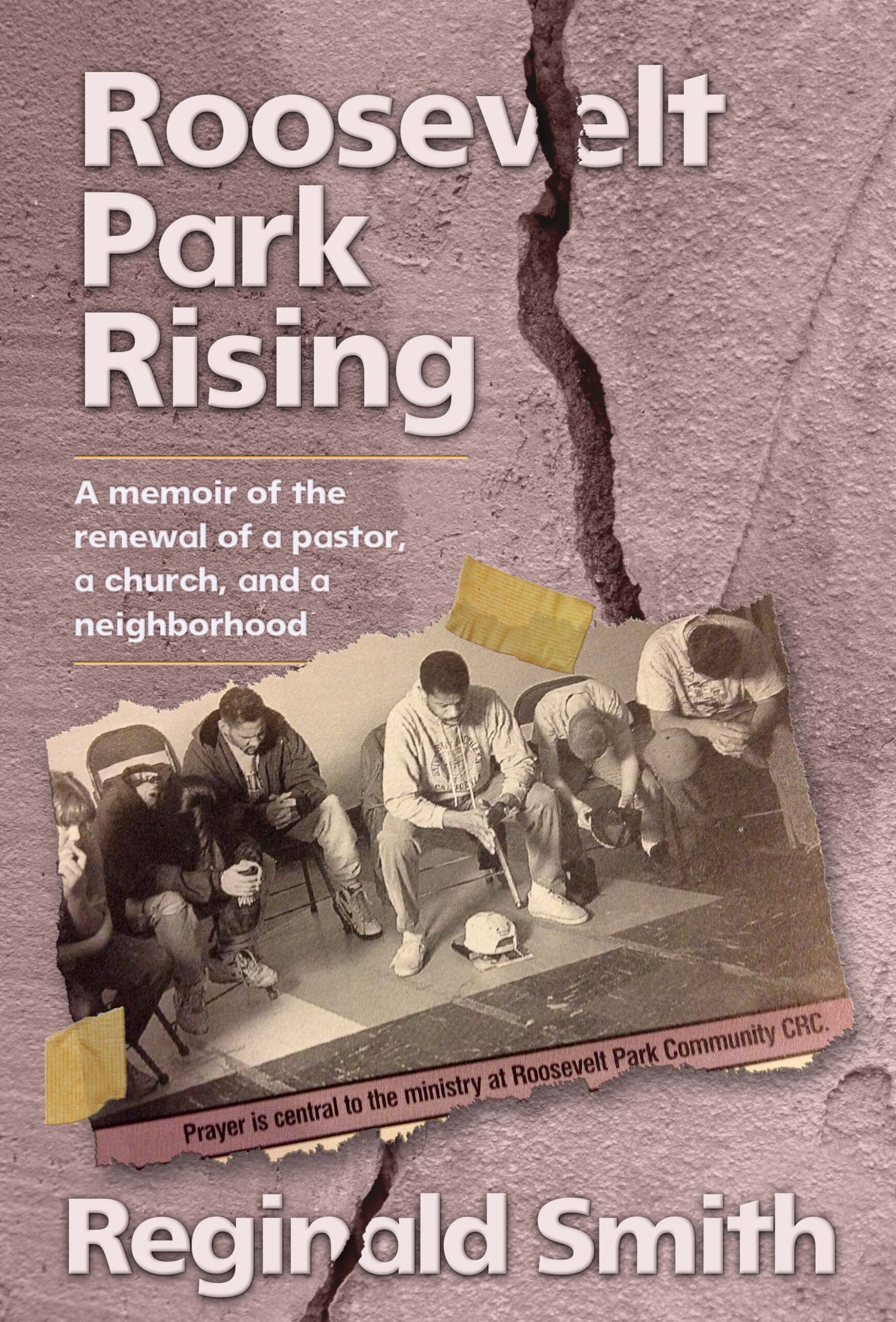
Reggie Smith turns that convention on its head. Reggie’s memoir tells the story of a black pastor serving in a white context. That’s a simplistic summary, but it suggests the complex and nuanced story of Roosevelt Park Rising: A Memoir of the Renewal of a Pastor, a Church, and a Neighborhood. With a flair for dramatic storytelling and unforgettable characters, Reggie recounts his journey as a black Christian Reformed pastor called to serve a struggling congregation in a changing neighborhood. He details jaw-dropping racism and institutional inertia while reflecting on the joys and challenges of cross-cultural ministry.
Reggie is a charismatic preacher/pastor from Chicago who has carved out a career in the CRC. While I anticipated the ecclesiastical struggles the book recounts, I didn’t anticipate the vulnerability. Reggie deftly navigates congregational expectations and his own gospel impulses while loving and serving a diverse community – both inside and outside the church walls. Many pastors will recognize the passion, courage, and pain. Roosevelt Park Rising is not a heroic tale of ministerial “success” but an authentic glimpse into a pastor’s heart.
Doug Brouwer, in a Substack review of the book, puts it this way,
The central irony of the book is also its engine: a mostly white congregation brought in a Black pastor specifically to help it connect with a neighborhood that had changed around it, and for twenty years, that connection remained frustratingly, achingly incomplete. Smith doesn’t dress this up. Early in the book there’s a scene in the church sanctuary, in front of a painting of a white Jesus (which Smith looks at each Sunday in the early morning hours while he prays alone), a scene where he doesn’t so much pray as shout — anger and frustration aimed straight at God. Theologians have a word for this — it’s lament — but that word seems too tidy for what actually happens as Smith tells it. It reads less like liturgy and more like a man coming apart in real time.
Reggie doesn’t tell his story in a linear fashion but offers episodic reflections on significant pastoral moments. Each chapter stands alone and invites consideration. The writing is colloquial, the editing is crisp, and the book is an engaging quick read. This is another important addition to the growing library of Reformed Journal Books.
Without romanticizing cross-cultural ministry and without resorting to an angry screed, Reggie captures the frontline realities of congregational ministry in a changing urban neighborhood. Roosevelt Park Rising chronicles a church struggling with their institutional shelf life. There are creative outreach ideas, faithful work as a community pastor, and difficult decisions. This memoir opens the door for reflection by congregations and pastors in similar situations.
Toward the end of his memoir, Reggie writes,
Early on in this story I confessed I had fantasies of myself as a pastor-superhero who could fix everything. After decades of ministry, I am painfully aware of the outlandishness of that fantasy. Ministry has a way of stripping away your pretensions.
Roosevelt Park Rising is a helpful story about cross-cultural ministry, but finally it’s the humanity that seeps through. The myths we’ve inherited are set aside, and readers are given an unvarnished glimpse into the heart of a pastor. Reggie “keeps it real”, and in doing so, his readers and the church of Jesus Christ are better served. “Well done, good and faithful servant.”

5 Responses
Thanks Roger. Well said. I was moved by the book as well, but not surprised. Reggie is the real deal. And Reggie’s long journey with the CRC (that goes far beyond his Roosevelt Park years) illustrates some of the CRC’s best intentions and impulses and also its greatest challenges, challenges not at all unique to the CRC. To me, the most amazing part of the book was that Reggie was able to name egregious shortcomings in people and institutions, but yet, with no pious sugarcoating, show how deeply he loved them despite their shortcomings. The more of life I live, the more I’m convinced the most apt word for describing the Christian life is cruciform, the way of the cross. Thanks for showing us that way, Reggie.
I too just finished this book. I do see Reggie Smith as someone who tries with great effort to forgive us for our racism. I saw him talking at Dordt University a few years ago and someone responded in a terrible racist manner. I did also speak to try to undo the damage that the responder was doing. Reggie responded as a true Christian man. This fits well with his book. I have great admiration for him and thank the Lord for creating him. We all should learn from him.
I enjoyed reading the book about Roosevelt Park and thank Reggie for his vulnerable and honest accounts of his experiences. I also found it instructive. As a senior (old) woman, I truly appreciate knowing how I might even inadvertently be offensive to a person of color. So, I ask Reggie to keep writing and instructing. Some of us are truly wanting and needing your to learn.
Dear Reggie, a couple of months ago I read your book with deep appreciation. In fact, I’ve still had your name and book title on my to-do list, to craft something appropriate in praise of your writing as well as about the story of itself. However, having read Roger’s insightful observations, I’ve decided to shorten my to-do list and simply tell people. “You know, about Reggie’s memoir on ROOSEVELT PARK RISING, just read and reflect on what Roger Nelson wrote in the August 11 issue of the Reformed Journal.” Grace and peace, Al
Thank you, Al!