
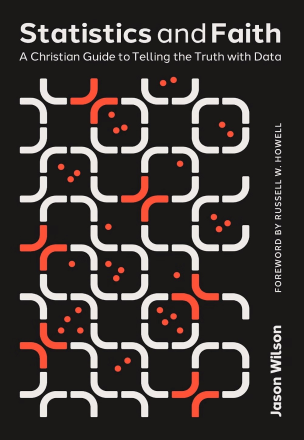
When we tell stories with numbers, we depend on the field of statistics―but how do we know that those stories are true? Almost everything in life is connected to data, and that data can help us make sense of truth in a world that feels increasingly challenging to navigate as Christians.
But in a world where we are told to “do our own research,” it can be nearly impossible to know whether we’re just gravitating toward stories that confirm our own untested biases, or whether we’re analyzing the data in a way that is illuminating truth.
What is statistics and how can it be used by Christians to discern what is true? Jason Wilson attempts to answer this question in his book, Statistics and Faith: A Christian Guide to Telling the Truth with Data, which provides Christians with a guide for assessing statistical studies. Wilson is a professor of mathematics and statistics in the Department of Math and Computer Science at Biola University. He believes that “The goal of statistics is to discover the truth about the world through data” (p. 29) and that truth is what connects statistics and faith.
Truth is a central theme throughout the book. While statistics can be used to discover truth, the author cautions that it can also intentionally or unintentionally be used to promote falsehoods. One example is the misuse of statistics based on false assumptions to justify racial eugenics. On the other hand, statistics has led to advancements in medicine, public policy, economics, and discoveries in many disciplines. Wilson describes this tension with an apt analogy, “Like the difference between a knife in the hand of a surgeon versus a murderer, or a gun of a police officer versus a gang member, statistics is a tool that can be used for good or evil” (p. 25). He discusses the interplay between statistics, truth, morality, and ethics and how Christians encountering statistics should use it for good but also be able to discern when it is being used for evil. Wilson provides a framework/checklist of questions that can guide the assessment of statistical arguments. He concedes that while no study is perfect, these questions, along with one’s faith lens, and even prayer, can help readers evaluate the assumptions, implications, and results of the study.
The book is divided into two parts, the foundation (Part 1) and the applications (Part 2), labels that aptly describe the content of each section. A baseline understanding of statistics is developed in the first part so that readers are comfortably able to engage with the applications in the second part. Wilson strikes a good balance, making the content accessible to readers with varying levels of understanding of statistics. A glossary of terms is included at the back for easy reference. The topics in Part 2 are timely and well chosen. Some of the contexts discussed include gambling, coincidences, prayer requests, Covid-19, and Bible code. These topics are relevant and engaging, and somewhat polarizing, which makes for an especially interesting read and conveys the variety of contexts to which statistics can be applied. Wilson does an excellent job of presenting the evidence without imposing his own opinions on such issues, allowing readers to make up their own minds. The statistics in Part 2 can be dense at times, but the writing allows readers who are interested and able to follow the calculations to dive deeply into the mathematics, while those less interested in the technical details can skim the more involved calculations and still understand the big ideas being conveyed.
The statistical scenarios discussed in the Part 2 reveal how the relationship between statistics and faith is more intertwined and straightforward in some contexts compared to others. In Chapter 3: On Gambling, for example, Wilson demonstrates how to calculate the probabilities associated with games of chance before considering gambling’s morality. Although probability cannot determine whether gambling is sinful, it can inform questions about stewardship and exploitation. Statistics and faith seem more directly connected in Chapter 4: Probabilities of the Origin of Life, Prayer, and Fulfilled Prophecy. In the contexts of coincidences and prayer requests, calculating the probability of an event can help one assess whether an occurrence is plausible or whether an alternative explanation should be considered. Each scenario represents a different way in which your faith can informs statistics or statistics can inform your faith; the relationship is bidirectional.
An interesting takeaway from Part 2 is that the relationship between statistics and faith differs depending on the context that is being examined. In Chapter 6: Assessing Covid-19 Statistics, Wilson presents statistical evidence used to support both alarmist and denialist positions and suggests that the truth likely lies somewhere between the two. This raises the larger question of where we place our trust; even if our faith does not change the statistics themselves, it may influence how we interpret and respond to them. Chapter 8: Statistics of the Bible Code exposes how well-meaning people can accept faulty statistics because of invalid or refuted evidence, while also illustrating how legitimate statistical evidence may support apologetic arguments. In general, Wilson shows readers how to think through these different statistical scenarios. One limitation to a book like this is that the statistical and contextual background required for some applications occasionally overshadows the book’s central focus: the connection between statistics and faith.
Returning to the question, “What is statistics and how can it be used by Christians to discern what is true?”, the first part is easier to answer. Statistics encompasses the processes of collecting, organizing, analyzing, and interpreting data, along with key concepts such as sample, population, bias, confidence intervals, hypothesis testing, and p-values, just to name a few. It is not necessarily in these technical aspects of statistics that disagreement arises. Rather, one’s faith lens and underlying assumptions may shape the questions one asks and the way results are interpreted. The more interesting question, then, is how statistics can be used by Christians to discern what is true. As Wilson’s examples illustrate, the answer depends in part on what one is trying to determine: Are you trying to determine something about the world, or are you examining a question of faith? Even when the question concerns the world, new knowledge may impact your faith, just as your faith may impact what you do with that new knowledge.
This book would appeal to many readers wanting to explore the connection between statistics and the Christian faith. Even one adept with statistics may not be familiar with its rich history, which is covered in depth in Chapter 1, or how their faith has possibly influenced how they do statistics. Every reader will leave more equipped to think critically about the statistics they encounter. The book is interactive and practical, using contemporary contexts to demonstrate that statistics is not merely a collection of calculations, but a tool Christians can use to think more carefully about truth.
Photo credit: Stephen Dawson Unsplash

2 Responses
A list of resources for further exploring connections between mathematics and faith can be found in the online annotated Zotero library *Bibliography of Religious Faith and the Mathematical Sciences* (https://www.zotero.org/groups/4991506/bibliography_of_religious_faith_and_the_mathematical_sciences/library).
Truth might be thought of as a statement that corresponds to a reality that is larger than one’s own thoughts and feelings, but I believe biblical conceptions of truth are also integrally relational. That’s why Jesus claims to be the truth. Truth is the relational person of Jesus. I’m curious if this book also addresses that aspect of truth.