On October 7, 1987, after she put it on a list of things she wanted for her birthday, I gave my sister a compact disc—that’s CD for short, we no doubt said—entitled The Joshua Tree.
Truth is, my mom bought it for her at Shopko (R.I.P.) on my behalf, since I was eleven, but I’m sure it was the first CD we owned. We poured over the lyrics in the jacket cover, noting the blatant Christian allusions in “With or Without You” and “I Still Haven’t Found What I’m Looking For” and wondering what in the world “Bullet the Blue Sky” meant.
In this way, my sister Heidi was my first literary tutor. When we later heard that Bono had been reading Flannery O’Connor, she also got put on our readings lists. I was in 6th grade.
Mired in the midst of the farm crisis at the time, The Joshua Tree strangely enough fit our experience as good as anything. It was an album that was nostalgic for something we didn’t realize we were losing, nostalgic for a place we didn’t know we yearned for. As such, it was a wonderful study of Christians doing art for a secular audience.
Recently, U2 frontmen Bono and the Edge were interviewed in the New York Times ahead of releasing a new album, Carnaval de Luz.
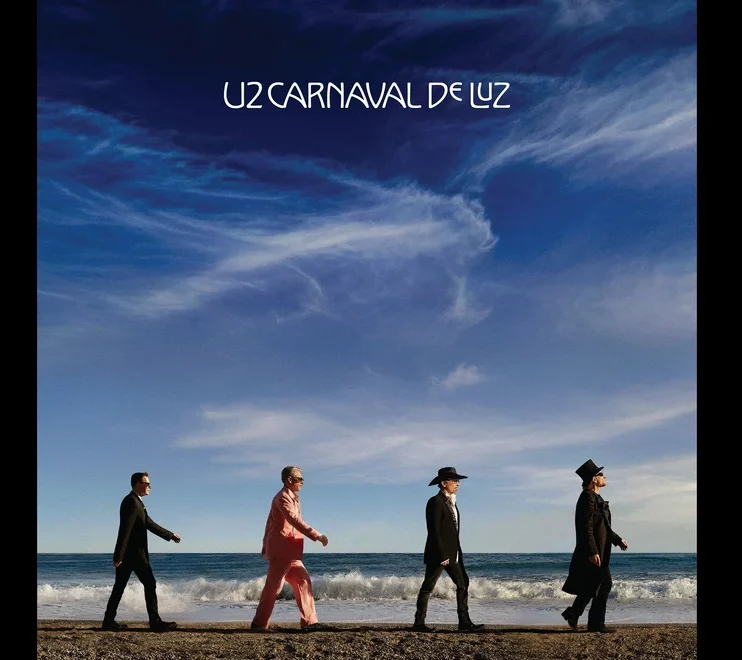
Almost forty years on, I’ve admittedly had a somewhat complicated relationship with U2, and I’m not sure it makes sense for them to try to be relevant at 66. But their 50-year career is perhaps as good a way as any to measure evangelical relationships to art over that same time period.
There was the we-have-to-quit-art-to-be-Christians phase that almost killed the baby band in the cradle. (Can Christians really do art?)
There was the aforementioned secret Christian witness phase, planting Christian meaning in their songs for an unwitting secular audience! (And they’re popular, too!)
There was the “but wait Bono’s wearing makeup” phase that threw everything back into doubt. (Ope. Too worldy. See what happens?)
There was an art for art’s sake phase. (Tut-tut.)
But there have also been several the-heck-with-it-here’s-a-straight-up-praise-song-for-ya moments. (“Forty,” “Grace,” “Yahweh”…)
There was the turn-your-power-into-platform phase, on a level no one had ever seen before. Yeah, you know the sponsor-a-child promo of Christian bands? Bono did that on a level rivaled only by USAID. (More on this in a minute).
There was the oblivious-corporate-megachurch-privacy-invasion-overreach phase where they just slid into the whole world’s AppleTM playlist. (Bono: What? Is this a problem? But it’s free music!!!)
To be honest, I’ve not paid much attention the last few years, even—please don’t pull my U2 card—missed one album entirely. Trying to write love songs for the whole world skims over local places, local love songs. Then again, U2 have long made it a point to platform local artists.
So when I heard last spring that they had put out a Rene Good song (“American Obituary”) also to be honest, I rolled my eyes. Wasn’t this just ambulance chasing? Then I listened to it. It’s a better-than-average song (and I’ll take it over Springsteen’s). I admit, after watching the horrors of Operation Metro Surge unfold in my home state, including the murder of Alex Pretti just outside of one of our favorite bánh mì shops, I was glad someone with a voice was paying attention.
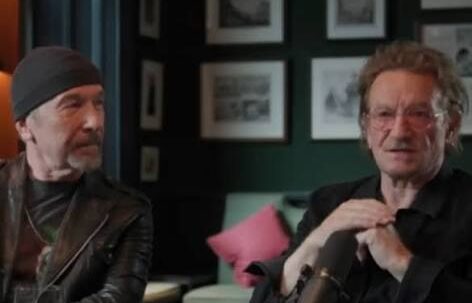
As to the NYTimes interview, there’s a lot that’s remarkable. Notably, Bono and the Edge claim to laugh at each other and themselves a lot. And then proceed to do it.
But what really caught my attention were questions about how to stand up for what you believe in the present political moment. For his aid work twenty years ago, Bono openly courted politicians on both sides of the aisle in a way few actual politicians have done. Now, due to the cuts of DOGE, much of his group’s work has been undone. How does he feel about that?
Predictions say the DOGE cuts will mean millions of dead children by 2030, he says in the interview. The suffering of children, he also notes, is a way to recognize the face of evil.
But then the interviewer asks the hardest of all questions. A line in a song called “Glorify” on Carnaval de Luz claims that U2 love their enemies, so does he love the men who are literally causing the deaths of children?
Bono says yes, at first somewhat unconvincingly, but then he spends some time explaining what he means in a way that makes sense not only at the strange global level at which U2 live but also at a local neighborhood level. He makes clear that evil is being done while also refusing to apply simplistic labels that divide us too easily into the elect and the damned.
More and more, this is the only kind of story I’m interested in.
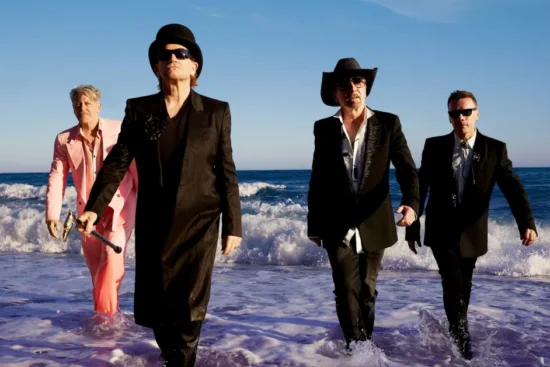
The way Carnaval de Luz works, U2 claims, is by celebrating in the face of despair. U2 is betting (with significant financial gain no doubt on the line) that people want to get together to celebrate what’s good, that such a celebration around rock and roll can be a needed antidote to dwelling on what’s bad.
It sounds a fair bet. Does Bono still also have a weird obsession with wanting to be on top of the charts at age 66? Totally.
But the interview dances on the edge of a wider question for the Christian church. What the heck are we doing about world despair?
And so, U2 may once again be a good reminder of what ecumenism—or even just good old American polyglot—is. With recent world events, it’s not only nations that have put themselves first. Churches have done the same. Since COVID, there has been an unmistakable turning inward to protect our own.
This is why art is so important, especially for the church. Art can save us from ourselves by turning us outward. In a time when there has been so much ruminating on various card-carrying loyalty tests, including in various branches of our churches, isn’t it time to once again turn outward, to the world that needs us—or maybe more importantly, to a world that we need?
U2 have been decent at crossing boundaries over the years; it’s something else the church could learn from. Crossing boundaries is the only way to actually bring peace.
Or to receive it.
In so many ways, the world we find ourselves in is not only a world at war, but a world posed for much more war. U2’s wager is that art in the form of rock concerts can bring us together and even bring peace. Here’s hoping they’re right.