
Near the end of Down the Long Stairway, John tells this little story: The night janitor, at the Christian Reformed denominational building, Tido, asks John what he’s doing there so late. John replies, “I’m writing a chapter about God’s loving mission to the world.” Tito asks, “Who will read it?
My question, slightly different, is “Who will want to read John Rozeboom’s memoir?” Here’s what I have decided: Anyone who knew or knows its author, anyone who lived in Edgerton, Minnesota, at some time in his/her life, anyone who appreciates passionate narrative writing, or, quite simply, anyone who cares about bringing the good news of Jesus Christ to those who do not know it. It is a book chock-full of stories and people, full of hope and joy (and also deep sadness), and deep, rock-solid conviction about the importance of the work he and his cohorts are doing. This conviction does not diminish but is as strong and joyful in Rozeboom’s eighty-fourth year of life as it was in his first church in Riverside, California.
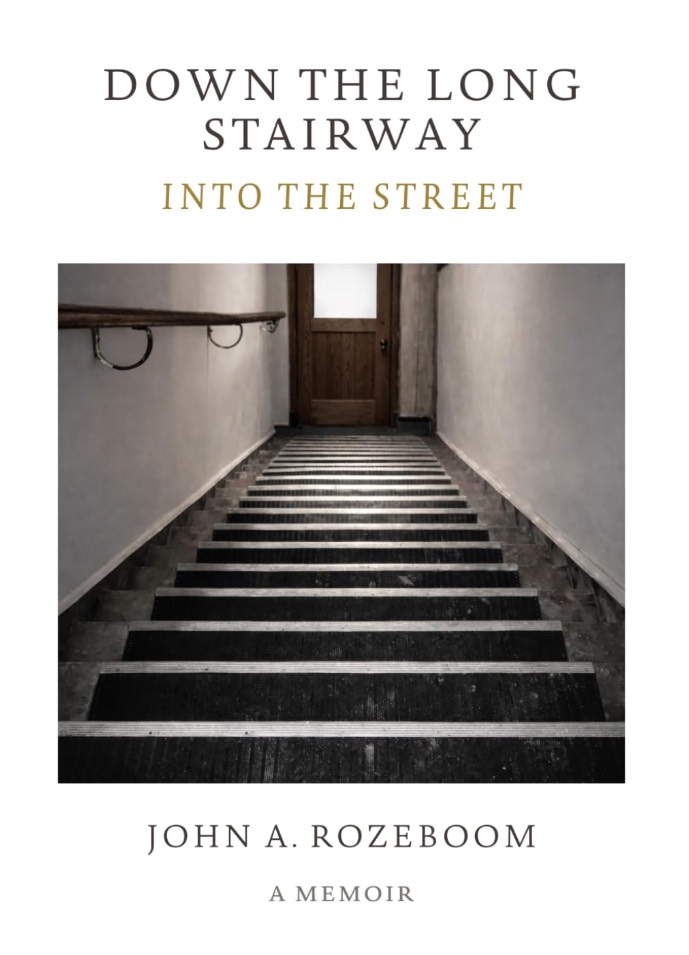
In the beginning there was a young couple who, in 1942, brought into the world a son, Johnny; but soon Johnny’s dad, Bill, was called by the U.S. government to serve in the U.S. Air Force in the Pacific theater of World War II. Meanwhile, Johnny and his mother lived in a second-floor apartment in the Hartog building in Edgerton, Minnesota. The picture you see on the book cover is the long stairway he had to go up and down as a toddler, but of course, as you read the book, you will recognize the metaphorical significance of the stairway and the street.
Of the family stories that Rozeboom tells, the most heart-rending is the story of the death of his younger brother, Billy. Born with serious congenital heart issues, Billy underwent open-heart surgery at Mayo Clinic in Rochester as a seven-year-old and died during surgery. The whole community of Edgerton—so it seems in my memory—had been praying during the surgery, and then after several hours, they were grieving.
Life went on, but grief lingered in the home, compounded by the death of John’s thirteen-year-old cousin John Wesley Christians and of a beloved grandfather. Through it all, John’s father, Bill, was a calm, soothing presence. Rozeboom writes, “I received from Dad examples of how love acts—with forbearance, patience, kindness. I received a good dose of his calmness in the face of life’s reverses. He taught me his skills for everyday life, repairing, painting, taking care of cars . . . caring for others, not running from trouble, and recognizing that silence often communicates better than speech. . . One evening in the vet’s nursing home we were praying with him and singing, thinking these may be his last moments because his vital signs were less than vital, when he said: ‘What’s wrong with this dumb hearing aid? ’ (55-57)
This is classic Rozeboom, writing or speaking. Often, no matter how important or holy a moment may seem, something happens that reminds us of our humanity. It’s one of the things that keeps this memoir from slipping into overly-pious talk and keeps us in touch with reality. Rozeboom has always had a keen ear and eye for the comical or absurd in life. Here’s Grandma Rozeboom when John came home from Dordt College for the weekend: “You’re so skinny. Doesn’t that old Haan (B. J., president of Dordt) feed you?” (61)
Rozeboom’s former English professor at Dordt, Peter DeBoer, once asked him, “John, what’s up with Edgerton? Is it the water?” He was genuinely “impressed with the aptitude and achievement” of his Edgerton students during the years he taught at Dordt and Calvin.
Two of the eight chapter headings have “Edgerton” in their titles, and throughout the entire narrative we come back to Edgerton and Minnesota, including a passionate digression into the abuses by whites of the native Lakota Sioux in southwest Minnesota. Rozeboom quotes fellow Minnesotan Garrison Keillor, walking home from worship, “The Anglican Prayer of Confession is rather breezy in my case. A man of 81 cannot confess in thirty seconds; he needs hours.” But then, he remembers his dad saying, “John, our sins are forgiven, that’s the greatest thing in the world” (54).
At the end of the two Edgerton chapters, Rozeboom writes, “By the time I left high school, faith had grown in me in much the same unselfconscious way as I derive oxygen from the air I breathe.” It’s a profession, I believe, many of his RCA and CRC contemporaries would also make.
As I have said, this book is full of stories. Here’s another one I loved: John and Calvin College housemate Bill Van Tol applied for and received summer jobs as game wardens for the Alaska Department of Fish and Game. Their job was to catch salmon boats fishing illegally. One of them, John, would row a small kayak out to a boat that had made a “set” and issue the fishermen tickets, which resulted in a huge fine. The only thing preventing the fishermen from shooting John was the fact that they could see Bill standing on shore with a rifle. It was dangerous work, but the pay was good.
The wonderful irony of this story is that eventually Bill Van Tol became Director of Christian Reformed World Missions and John Rozeboom became Director of Christian Reformed Home Missions. As if being a game warden in Alaska was a job requirement.
While they were students at Dordt College, John met Linda VanderVeen—a marvelous pianist, the accompanist for the Dordt College Choir. They married, and when he had completed his seminary work, she became his wife and partner in ministry as home missionary for the Christian Reformed Church in Riverside, California.
Rozeboom compares his immersion into ministry to “drinking from a fire hose,” but notes that Linda’s role at the piano was vital to the ministry: “Most preachers worth their salt will quickly admit that without fine, energetic musicians, worship falls flat and their best preaching will not revive it” (283).
The last third of this memoir is primarily about John and Linda’s ministry at Riverside, John’s role as Regional CRC Missionary of the Western United States, and then as Director of Christian Reformed Home Missions. His stint at Riverside taught him, among other things: 1) A two-sermon, one-preacher Sunday adds up to guaranteed mediocrity for one of the messages, sometimes both. 2) The minister may sustain working over fifty hours a week, but one’s marriage not so much. 3) My natural interest in the stories of unbelieving folks grew as did my love for people of deep faith who harbor deep doubts about Christian belief (287).
While at Riverside, Rozeboom was offered and accepted the position of Regional Home Missionary for the Western United States. He accepted the challenge. His job involved, among other things, care and nurture of local home missionaries. The pastor of Los Angeles Community church remembers a Rozeboom visit this way: “Judy and I got pretty emotional today recalling that day you took us all over L. A., introducing us to what would become our lives. We met Mr. Lee, store owner, church neighbor, whose funeral Tom and I would conduct twenty years later, who became a friend and ally of Community church… I can still see your lanky frame coming across the yard with a jug of Carlo Rossi Sangria and fruit, plunking it down on our folding camp table. Kindred spirits” (296-97).
In 1986 John was appointed Director of Christian Reformed Home Missions. “I was unable to say ‘No Thanks.’ Home Missions had been my life since seminary, its people my esteemed colleagues and beloved friends” (325). Between 1984 and 2008, over 60,000 new members were added to both established and new CRC church rolls (372).
This is a 470-page memoir, and it reads like a big old-fashioned novel full of characters and settings and conflicts and resolutions and reflections and sadness and joy. We might call it a true novel. We might call it a love story—a story of family love, of the love of Jesus, of love for the church of Jesus Christ and for one small part of that church, the Christian Reformed. And always at its core is the sense of the Holy Spirit inciting, moving, encouraging, interceding, blessing, challenging, sustaining. What else could it be that takes a small-town kid on the kind of journey we experience as we walk with him down the steps and into the street?
Author’s Note: I grew up in Edgerton, Minnesota, just three houses west of the Rozeboom house. I played and worked with John during our growing-up years, attended Dordt and Calvin with him, and shared lodging with him for three of our undergraduate years. What I love most about him is his typically positive attitude, zany sense of humor, and willingness, even pleasure, in helping someone in their moment of need. I have been the recipient of that kind of help from John on numerous occasions.
