
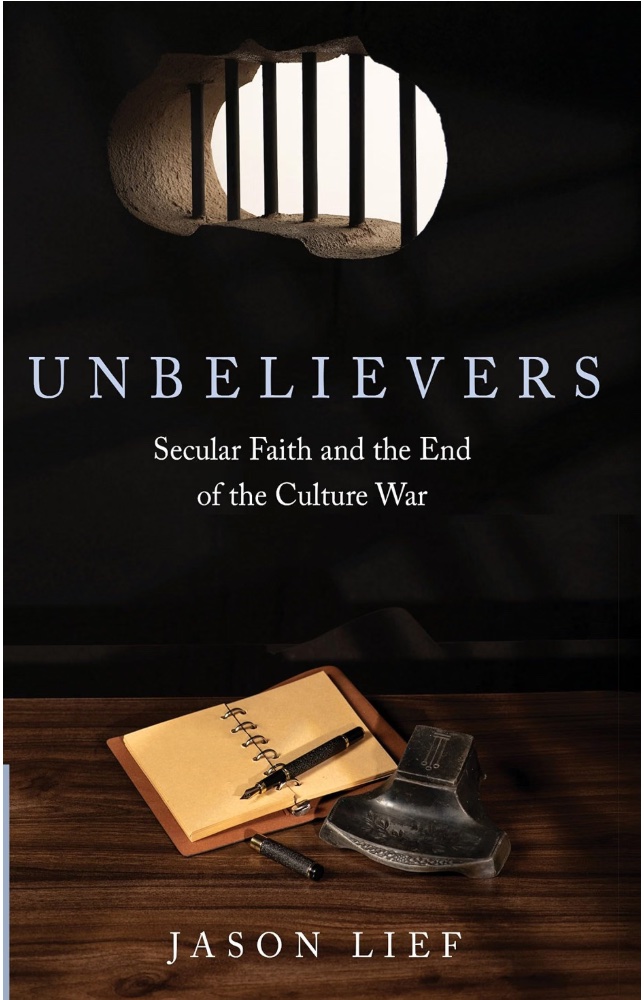
In Unbelievers: Secular Faith and the End of the Culture Wars, Jason Lief offers up a small but provocative book that marshals theological insights to address the chasm dividing secular unbelievers from militant Christian believers. Lief is a professor of theology at Northwestern College and a writer well known in these parts, having served as an editor of RJ and as a frequent contributor. He styles his specialty as “practical theology”, although for some that old seminary rubric might not signify as clearly as “theology of culture” or “lived theology”.
As Lief sees it, “the choice for many in Western culture is to either accept the developments of modern life or the religious expressions of Christianity – but a person cannot do both.” In place of this dualistic view, he argues that “the focus of the Christian faith . . . is to embrace our humanity and the humanity of our neighbor. It is to seek the flourishing of the world, mediated and reconciled in Jesus Christ. What needs to be overcome . . . is the fracture between the spiritual and the material, between Christian faith and the world” (p. 26).
His method combines close reading of theological and cultural sources with a practice of theological “pilgrimage”. For his three primary interlocutors – Dietrich Bonhoeffer, St. Francis of Assisi, and Søren Kierkegaard – we travel with Lief to Berlin, the Camino di Francesco in central Italy, and a BBQ joint in Copenhagen. His experiences and conversations at those sites add texture to his reading of these historical figures.
In addition, Lief engages with contemporary thinkers who also focus on religion and culture. He offers compelling critiques of MAGA culture warrior (and purported Bonhoeffer expert) Eric Metaxas and of New Atheist polemicist Sam Harris, but he finds much more compatible conversation partners in secularist Yale philosopher Erich Hägglund and theologian Jürgen Moltmann.
Lief identifies Bonhoeffer’s notion of “religionless Christianity”. Francis’s practice of “downward mobility”, and Kierkegaard’s existential concept of “repetition” as key ideas that can help Christians navigate a secular world with Gospel authenticity. Each of these ideas merits extended discussion, but here I will focus on Bonhoeffer, both to appreciate Lief’s central insight and to propose some issues for further thought.
Lief rightly pushes back on Eric Metaxas’s culture-war paradigm for interpreting Bonhoeffer’s religionless Christianity. Metaxas argues that Bonhoeffer’s critique of “religion” was always and only directed at theological and cultural liberalism, and hence that Bonhoeffer favored a conservative restoration in church and society, of the sort famously promised by Donald Trump in a speech in Sioux Center a decade ago:
Christianity will have power. If I’m there [in the Oval Office], you’re going to have plenty of power, you don’t need anybody else. You’re going to have somebody representing you very, very well. Remember that.
Not only is this interpretation contradicted by Bonhoeffer’s own words, as Lief effectively shows, but it flatly reverses everything Bonhoeffer stood for, culminating in support for exactly the kind of religiously backed nationalism that he repudiated in 1933 and resisted for the rest of his life. In one of the last documents he ever wrote, Bonhoeffer said:
The church is church only when it is there for others …. The church must participate in the worldly tasks of life in the community – not dominating but helping and serving. It must tell people in every calling what a life in Christ is, what it means to “be there for others.” In particular, our church will have to confront the vices of hubris, power-worship, envy, and illusionism as the roots of all evil. It will have to speak of moderation, authenticity, trust, faithfulness, steadfastness, patience, discipline, humility, modesty, contentment.
One can hardly imagine a church less MAGA than that!
For all its merits, Lief’s treatment of Bonhoeffer could have been deepened if he had offered readers a more comprehensive view of Bonhoeffer’s life and career. Skipping abruptly from Bonhoeffer’s student experiences in Harlem (1930-31) to his Resistance work with the Abwehr in the 1940’s (see p. 19 f.) leaves out any mention of his participation in the German Church Struggle. Metaxas uses the more militant, antithetical posture toward culture found in Bonhoeffer’s writing from this period (1933-39) to justify his portrait of Bonhoeffer as a culture warrior; hence, an alternative reading of this material would have been helpful.
Overall, I recommend this book as thoughtful, provocative, fresh, and faithful. Those who seek to walk the path of this-worldly discipleship will find ample insight and inspiration for their pilgrimage.

One Response
Dave, thank you for highlighting what Bonhoeffer said about the nature of the church at the end of his life. His words offer us both encouragement and direction as we, the church, struggle to recover our true identity.