
November mornings begin in a deeper sort of darkness, and restlessness is now my native state. The dream that woke me was a kiss from a stranger, its residue a familiar rock-n-roll longing that’s traveled with me since I was a teen.
My face was cold, so I pulled deeper into my sleeping bag and gathered its collar tighter around my neck.
In my dream, I was seated impatient in the cockpit of an old wooden sailboat. The brightwork was weathered. The rigging looked suspect. A former student showed up to sell me financial services, but I was annoyed and I sent him away. It’s a foggy darkness in my head but a clear-sky sink for all the lingering warmth around me. I’ll shake off the cobwebs and be there soon enough.
Up early, long johns and heavy boots.
We hiked up a trail near the pass. Old snow. Ablated and crystalline. The sort that won’t hold the next snowfall firmly — if it comes. The beginnings of avalanche conditions.
There were moose tracks in the seeps, hooves splayed wide, dew-claws punching their own impressions. Moose do this, caribou too, walking on their whole foot for traction and flotation. Deer mostly stay dainty on their hoof-covered toes. Mud where the sun was. And the sun was relentless in the afternoon. No clouds at all, thin air at this elevation. I could feel my cheeks and lips sunburning. My lungs felt small.
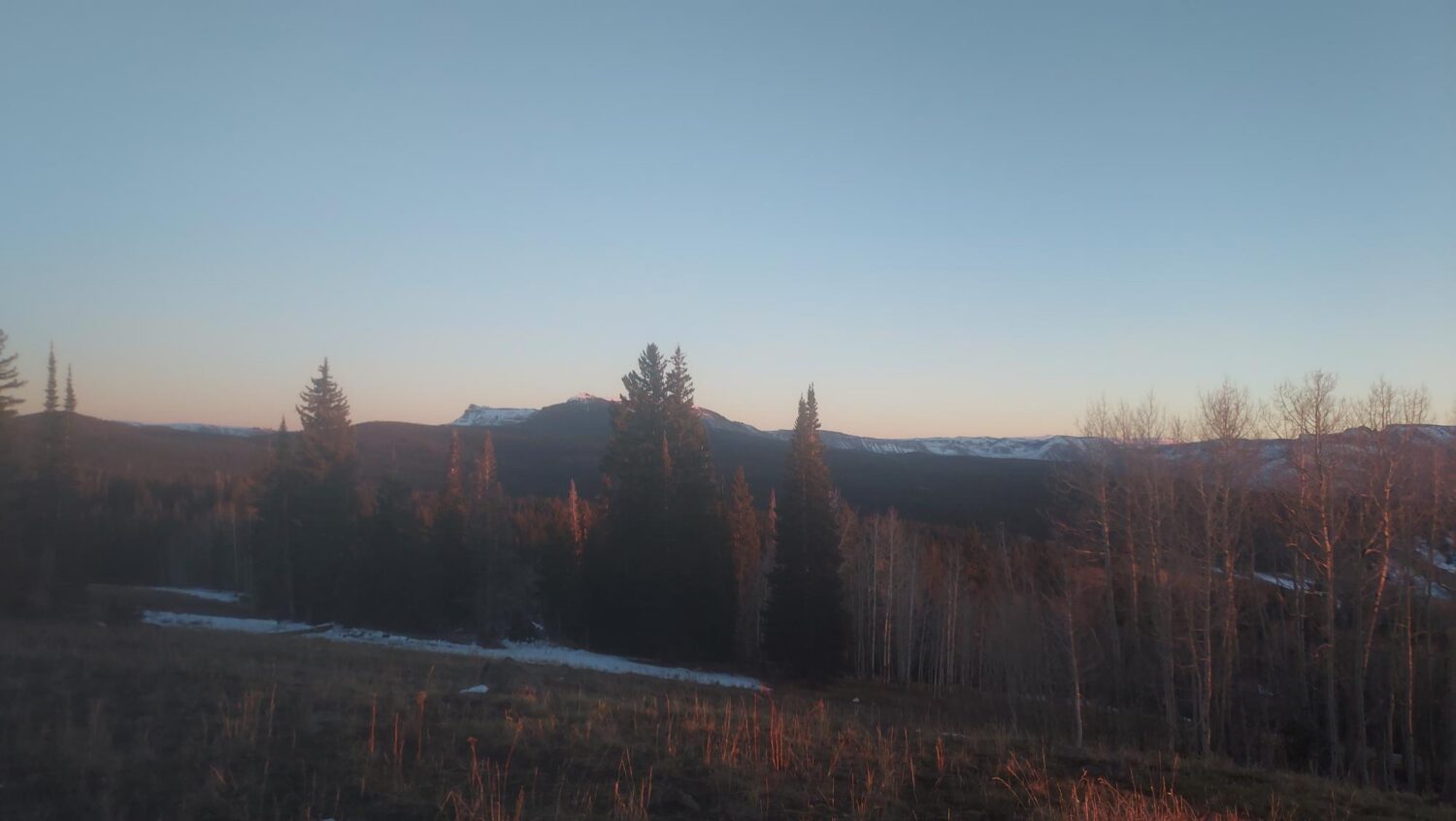
Our plan was to look for the meadow adjacent to the dark north-facing timber. To sit and watch the afternoon pass. A copse of three firs provided a perfect view and a place to rest my back so I settled in, expecting to watch the world intermittently though my binocs, punctuated by warm almost-naps in the drowsy sunshine.
We weren’t the first to find this spot, high in the White River National Forest, in view of the Flat Tops Wilderness. There in a neat little pile, a granola bar wrapper and instant coffee container and three crushed plastic water bottles (grrrr!) – next to a dried cow pie. For a moment, I let it hurt.
But the meadow looked downslope into the attenuating sun, patches of snow in the northside shade. Mountains on the horizon. Willows in the crease. I listened. I heard no car tires on a distant road or airplanes over head. Only the gentle wind in the branches and the rowdy little creek tumbling over itself 200 yards off. And I thought, this. This is what vast areas of the mountain west still sound like.
Lights danced over the meadow. Long and thin, random and sinuous. Flowing there and then gone, and then again a little downwind. Enough of them and often enough to describe an identifiable mean angle to the horizon. Some rising, some chasing, some hanging in the dry grass. Like the traces of fireflies rotated sideways but finer and hot-white in the afternoon sun.
In geometry theory, a line has no width, only length. These were the biological equivalents. I was seeing sunlight refracting, the actual object invisible. Refracting light bouncing on or through the finest spider-silk. And though I couldn’t see them, each trailed a tiny spider juvenile – bound to earth by the barest bit of gravity. Their bodies a sea-anchor trailing in the waves of thin air keeping the silken sails trim while they flashed in the sun.
I can sail within 20 degrees of upwind or so because I can hold my sails at an angle to the wind and slip across it. I wondered about a similar physics for the spiders — their sails carrying them ever higher even as the elevation peeled away underneath. How is it that this is the strategy? Sailing ever higher in the dry thin air, sailing on the uncertain wind with winter on the way.
Movement at the edge of the timber revealed a coyote. Full winter pelage. Buff and tawny. Ears up and alert. It poked around the edge a bit and then dog-trotted upslope in characteristic canid cadence. Like other members of the dog family, coyotes are coursing predators and move with a nearly frictionless liquid efficiency, perfectly adept at turning distances into opportunity or security as the need arises. I wish I had a bit of that.
I still harbor my fantasies of the pristine and untouched and I can look past some jerk’s trash (provided its small) and the evidence of range cattle. But fantasies grate against McKibbin’s argument in the “End of Nature.” That nature as an ideal no longer exists. That we humans changed the very chemistry of the atmosphere that shields all life. That here are no longer places remote enough to be untouched by our hubris.
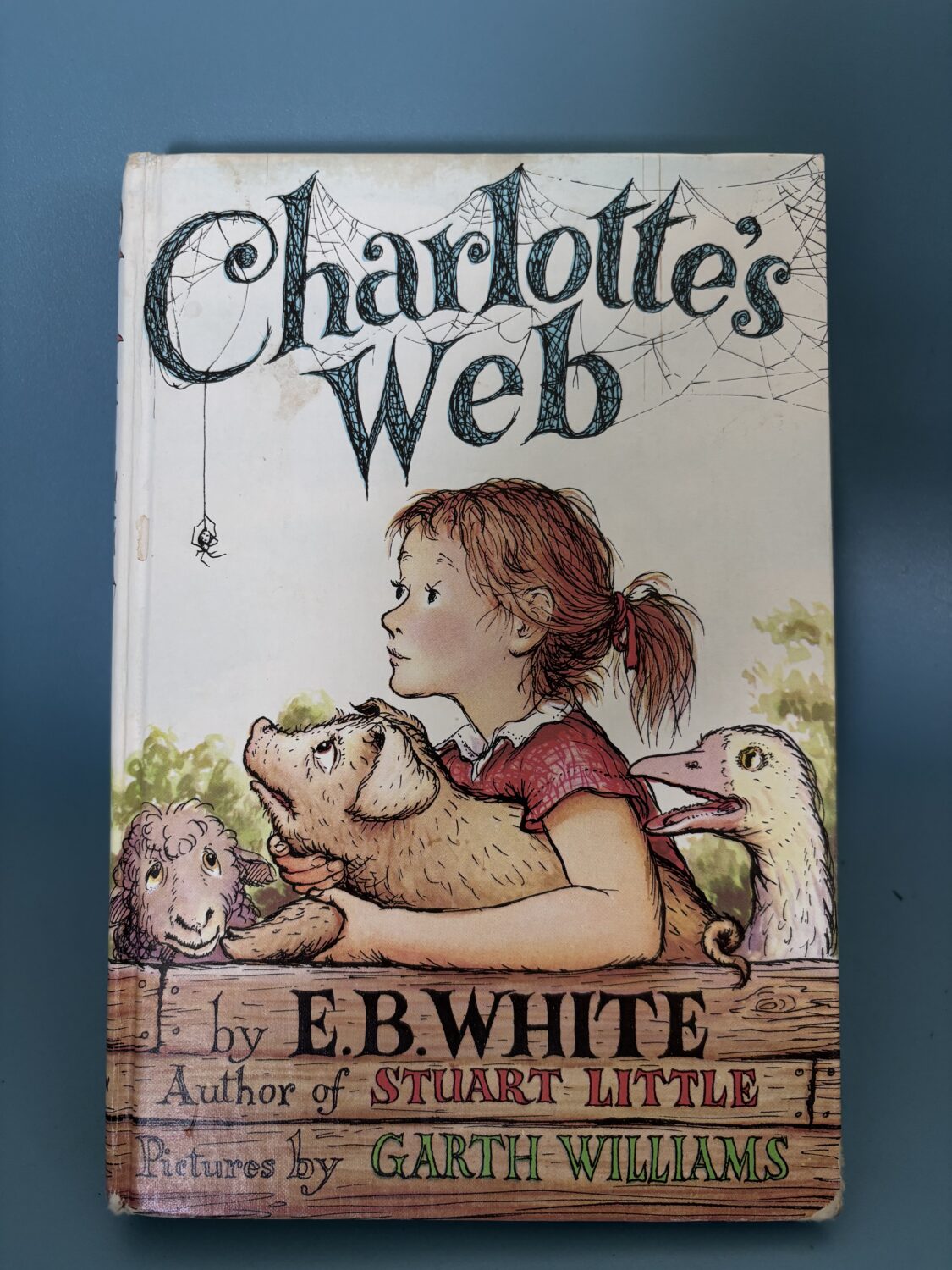
I learned of flying spiders from E. B. White’s “Charlotte’s Web” at the end when the egg sac split and the spiderlings set their silky sails and left poor Wilbur. I was young enough, that I remember having the book read to me, likely by my mom on a family camping trip.
I learned of dreaming spiders just yesterday. The almighty algorithm sent notification of a new paper in the prestigious Proceedings of the National Academe of Sciences1. Evidently juvenile jumping spiders “possess movable retinal tubes to redirect gaze, and in newly emerged spiderlings, these movements can be directly observed through their temporarily translucent exoskeleton.” Researchers reported “evidence for an REM sleep–like state in a terrestrial invertebrate: periodic bouts of retinal movements coupled with limb twitching and stereotyped leg curling behaviors during nocturnal resting,” meeting the “core behavioral criteria of REM sleep observed in vertebrates, including humans.”
What even to think about this? The visual brain of our tiny kin, a long distant commonality deep in neural mysteries of our shared physiology. Translucent little captains with a water-based biology like my own, making effortless passage across the vastness of a cold sky. And when at last they wait out the long winter and sleep, do they dream of their sails too?
When the afternoon sun set behind the mountain, I could feel the temperature drop. I had an hour before full darkness. I stuffed the little pile of trash into my pack and started walking back. Laboring and heavy among the gossamer captains. Slipping in the mud.
1Regularly occurring bouts of retinal movements suggest an REM sleep–like state in jumping spiders. https://doi.org/10.1073/pnas.2204754119

2 Responses
Thank you so much. You keep opening the world, a witness for us.
Tim, this is holy writing. Thank you. Poetry. Vision. I feel blessed by the words. Awakened by beauty to beauty.