
Moes and Riek’s motivation to write Integrating Psychology and Faith stemmed from teaching the psychology and religion capstone course for their university’s psychology major. They hope to provide concise summaries of foundational issues regarding the integration of faith and psychology, articulate the pros and cons of different approaches to integration, and provide contemporary applications relevant to today’s readers.
The authors open by noting that humans often fail to notice the degree to which our values and attitudes impact our interpretation of any new information. This is true for theological, psychological, political, or other ideas. They then provide timely examples of common inconsistencies in thinking about scientific, religious, and political issues. In my experience, these examples generate interest in the material and deliver a great springboard for discussing other ways in which our beliefs might contradict one another. These brief vignettes are followed by a short description of six worldview components, such as anthropology and epistemology, to set the course for future chapters.
One strength of the text is its attempt to focus on the integration of faith and contemporary psychological theories. Moes and Riek rightly note that arguments of long-abandoned psychological theories being incompatible with Christianity do little to help students understand how psychology and faith might be integrated in the present. Additionally, they point out that “psychology” as a field consists of several fields of thought and many subdisciplines, each with their own theoretical underpinnings. Thus, the authors attempt to describe the most common psychological theories and discuss how each may have similarities or differences with Christian understandings of human nature. For example, rather simply describing Freud’s opinion that religion is mental illness, the authors present ways in which more modern psychodynamic approaches view humans as largely driven by unconscious processes.
If psychology is the study of the minds of beings that were made in the image of the Divine, perhaps psychology and spirituality are by definition inseparable. Moes and Riek note that understanding one’s integration worldview is especially important for clinical psychologists, whose beliefs about human nature and psychological health inevitably impact the way in which therapy is conducted. The authors hint at recent changes in cognitive theory that allow for human agency, although no mention is made of third wave cognitive behavioral theories, which encourage therapists to engage in work which is in line with their patient’s deeply held values. In practice, these theories may lead to increased ease of integration with faith, both for therapists and their clients, and may be worth discussing in future editions.
Another strength of this text is that the authors note that Christian thinkers come to a wide range of conclusions about various scientific, religious, and political issues. They do not seem to suggest that there is an easy answer to the question of how to integrate faith and psychology, and they note potential pros and cons for a variety of positions. I appreciate that the text provides less opinion than some integration texts about which views the authors prefer, as this is more comprensive and less leading, giving readers the opportunity to think through which options may be closest to their own worldview. It is notable, however, that the book still contains some opinion on integration models, such as suggesting that one view appears to give “undue deference” to science.
I have appreciated using this book for my capstone course over the past semester for several reasons. One is that its concise descriptions are straightforward and easy for students to understand. The brief nature of the book gives a professor ample room to bring in additional relevant topics in the field that are of interest to students and to critique them from the views presented in the text. Discussion questions at the end of each chapter lend themselves to deep in-class discussion. The wide variety of topics presented prepares students well for writing a final integration paper, related to how their worldview informs their view of psychology and their responsibility to the world. Finally, this text reinforces the complexity of integration while finding some commonalities on which most Christians can agree.
In summary, this book is well-organized and provides less personal opinion than many other integration texts, giving readers more space to weigh their own views. I believe that anyone with an interest in psychology can emerge from this book with a better understanding of their own values and assumptions if they seriously engage the questions in this text.
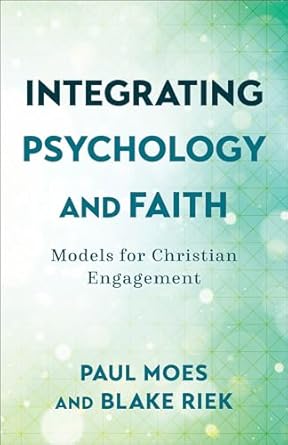
This textbook updates the conversation about models of psychology and faith integration, helping students understand the range of options for Christian engagement. Drawing from themes developed in Paul Moes’s well-received Exploring Psychology and Christian Faith (coauthored with Donald J. Tellinghuisen), Integrating Psychology and Faith develops a set of worldview dimensions that serve to organize a variety of psychology-faith integration models.
Paul Moes and Blake Riekset forth principles and themes and establish historical context to help students explore where different views fit on a continuum of approaches to integration and understand the perspectives of other Christians in the field of psychology. In this way, students come to better understand the organizing principles for various views about psychology that they encounter. The book also shows how theological traditions and positions shape views on natural science, social science, and psychology.

One Response
Thanks for writing and sharing this, Rachael. It becomes complicated and difficult to respond to, but you are to be commended for teaching on this subject. I would contend that one cannot understand one’s faith without understanding their own psychologically shaped worldview and vice-versa. What theology calls sin, psychology calls blindness, denial, or narcissism. Both are correct. I know people with good, sound theology who are really not nice people. Conversely, I know people with a pretty rigid and untested theology who nonetheless exude a joyous gospel. I suspect we all drift back and forth on that continuum. It is complicated.
Thanks again for what you do!