
We come to the end of our engagement with Robert Farrar Capon and the parables of Jesus. For this last Sunday, before turning to Capon, I will engage with the environmental crisis through some parable-like stories found in Charles C. Mann’s book, The Wizard and the Prophet: Two Remarkable Scientists and Their Dueling Visions to Shape Tomorrow’s World. The two scientists Mann focuses on are Norman Borlaug and William Vogt. Although Mann’s book is well worth reading, I’ll offer this lecture on YouTube as a short cut.
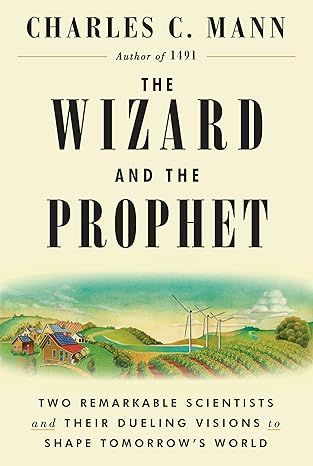
Borlaug’s research in Mexico led him to produce a new hybrid high-yield form of wheat that saved millions from starvation. Borlaug engineered this new wheat through the tedious, mind-numbing practice of thousands of trial-and-error combinations (there was no Watson and Crick DNA discovery when he started in the 1940s). Mann calls Borlaug “The Wizard.” His clarion call to overcoming our environmental problems, including climate change was “Innovate!” We will overcome our problems through discovery, which will push beyond creation’s natural capacity, and everyone will win.
William Vogt was a founding environmentalist. He held a French literature degree and was also an avid bird watcher. Through this hobby, he was assigned a research project on an island off the coast of Peru where he discovered what we now call the “carrying capacity” of the earth. Vogt determined the island and the fish off-shore could only support so many birds. He concluded that using more than our planet can sustain will lead to ruin. Mann dubbed Vogt “The Prophet.” His clarion call to overcoming our environmental problems was “Cut Back!” or everyone will lose.
We can see the approaches of both the Wizard and the Prophet when we look at modern problems. How will we feed everyone? The Wizard says, “Innovate beyond what is now possible! World-scaled industrial farming is the answer: GMOs, the C4 Rice Initiative, lab grown meat, etc.
The Prophet’s answer is something like Lloyd Nichols’s farm. Nichols plants a thousand varieties of fruits and vegetables to re-create a natural habitat of an abundance of species. It’s the opposite of our farming practices today. Nichols’ farm might look like innovation because it is precise, high tech, and on the cutting edge in many ways, but it follows the natural carrying capacity of the land he farms by mimicking what is natural.
Looking at the issue of energy and climate change, you hear the Wizard/Prophet framework in the arguments over natural gas and oil versus renewable energy forms like solar and wind.
Mann gives a lovely metaphor for understanding climate change. Imagine the atmosphere is like a bathtub with water flowing in. You’re enjoying your bath, because your tub has a few holes strategically placed in the tub, so water also flows out in perfect balance. Then some gum (carbon dioxide) is used to plug the holes, and all hell breaks loose as the water rises.
This is what is happening with climate change. How do we fix it? The innovative Wizard loves nuclear energy. It’s energy rich with the smallest footprint. The Prophet prefers renewables. It connects communities with no giant facilities or utilities and lives within creation’s boundaries.
The newest innovation from the Wizard is geo-engineering, essentially copying the effect when Mt. Pinatubo erupted in the Philippines in 1991. The Prophets exclaim, “You’re going to fix carbon pollution by releasing more pollution! God forbid!”
The Prophets advocate returning the Sierra Desert to its past state. Irrigating the desert with de-salinized water from the ocean and then planting millions of trees, which are natural carbon-eating machines. This is a technological vision bound by creation’s natural boundaries.
Do you think our problems will be solved through innovation or conservation?
What would Robert Farrar Capon say about these approaches? Capon argues that God uses the left-handed power of love and sacrifice over the right-handed power of coercion. Repeatedly, Capon finds Jesus on the side of the last, least, lost, little, and the dying ones. The Wizard (innovate!) and the Prophet (cut back!) argue back and forth, and we listen hoping one of them will save us. Capon argues Jesus enters our bookkeeping systems developed for power and privilege and ruptures them. He would say Jesus calls us to the side of the dying ones, to the ones we usually think of last. He would find Jesus in creation, which is rupturing our systems.
There is urgency in finding our way out of these environmental disasters, and I’m grateful for the Wizards and Prophets, but I don’t think we’ve listened to Jesus in his disrupting presence. And I ask myself if I truly want to live in a world shaped by Jesus on the cross—the left-handed power of last, least, lost, little, and dying. Do any of us really want that as we struggle to find our way?
5 Responses
Thanks for putting a persistent division in climate discussions in a fresh perspective — and for reminding us all month what an original and insightful voice we find in Capon. (Has anyone else merged theology and cookery as artfully as he did in”The Supper of the Lamb”?)
But the desert in dispute is the Sahara, not the Sierra. (I think Capon slipped into Spellcheck just now and tried to o substitute “dessert.”)
Thank you for the correction. You are absolutely correct
🤦♂️
We should also be aware in this discussion of the wizardry of Borlaug’s Green Revolution that the high yielding crops require water and fertilizer. The need for irrigation has lead to excessive groundwater depletion in India from all the tube wells that were installed to meet the irrigation demand. So this “green revolution” is an unsustainable solution to the food shortages.
Thank you for this Rodney. I wonder if you would be interested in joining a book discussion of Timothy Gorringe’s, “Word, Silence and the Climate Emergency: God, Ekklesia and Christian Doctrine.” We meet -with the author! –every Monday via zoom. We’d welcome your participation.