
Right off the bat, I want to apologize to any non-US readers. This will be a thoroughly US-centric post. However, I do hope that some of my reflections will find purchase in your context as well if you, like us, are living in a polarized society.

Because there’s no doubt we are polarized here in the US. But doesn’t it sometimes feel like more than that? “Polarization” sounds so polite. Inherent in the word seems to be the assumption that even though some of us occupy different ends of the spectrum, we all still share the same spectrum. It seems to presume that despite our disagreements, we still occupy the same plane of existence and agree on the same basic principles of reality.
Yet more and more evidence seems to suggest that Americans are increasingly living in completely different worlds. We hear completely different news stories. We see completely different social media feeds. More and more, our social circles reinforce our existing interpretation of reality.
It can be easy to spiral and believe that we are simply too far gone for the healing. But I’d like to offer up a thought experiment. Not a panacea by any means (I’m afraid one simply doesn’t exist). But an offering, nonetheless, to help break the hyperpartisan fever and restore some semblance of sanity of our politics.
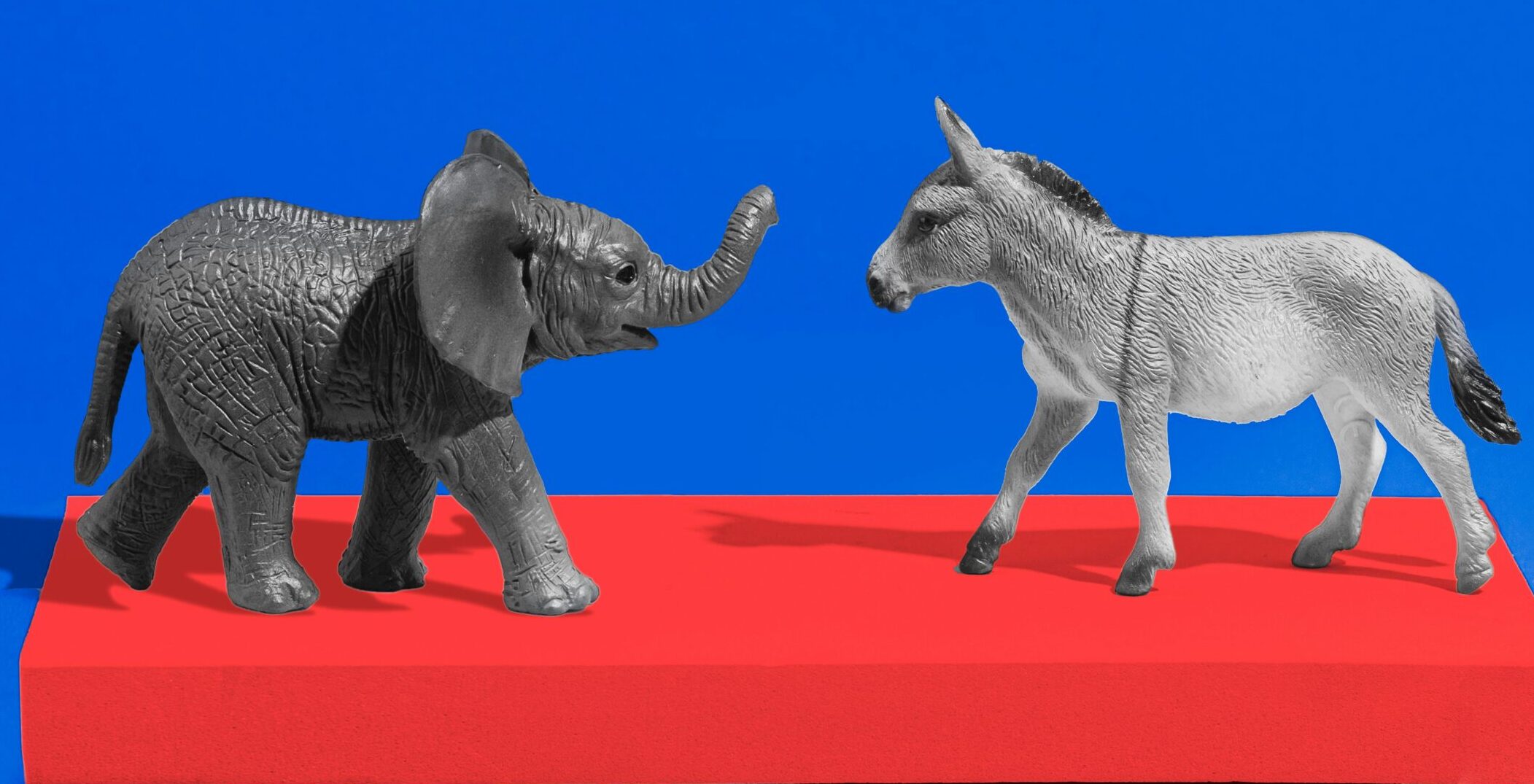
The idea for the experiment comes from two Gallup polls. The first from 2023 showing that both political parties are underwater with voters, and that a record 28% of voters said they had an unfavorable view of both parties. The second from 2024, showing that vastly more Americans are identifying as independent (43%) than as either a Republican (28%) or a Democrat (28%).
Yes, we are polarized. But a growing number of us don’t like that we are polarized and are trying to move toward the middle. And it seems to me that the ones most preventing us from doing so are our elected officials. Partisan elected officials do not benefit from a growing share of independent voters. They benefit from radicalizing more partisans. And as long as gerrymandering shrinks electoral competitiveness and our primary systems reward the most partisan candidates, we will continue to have hyperpartisan elected officials.
So, the thought experiment: what if we could generate a grassroots movement of independent citizen candidates up and down every ballot, across the country, by 2028? And what if they ran on a platform of enacting only policies that a majority of Americans support?
To be clear, this thought experiment is not advocating the creation of a third party. It involves true independents. People with no current partisan affiliation–and preferably with no history of it either (though that could admittedly limit the number of candidates).
It also does not include independent politicians. When I say “citizens,” I mean it. People with little to no history in politics whatsoever.

Dan Osborn of Nebraska is a great example of an independent citizen candidate. A mechanic, Navy vet, and lifelong registered independent, Osborn made waves in the 2024 election cycle for running for–and almost winning–Nebraska’s open US Senate seat. He had no party ties and no partisan baggage. He was a truly independent citizen candidate. His candidacy captured the nation’s imagination and almost captured a US Senate seat.
When I talk about independent citizens candidates, I’m talking about people like Dan Osborn. And I’m talking about people like you, Dear Reader, and me. After all, it’s going to take an army to fill every ballot from sea to shining sea. Why not us?
Now, I can hear you even as I type this.
“Independents won’t be able to compete with the infrastructure of the established parties”. Probably. But social media and small dollar donors are powerful. And recent election cycles have shown us that the biggest war chest does not necessarily equate to electoral victories.
“They’ll never be able to establish name recognition”. Maybe. But could the movement gain enough attention to sweep them up with it? And if not, name recognition becomes much easier to establish the further you travel down-ballot and the closer you get to home.
“Disinformation would find any way necessary to smear independent citizen candidates.” Undoubtedly. But disinformation will already do this with every other candidate anyway.
“Ballot access is too restrictive for everyday folks to actually run.” True. But a growing network of organizations like Run For Something and Lead Locally are helping connect the dots for aspiring first-time candidates to run for office. This infrastructure could be scaled up and expanded with the proper funding.
“How will these candidates define “majority support” for a policy, and what metrics will they use?” Great question. Maybe we could start with 60% or higher support in at least three national polls?
Obviously there are plenty of holes. But I’m less interested in answering all of the small “what ifs” and more interested in asking the big “what if.”
What if a groundswell of independent citizen candidates could be recruited to run in most races across the country?
Would some of them win? Would it put pressure on the established parties to move away from the edges and toward the center? Could it prove to voters that want to cast meaningful ballots that they need not be beholden to established parties to do so? Could it do anything to reverse our hyperpartisanship?
I’m not sure. But I guess that’s the thing about thought experiments. They live in our heads. They remain hypothetical. That is, at least, until we decide to make them real.
Polar bear photo by Sterling Lanier on Unsplash

9 Responses
Kyle, thanks for this thought experiment as resolution to the “polarization” in our country. I have a couple of comments.
First, I don’t think “polarization” is an appropriate description. The supposed polarity I think is largely driven by the difference between truth and untruth. That difference is real, but I don’t think that is a polar difference. We can have polarity with regard to policy differences, but truth vs. untruth isn’t a polar difference. The disinformation you allude to undermines truth which is the major problem in our differences.
Second, it seems to me that a better way to deal with the hyper partisanship is through rank voting. Rank voting allows for the more centrist candidates to win elections in which the hyper partisan candidate might get more votes in the first round but not enough to get the 50%. The centrist candidate could then eventually get to the 50% in the second or third rank of votes. Some states like Maine have already employed rank voting. I think that would have greater success that the proposal in your thought experiment.
It’s working in New York City.
Thanks, Kyle. I admire your courage and optimism here. I, too, lament the great divide in our country and the lack of desire for understanding or working together. I encourage people to get involved in their local governments – attend meetings in your township, county, or city and speak up during the public comment section. Get involved and run for a local position and find out what this party system we are embroiled in means for decision making. I think I still believe in a two (or three) party system – we need differing opinions and experiences. But I also believe in a large middle and listening to learn from each other, and that doesn’t seem to be happening. As someone who has recently disaffiliated from the CRC, I have observed that even my beloved church governance couldn’t find that understanding, respect, and middle ground in Jesus Christ – so how can I expect the world to?
Your focus on independents causes me to share a FACEBOOK POST I made a few days ago.
Dear viewers,
I have used FACEBOOK exclusively as a social media site since it appeared on my devices. Indeed, I have enjoyed pics, comments, posts, and information found on this site from many of you. In the past several years, I typically post only birthday announcements. In light of recent events in our political world, however, I can no longer remain silent. Thus, I choose to participate in NO KING’S DAY by registering my thoughts using the most creative words of the English language: WHAT IF. These ideas are mine, but perceived advantages/disadvantages listed are the result of AI.
1. WHAT IF we had an American congress where 20% of its members served as Independents?
Advantages –
Independent members are more likely to be issue-driven, evaluating legislation based on its merits and their constituents’ needs rather than strict party directives.
A large independent bloc could act as a crucial swing vote, forcing the two major parties to negotiate and compromise to pass laws, potentially leading to more broadly supported, moderate policies and less partisan gridlock.
With no single party able to completely control the agenda, all members might be more accountable for legislative outcomes, as they cannot simply blame the other chamber or party for failures.
A system that encourages independents could lead to a “citizen legislature” with a wider variety of real-world experiences and professional backgrounds, as opposed to a body primarily composed of career politicians and lawyers.
It would provide a voice for the large segment of the electorate that is critical of the current two-party system and feels unrepresented by either major party, potentially increasing overall political engagement among a group that tends to have low voter turnout.
Disadvantages –
Without strong party structures to maintain discipline and coordinate action, forming stable governing coalitions could be difficult, potentially leading to legislative chaos and a government that struggles to get anything done.
Inexperienced or unaligned lawmakers might have to rely more heavily on unelected staff, lobbyists, and special interest groups for guidance on complex issues, potentially increasing the influence of these outside entities over the legislative process.
Independents often face hurdles with committee assignments and leadership roles under current rules, which are designed around party caucuses. A large number might require significant changes to House and Senate rules.
The fluid nature of an independent bloc, where members might align differently on every vote, makes legislative outcomes less predictable, which can complicate long-term planning and governance.
Voters might face more confusion in a less-structured system, and there could be practical complications related to primary elections or ballot access rules in states that are not designed for a multi-party or non-partisan system.
I THINK THE ADVANTAGES OUTWEIGH DISADVANTAGES!
2. WHAT IF we had a President who appointed qualified Republicans and Democrats to cabinet posts who shared a commitment to working for all Americans regardless of party affiliation?
Potential benefits –
A bipartisan cabinet could significantly lower the political temperature in Washington by signaling a commitment to national unity over party loyalty.
Appointing individuals solely based on qualifications, rather than party affiliation, could lead to more effective policy development and implementation, potentially improving overall government performance.
This approach could help restore public faith in government by demonstrating that leaders from both sides can collaborate on shared national goals.
A president might find it easier to get cabinet nominees confirmed by a divided Senate and could potentially foster greater cooperation with Congress on legislative priorities, as some historical examples show.
The president would benefit from a wider array of perspectives and expertise, potentially leading to more nuanced and comprehensive policy decisions.
Potential challenges –
Ideological clashes within the cabinet could lead to internal dysfunction and conflict, especially in today’s highly polarized political climate.
Cabinet secretaries are expected to help the president execute their specific agenda. Appointees from the opposing party might not be fully committed to the president’s core policy goals, leading to friction.
The president would likely face strong criticism and even anger from their own party members for giving power and visibility to political opponents.
Historical examples show mixed results. Presidents like FDR successfully appointed opposing party members during crises (like WWII) when shared values on a core issue (winning the war) superseded other disagreements. In other instances, such picks have not always bridged party divides, and some past cabinets have been deeply divided.
The increasing ideological sorting of American political parties means that it would be very difficult to find genuine cross-party appointees who don’t face immense pressure to conform to their own party’s ideology, rather than aligning with the president’s.
I THINK POTENTIAL BENEFITS OUTWEIGH POTENTIAL CHALLENGES!
3. WHAT IF political leaders encouraged open debate and peaceful protests for issues which matter to the American people?
Advantages –
Historical data suggests that nonviolent campaigns are more than twice as likely to achieve their goals as violent ones.
Nonviolent tactics are more inclusive, allowing people of varying physical abilities and backgrounds (including women, the elderly, etc.) to participate, leading to larger movements.
Peaceful actions generally maintain the moral high ground and are less likely to alienate bystanders or the public compared to violent protests, making them more difficult for the state to repress without incurring reputational costs.
The visibility and moral authority generated by large-scale peaceful protests can force political leaders to address demands and can lead to significant legislative changes (e.g., the U.S. Civil Rights Act of 1964 and Voting Rights Act of 1965).
Large, inclusive, peaceful movements are more likely to win support, or at least neutrality, from key pillars of the establishment, such as the police, military, and business leaders, eroding the power base of the adversary.
Countries where nonviolent struggles succeed are more likely to emerge with democratic institutions and less likely to relapse into civil war.
Disadvantages –
Peaceful protests can be seen as less impactful than more disruptive actions and may be relatively easy for lawmakers and those in power to ignore if they do not cause sufficient public inconvenience or disruption.
While the protesters’ intent is peaceful, law enforcement or counter-protesters may instigate violence, leaving participants who expected a non-confrontational event physically and mentally unprepared for a hostile situation.
In a highly polarized political landscape, opponents can mischaracterize or depict peaceful protests as violent, which can turn public opinion against the movement and make progress more difficult.
Change through peaceful means can be a slow process, sometimes taking years of sustained effort and strategic planning to achieve goals, which can lead to frustration among participants.
While inclusive, nonviolent civil disobedience often requires participants to willingly accept consequences, such as arrest or imprisonment, to highlight injustice, which demands a high level of personal commitment.
Depending on the circumstances and how they are perceived, protests can sometimes deepen existing social or political divisions, particularly if one side feels unheard or misrepresented.
I THINK ADVANTAGES OUTWIGH DISADVANTAGES!
What a great idea!
As lifetime third party voter, I support most of your and Ronalds conclusions. As a California resident I preach to friends that this is the easiest state to be a third-party voter since outcomes are so lopped sided, your vote is a more powerful call for change. Also that your vote then keeps the third party on the ballot. As of our last presidential election I had to do my first certified write-in vote, but was so happy to talk to people about that vote. Our national congress continues to express a single party system. Let’s acknowledge that third parties are polarized also, which is the weakness of their effect. Libertarian Party calls it’s members to fill local seats for change in policy.
Kyle:
But doesn’t independent candidates imply that the current two political parties are equally responsible for polarization, lying, and other maladies currently threatening our republic? I know some people believe that (remember “well-meaning people on both sides” at Charlottesville, January 6, was a “day of love,” and other claims that blame should be shared. I don’t believe that. And so if people don’t think that blame should be equally shared, wouldn’t an independent (as you described it) hurt the group that one believes is the far-better alternative in the current state of our politics?
I very much appreciated your thought experiment. A fantasy I’ve held for a time is if a moderate Democrat and moderate Republican teamed up on a ticket, they’d get my vote in a nanosecond.
Thanks much, Kyle. Don’t make an apology for “US centred” talk. At least in Canada the potential for such living in different planets lurks ominously behind many doors. Negativity and personal attacks against opponents quickly turn opponent colleagues into enemies. I remember a friend’s comment re Tip O’Neill and Gerald Ford; it came from the son of Gerald Ford. The son said, “Tip and Dad would argue ferociously in the House and regularly go out for martinis after the day’s session. Not a panacea either, but neither a bad idea for politicians who haven’t spoken except in anger for years. In vino veritas, but martinis are not a bad, bold start.