
The other day, I came across this photo I’d snapped of Muhammad Ali signing an autograph on January 17, 1988. We were in a strip mall in Toledo, Ohio, and I know the precise date because it was his birthday and the back of the photo has the year stamped on it. Yes, that’s my wife in all her 1980s splendor getting an autograph from the champ.
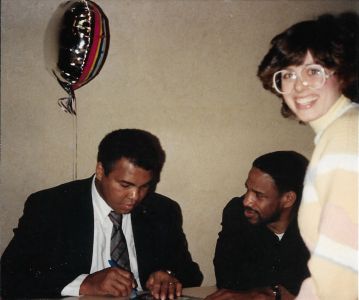
Ali had been diagnosed with Parkinson’s Disease in 1984 and had mostly lost his voice by the time we saw him in 1988. Eight years later, he moved the world when he raised his trembling arms to ignite the Olympic flame in Atlanta. (It’s impossible for me to watch that video without a lump in my throat.)
I have a theory about Ali: America loved him and honored him more after he’d lost his voice than when he had it.
He was an Olympic champion in 1960 and became heavyweight champion in 1964. By the time I became fully aware of him, he’d been stripped of his title because he refused to go into the military during the Vietnam War, famously saying, “I ain’t got no quarrel with them Viet Cong.” Ali had registered for the draft when he turned 18 and was classified as fit for service only in a national emergency because of his dyslexia. But the US needed warm bodies for the war, and in 1966 Ali was reclassified. By then he had converted to the Nation of Islam, which does not support participation in wars. Ali said he was a conscientious objector, and in 1967, after he failed to report for military induction, Ali was convicted of draft evasion, sentenced to five years in prison, and stripped of his boxing titles.
He didn’t make a lot of friends with the status quo during the years of his suspension, saying things like this: “My enemy is the white people, not the Viet Cong or Chinese or Japanese. You my opposer when I want freedom. You my opposer when I want justice. You my opposer when I want equality. You won’t even stand up for me in America for my religious beliefs—and you want me to go somewhere and fight, but you won’t even stand up for me at home?”
He also said this: “Why should they ask me to put on a uniform and go ten thousand miles from home and drop bombs and bullets on brown people in Vietnam while so-called Negro people in Louisville are treated like dogs and denied simple human rights?”
As a kid, I could understand what he meant by “I ain’t got no quarrel with them Viet Cong,” but I could not understand what he was saying about white people. I just remember he got under the skin of a lot of people I knew. I remember the hero who was cheered so loudly in Atlanta in 1996 being hated. I always liked him—I found his constant verbal sparring with Howard Cosell amusing and laughed out loud when Ali referred to himself as being “pretty as a girl.” At that time, the simplest way to tell where someone stood on Ali was whether they called him by his chosen name or his birth name of “Cassius Clay.” If being a brash Black man wasn’t repellent enough to white America, a brash Black man who had converted to Islam did the trick.
Ali managed to stay out of prison while his case was appealed. Eventually the Supreme Court unanimously overturned his conviction and he was allowed to box again in 1970. I remember well his return to boxing in a fight against Jerry Quarry and the speculation whether the long layoff had diminished Ali’s skills. He beat Quarry but had a winding path back to the championship.
I was a sophomore in high school in 1974 when Ali fought for the heavyweight crown against George Foreman in Zaire in what Ali called the “Rumble in the Jungle.” As much as I liked him, I thought Ali was too old and had been too beaten up to challenge Foreman. Most people felt that way—the odds were heavily in Foreman’s favor. Foreman was an incredibly strong puncher who had become champion in 1973 by knocking Ali’s nemesis Joe Frazier out in the second round after dropping him five times in the first round. In those days, Foreman was perceived as a hulking brute—it would be some time before he’d develop the public persona he displayed when he became a loquacious grill salesman.
I bet my gym teacher, Mr. Summers, three dollars that Foreman would beat Ali. This is how discerning readers know I did not attend a Christian school. A Christian school teacher might lose their job gambling with students. At my public school, nobody cared. However, at my school, students would get suspended if caught smoking. My Christian school friends were bumming cigarettes from their teachers. Isn’t morality interesting?
I wasn’t the only one who had some action with Mr. Summers. There were 10 or 15 of us. Every one of my classmates who bet with Mr. Summers against Ali was white. Mr. Summers was a physically imposing African American who had once had a tryout with the Chicago Bulls. Although George Foreman was also Black, I could tell backing Ali in this fight meant something to Mr. Summers beyond sports. When it was over and Ali regained his heavyweight crown, Mr. Summers didn’t let any of us off the hook. He collected his money from each and every one of us young white doubters.
I suppose I drove to Toledo 14 years later to see the man who had cost me three dollars. Of course, it was more than that. Ali made history. Ali was history. I’m glad I got to see him in person.
Finding this picture brought those memories of Ali to my mind along with a lot of questions.
If you’re old enough to remember those days, what did you or the people around you think when Ali refused to go to Vietnam?
Did you hear people continue to call him “Cassius Clay” after he had changed his name? What did you make of that? (Ali said “Cassius Clay” was his slave name.)
What does the vitriol aimed at Ali say about America?
What does the embrace of Ali after he had Parkinson’s say about us?
How in the world does the MAGA movement, with its revisionist history, tell the story of Muhammad Ali? (After all, those who condemn Ali as a draft dodger did vote for a man who evaded military service with dubious bone spurs.)
I’d love to hear your thoughts about my trip down memory lane and your thoughts on the fighter who became known simply by his nickname: The Greatest.
18 Responses
THIS was a very fun read, Jeff. You made me laugh out loud more than once. In many ways he was the Greatest. This kinda made my day.
Jeff….Someone has to tell you that was just one fine story. Thx.
My whole hearted recommendation: the Muhammad Center in Louisville, Kentucky. Bring your kids (or grandchildren).
Thank you for reminding me of Ali’s greatness, and of our nation’s shameful reaction to it. Americans loved him as long as he was throwing punches, but when it became clear that he could think, that he had a mind and conscience of his own, admiration turned to hatred. Our racism couldn’t tolerate a Black man who spoke his mind about national issues. Imagine the gall!
As a white man, I believe that we’ve made some progress. It’s no longer unusual to see Black men and women in positions of leadership – but Colin Kaepernick’s stand against police brutality shows how tentative that progress really is. He, too, is a man of integrity. He is intelligent, and he is an outspoken Christian. Yet in America, being half Black still trumps all.
Whatever ground we’ve gained feels lost again. We’ve devolved to the point where young conservatives feel free to exchange vile racist messages publicly because the president himself defends and encourages such behavior.
One step forward, two steps back. When will we ever learn? When will we ever learn?
Jeff,
I was in the hospital in Kurume, Japan when Cassius Clay beat Sonny Liston for the heavyweight championship of the world. Listening to Far East Network on my little transistor radio, I was incredulous that the Louisville Lip had won.
I remember my disbelief when he changed his name to Muhammad Ali. And, attending a Department of Defense high school during the height of the Vietnam War, his decision to be a conscientious objector wasn’t a popular one.
These were the days before pay per view so I believe I watched every one of his fights on broadcast TV. And, yes, his verbal sparring with Howard Costello was delightful and made iconic by Billy Crystal.
Thank you for this essay, Jeff. I have to admit that the first things that spring to mind when I think of Muhammad Ali are bragging and doggerel. But in hindsight, I see that Ali may have been exhibiting proper pride and that he was a precursor for what are now called spoken word poets. A few lines from his poem “The Truth”
Facts are but its shadows, Truth stands above all sin;
Great be the battle in life, Truth in the end shall win.
The image of truth is Christ, Wisdom’s message its rod;
Sign of truth is the cross, Soul of truth is God.
Ali was robbed of what would have been his best years because of his stance on Vietnam. Then, when he was allowed back in the ring, he prolonged his career too long, by about the same number of years he had lost. He was 38 when he was destroyed by Larry Holmes, a fight that probably was the final nail in the coffin when it came to his Parkinson’s syndrome. Had he had those years from 1967-1971 to amass wins and belts, I firmly believe he would not still have been fighting in his late 30s. One boxing beat writer said the loss to Holmes was the worst sports event he ever had to cover. And for all there is to admire about Ali and his dancing feet in the ring, he definitely had some feet of clay when it came to his relationships with women, including his wives.
Interesting trip down memory lane, Jeff. My brother is near your age, and when one of his fights verses Joe Frazier came up, he was in the Frazier camp. (You could have gone in a whole different direction with Ali’s interactions with Joe).
I’m not sure if politics were involved with my brother’s decision to not back Muhammad, he was more liberal than my parents in the early 70s, lettering a large rock in the back yard with “McGovern 72” in green paint which my parents allowed. Pretty sure they weren’t Democrats at that time.
Family secrets!.We did vote for hometown boy Gerry Ford oh and sad to say Nixon. But we converted!
My dad—WWII vet, China-Burma-India theater, lifelong Democrat stance inherited from his parents, educators and FDR supporters—was also a boxing enthusiast. My strong childhood memories include Friday Night Fights, sponsored by Gillette, sitting as a young kid on dad’s lap watching the pummeling on tv before bedtime (!), as well as watching Sunday afternoon professional wrestling, broadcast from the Chicago Coliseum; memories also include a wonderful early ’60s Christmas gift of boxing gloves for my brother and me, outweighed and short-reached. I’m sure we watched at least one of Cassius Clay’s/Muhammad Ali’s bouts on tv.
Re Muhammad Ali: Dad appreciated his swagger and his prowess in the ring, and ultimately appreciated his stance against the war in Viet Nam, which by 1968 tested Dad’s own loyalty to the Democratic Party and LBJ, and which by 1972 had him declaring he’d do all possible to keep his sons out of that d—-d war, including assisting us to relatives in Detroit, and ultimately to Canada, if necessary. In Ali’s later and waning career, Dad still loved the “float like a butterfly, sting like a bee / rope-a-dope” strategies and style of The Greatest.
Watching wrestling when there’s hockey on ?!
Thanks, Jeff, for a fun story. A lot of life happened since those days, but I think I always found Ali insightful, witty, and fun.
Wow. All of those overlapping and complicated parts of American history that I watched as a grade schooler without enough cognitive capacity to understand–politics, sports, music, and on and one. The emotions run deep when I read and watch material from that era. And it’s my favorite era to ponder–https://reformedjournal.com/2023/09/25/affirmative-action-and-fairness-part-2/. It’s probably why I led a Vietnam course in the summer for several years. By going to visit that country, even 50 years later, I feel like a got a chance to understand things like someone who was born in 1955 instead of 1965. Thanks for your perspective. I wasn’t old enough to understand it properly when it was happening.
I remember the first Ali-Frazier bout. I was in the sixth grade. Nearly everyone I knew in my white suburban bubble was for Frazier. Why? I can only assume because we had “somehow” been told and trained that Ali was a dangerous, bad person. (I don’t really remember what we knew or thought of Frazier. I suppose he simply wasn’t Ali.) It took me a couple more years to come to appreciate Ali, not simply as an athlete, but as an incredibly bright and creative person.
Quite a lesson in generational brain-washing! (Blind) patriotism trumped justice and truth. Draft dodgers were “Commies.” Frazier was preferred because he wasn’t Ali. Good point. “Isn’t morality interesting”
Jeff,
This is great. Thanks for sharing it. As I was reading, I couldn’t help thinking about all the fraught American history with black boxers. Ali just happened to be the brash one who never stepped away from a microphone. God bless him for it or we’d miss “float like a butterfly …” and everything else, plus his willingness to put his faith into action.
If only we saw the same today. What would it look like if we saw Christians (not all) put their faith into action? …
As I was reading and thinking about Ali, I couldn’t help think about Dr. King. He too was hated, reviled, and demonized by white America, eventually assassinated for what he advocated for, particularly after he spoke out about the military industrial complex, the plight of poor people, and the Vietnam war. Now we celebrate him with a holiday. What a fascinating country we live in.
Ali liked to scare people in a group when they were offering their names. He’d suddenly stop and say, “Hi there. Wait! Ain’t you the guy who called me a ‘n—–?’” The guy would nearly pass out.
Then, “Just kidding.” And he’d laugh.
My wife walked up and kissed him.
I enjoyed the article, and I just have to say, I think “my Christian school friends were bumming cigarettes from their teachers” is public school urban legend not supported by facts. That may have happened somewhere, one time, not where I was, and surely not common. Your point is still valid.