
Three times over the past three weeks I had the opportunity to travel to the University of Missouri, Kansas City Dental School to work with Dr. Donggao Zhao, Research Professor & Director of the Electron Microscope Laboratory. I went once with a colleague, once with students, and once on my own to image the bacteriophages our students discovered.
Bacteriophages (or phages) are viruses that infect bacteria. We discover ours in soil. The phages we discover infect bacteria that live in the soil. While the bacteria we use are mostly harmless (only causing infections in rare conditions if someone is severely immuno-compromised), they are related to bacteria that cause deadly infections like tuberculosis.
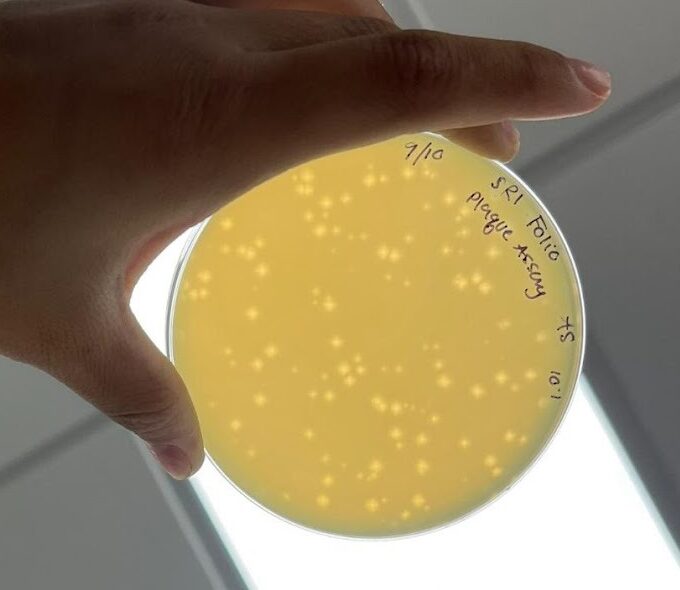
We know our phages are present when they produce plaques or clearings in a lawn of bacteria. Each plaque represents a region where a phage has repeatedly infected a bacterial cell, made lots of copies of itself, and killed the bacteria, releasing more phages to kill neighboring bacteria. You can see 80-100 plaques on the plate below caused by phage Exploradora (named by Adriana after Dora the Explorer).
While seeing plaques is reason for celebration in the laboratory and students have seen pictures of phages online, there is something special about seeing a phage you or your students discovered for the first time microscopically.
Phages are too small to see using a light microscope. The wavelength of light is the limiting factor. Instead, we must use electron microscopy where the wavelength of electrons offers a much smaller resolution.
To prepare for our trips to UMKC Dental School, we took a drop of a solution that contained millions of phages per drop and floated small grids, like the one in the picture below, on the drops. We floated the grids on drops of additional solutions to wash and stain the phages.
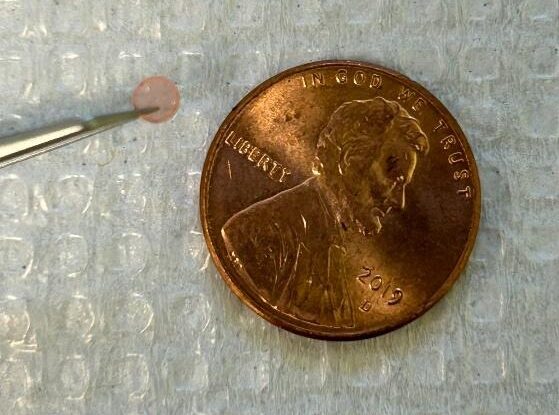
We drove the grids to Kansas City, took the streetcar to the Dental School, watched as Dr. Zhao loaded the grids into the electron microscope, and gazed expectantly at the screen with our fingers crossed.
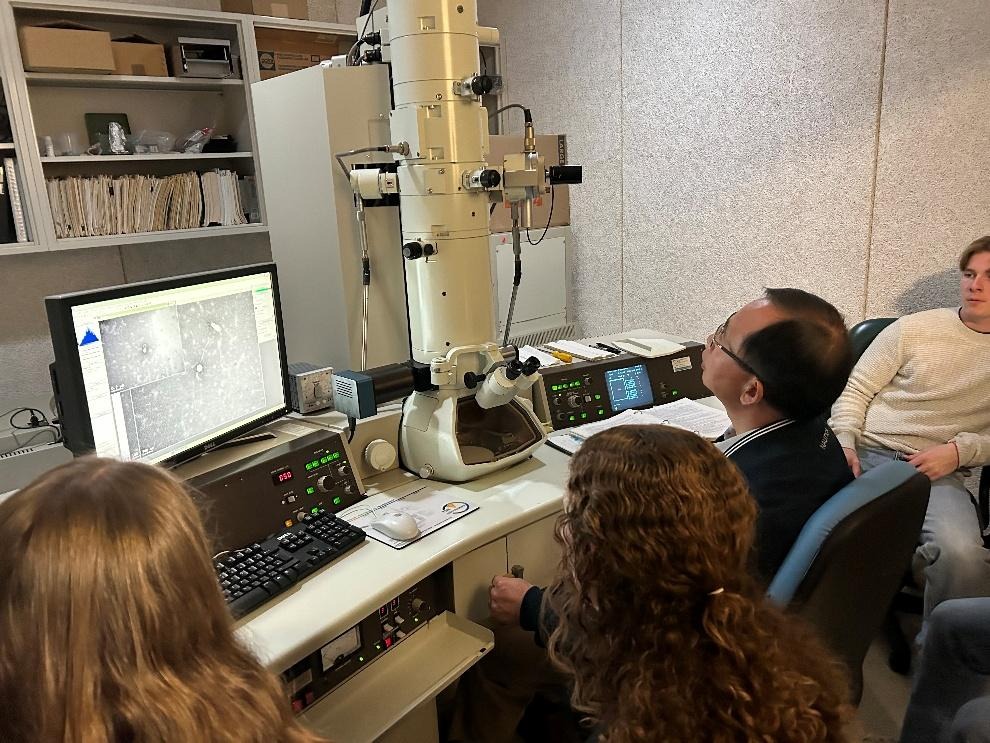
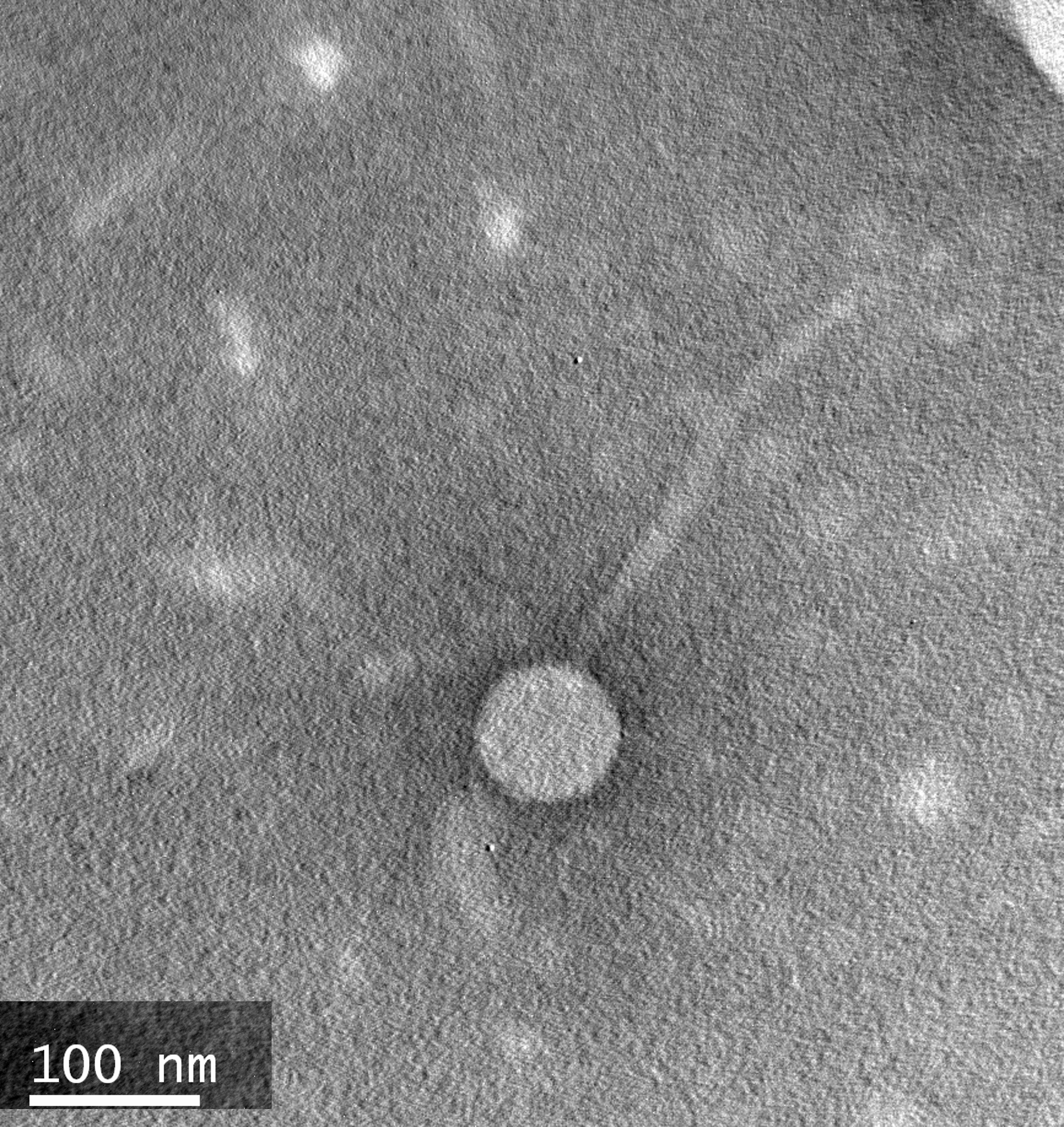
When we saw a perfect phage head with a beautiful tail appear on the screen, it was magical. We were the first humans to ever see these phages! You can see an example in the picture below. This is phage A3Wally, discovered by Abigail (named for the first letter in her name, her third attempt at finding a phage, and the fact that the soil it was isolated from was collected outside a Walmart). Its head is icosahedral-shaped and its long, elegant tail is pointing toward 1:00.
Spending so much time viewing these tiny phages has left me thinking about all the other tiny parts of God’s beautiful Creation—things we pass by without seeing them, even though we could notice them if we looked closely enough, and things that are so small that we need an electron microscope to see them. I think about all the activity in thimble-full of soil. Bacteria are being infected and killed by phages. Some bacteria have evolved sophisticated systems of defense to protect themselves from phage infection. Some phages have acquired genes whose products help them evade those defense systems. A complicated dance, a cat and mouse game teeming in the dirt we walk on.
We are part of a Creation that is truly marvelous. Not a single piece of it is insignificant. I never take for granted the privilege it is to spend my days learning about its wonder.
And I’m reminded of Jesus’ instructions recorded in Matthew chapter 6 as part of a long list of directives that follow the Beatitudes (chapter 5).
Therefore I tell you, do not worry about your life. . . Look at the birds of the air: they neither sow nor reap nor gather into barns, and yet your heavenly Father feeds them. . . Consider the lilies of the field, how they grow; they neither toil nor spin, yet I tell you, even Solomon in all his glory was not clothed like one of these (Matthew 6:25-29).
Look at the phages of the soil. They neither invest in the stock market nor stock shelves in your grocery store, and yet your heavenly Father provides a bacterial host, proper pH, moisture, and warmth. They are not insignificant.
Therefore do not worry, saying, ‘What will we eat?’ or ‘What will we drink?’ or ‘What will we wear?’. . . But seek first the kingdom of God and his righteousness, and all these things will be given to you as well (Matthew 6:31-33).
There is plenty to worry about: the economy, us/them politics, wars around the world, neighbors who are not getting a paycheck or their SNAP benefits during the shutdown, climate change. . .the list goes on and on. But I don’t hear Jesus saying sit back, do nothing, don’t worry. Jesus says seek the kingdom of God.
That is active work. For me, it means donating more to our local food pantry when the need is greater, choosing a lifestyle that is kinder to the environment, voting, and participating in acts of redemption whenever they present themselves. It also means remembering our beautiful phages and living a life of gratitude for the small, wonders of Creation that are anything but insignificant.

11 Responses
.Very interesting. I have placed it on my bucket list for contemplating while I apply pesticides on the fields in your back yard next spring.
Another marvelous report from Sara.
“Look at the phages of the soil. They neither invest in the stock market nor stock shelves in your grocery store, and yet your heavenly Father provides a bacterial host, proper pH, moisture, and warmth. They are not insignificant.”
Beautiful! Thank you
Your detailed report makes me figuratively fall on my knees in wonder at our Creator and the mind-blowing details he built into our world. It is a masterpiece beyond our comprehension but helps to explain why all of creation is groaning for the remaking he will complete at his second coming. I wonder what the phages will be doing; will there still be bacteria?
I hope there will be bacteria, or I won’t be able to digest the bread. Even if it’s the bread of heaven.
Janice–I think there will still be bacteria. Bacteria are constantly evolving mechanisms to protect themselves from phage infections. CRISPR is one of those mechanisms! Of course, phages are evolving mechanisms to evade those defense systems too but I don’t see one “side” or the other ever wiping out all the other.
– Sara
Awesome Sara! But when you say the phages don’t “stock the shelves in your grocery store” I wonder a bit. Absent the ecology and chemistry of soil microbes, I suspect the life around us, including our food plants would be impossible.
Such a joy to read. I loved learning about phages and also about the collaboration between a professor at the dental school and undergrad students at Northwestern.
And thank you for addressing the tension between remaining joyful and addressing the injustice all around us.
Sara, i enjoyed hearing you speak at Covenant last evening. I will admit I do glorify God a bit more for the immensity of our Creation but I should also glorify God for the creation too small to see. Thank you for opening my eyes.
Thank you for expanding and enriching “How great thou art” next time I sing that awe-filling hymn of faith!
Just amazing is all I have to say!! I miss this research and being at nwc with the best biology professors ever!!! 🥹