
From childhood, I heard about Christian Reformed domestic mission sites in New Mexico. Starting in the 1890s, Dutch American missionaries established mission churches, schools, and a hospital to “bring the gospel” to the Zuni and Navajo.
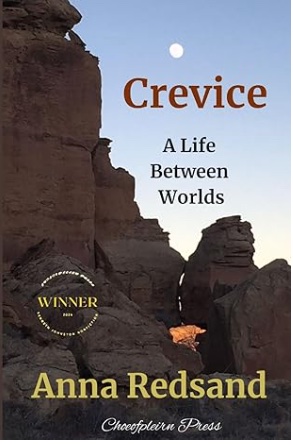
Anna Redsand’s essay collection, Crevice: A Life Between Worlds, reflects the author’s unique perspective of bridging two worlds: that of her Dutch Reformed missionary family and the Diné (Navajo) people on whose reservation land she lived. This collection is Redsand’s attempt to “know her own mind, her own experience” rather than be “an untethered astronaut, adrift in the cosmos” (p.111).
Playing with her Diné friends and attending a majority Diné school, Redsand learned a lot about this indigenous culture (the largest in the U.S.), but not as much as she could have due to government and mission language policies. Though she learned some Diné bizaad (Navajo language) from her father and her playmates, the White-controlled schools she attended did not allow Diné to speak their home language. She writes, “When my Diné friends were denied their language, it was denied me, too. Government and mission policies made it so I couldn’t learn the language from my peers. When we take something from one group of people, everyone loses” (p.127).
Though as a child she considered Teec Nos Pos and other Diné communities her home, Redsand came to understand that she was really only a long-term guest. She also gradually recognized the privilege of being White. At times, her connections to money and power granted her advantages not available to Diné children—including the privilege of using her home language wherever and whenever she wanted, attending a boarding school by parental choice (not by government dictate), and living in a house with running water rather than driving miles to fill water barrels.
However, her race didn’t spare her the bullying she experienced at the hands of White students at what was then Rehoboth Mission School. It was there that she also experienced shame and punishment for a relationship begun with a Diné boy.
It’s important to note that certain assumptions, beliefs, and practices of mission efforts among the Navajo have been regretted and lamented by mission organizations. For example, Rehoboth Christian School’s 100th anniversary (2003) included “reflection, confession, and testimony.” Excerpts of remarks made then can be found here. Now, students at all grade levels can receive instruction in the Navajo language at Rehoboth. Whether such efforts are enough is a matter of debate.
One way Redsand has tried to atone for damage inflicted by her people is to help develop Diné/English bilingual education. Her biggest project was serving on a team that created a “full-day curriculum that integrated Diné tradition, language, and learning modalities as vehicles for teaching customary school subjects” (p. 141). She writes that on some level, she was trying to compensate for the sins of her parents.
Even so, I appreciate the way Redsand tries to write in balanced ways about her parents. Whereas she mourns the way her parents tried to detach Diné from their own culture in their attempt to Christianize, she appreciated the way her parents welcomed Diné into their home (unlike many other White missionaries in the area) and assisted people with basic life needs.
Still, Redsand references the crevice between her and her parents. Upon her father’s death, Redsand returned home and viewed the body. She thanked her father for his gifts to her, like teaching her to read the Diné language and to believe in a life of the spirit. But seeing his lips sewn shut by the mortician, as a lesbian woman she reflects, “He couldn’t yell at me anymore to tell me that on Judgment Day I would pray for the rocks and the mountains to fall on me” (p. 50). And whereas Redsand’s mother used her medical knowledge to assist Navajo people when needed, she voiced many negative stereotypes and clearly considered herself and her ways superior.
My favorite essay is “Some Things Were True,” where Redsand compares Diné and Bilagáana (White) beliefs and traditions surrounding the dead. Her parents often prepared Diné bodies for burial, as most Diné preferred not to be around the dead or places where they died. Redsand feels as if Whites frequently simplified and generalized what they saw as Diné’s fear of the dead. This sentence seemed particularly insightful: “Maybe missionaries had a need to see Diné beliefs and customs around death as fearful, requiring the comfort of salvation, in order to make their task essential” (p.48).
Redsand, who has read widely and traveled broadly, arrives at broad-minded conclusions, like this one: “I find it easiest to trust people who admit they have known both—the fear and the naturalness of death” (p. 49).
At times, as a child, Redsand felt guilty when she appreciated a Diné ceremony. Based on her upbringing, it felt like a betrayal of Christianity to have an “inkling that there could be more than one pathway to the Infinite” (p. 108). However, as an adult, she has explored several other religions. To her Jewish friends, she is considered a ger toshav, a “good stranger,” someone who supports Judaism without converting (p.123).
Beyond the sociological insights, I appreciated the sensory details that accompany Redsand’s accounts—descriptions of the mesas, hogans, drumbeats, ululations, and Bluebird flour. Though growing up in the crevice between two worlds, she is clearly a product of both of them. As readers, the thought-provoking journey of Crevice: A Life Between Worlds offers us much to consider.
12 Responses
I’m adding this to my list! Thank you!
Kim, I appreciate this review. I did support for a number of years a young man who went to Rehoboth. I have learned of the white Dutch people’s arrogance in the past and mourn what was done in love to the Zuni.
Would that we humans would take to heart this sentence shared: “When we take something from one group of people, everyone loses.”
Thank you Kim, for your thoughtful analysis of the value of this book. I too, will add it to my reading list.
There is great wealth to be gained by listening when experiencing a vivid and vibrant culture that is merely different than your own comfort zone.
I am grateful for the exposure Anna Redsand gives to the efforts of the CRC mission efforts in the Southwest. She is right to offer a stiff critique re attitudes, policies and habits that were wrong-headed. But she also found the grace to honor her parents, and no doubt could create a list of other honorable servants.
My wife and I arrived in the Southwest in ’68, fresh out of Calvin, to teach at Ft. Wingate. Four years later we moved to Rehoboth for a decade, and then returned in 2000 for nine more years. We were products of the 60’s, and times “Ronthey were achangin.” I could make my own list of substantial changes made, though change rarely happens quickly. But RCS is a very different from its first six decades.
Anna’s inclusion of the 2003 Statement(s) enables one to catch the tone and direction of what was underway and continues to this day. For those interested in digging deeper, the link that
Kim Van Ess included in her fine review, is a convenient start. It helps one grasp the complexity of cross-cultural ministry.
Those who enjoyed this book may like Anna’s To Drink From the Silver Cup as well.
Thank you for mentioning To Drink from the Silver Cup, Ann.
I appreciate the dialogue and the author’s perspective. Thanks for sharing this, Kim.
It seems to me that what distinguishes a healthy missional initiative is a deep, intentional, ongoing sense of humility toward the prevailing narrative. An apology of some kind inevitably results and listening never grows old. Blind zeal can be just as destructive as neglect, but neither is one of our options. Kudos to Rehoboth leaders for facing up to the past and rebooting, but not giving up.
My father grew up with Anna in Shiprock. I’m sad that I haven’t yet had the chance to meet her at one of our author open houses in Grand Rapids.
Hi Scott, if you contact me through my website, www.https://annaredsand.com/contact, the next time I do a book talk in Grand Rapids (hopefully sometime this spring), I will make sure you know about it/them. I’d enjoy meeting you.
My family and I arrived at Rehoboth seven years ago, and it has been a place of incredible welcome and healing for us. As the school’s current executive director, I’m always excited to see writing that brings attention to the important, ongoing work we are doing. Anna Redsand’s words will serve as a great reminder of the dangers of bringing an ethnocentric attitude to cross cultural missions. It’s a daily challenge for us to commit to listen more than we speak and to hold a posture of learning rather than arrogant assumptions of superiority. Of course, all Kingdom work demands the same ongoing commitment.
I’m proud of the way Rehoboth has made progress while still recognizing we are far from perfect. For a chance to learn more about our area, the people we serve, and our mission, we invite you to visit or volunteer as an individual, a family, or a group. You can find more information at http://www.rcsnm.org.
Thank you for all the thoughtful responses to this review. I’m grateful for the rich dialogue made possible by the Reformed Journal.