
In nearly 40 years of preaching, I’m almost certain that I never uttered the word “sovereignty” in a sermon. Probably not in worship at all.
I know it’s considered a linchpin of the Reformed tradition. It’s not exactly that I deny the doctrine of God’s sovereignty. After all, God’s sovereignty is a bit like Neil deGrasse Tyson’s words about science, “It doesn’t really matter if you believe in it. It’s true anyway.”
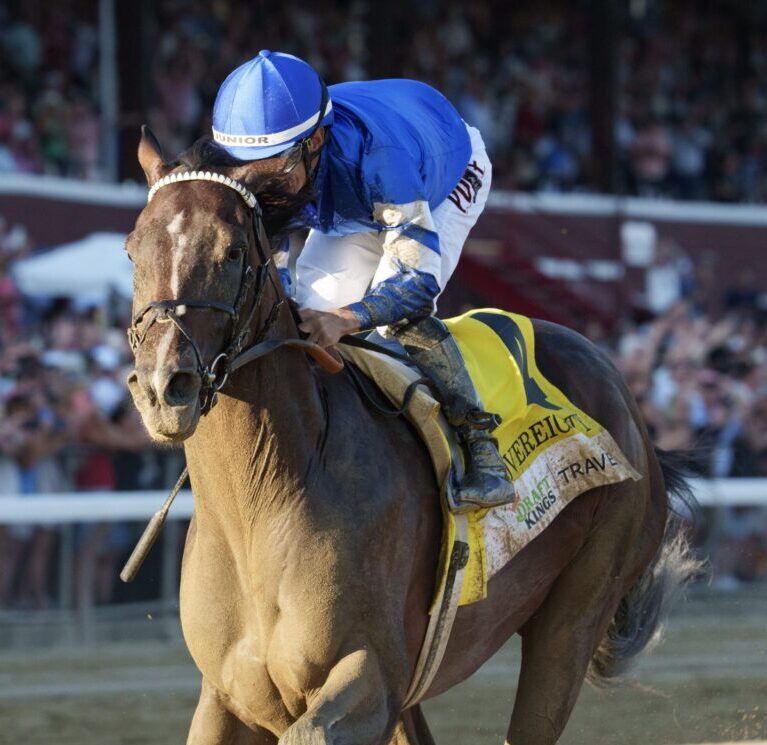
winner of the Kentucky Derby & Belmont Stakes, 2025
Some of my avoidance of the word simply has to do with its general unfamiliarity. I’d contend that most people can’t really explain what it means or use it coherently in a sentence. It comes up now and then when international disputes are in the news — “Venezuelan sovereignty.” And he was the winning horse at last year’s Kentucky Derby.
When sovereignty is used in church it is typically code for a God who is distant, enigmatic, and unaccountable. It’s somewhat like “omnipotent,” a big word, owing more to philosophy than Scripture. It makes us feel good — reverent and intelligent — to say it of God, more than it draws us toward that God.
Most people, I believe, hear sovereignty as the polite and Christian way to convey that God is basically a cold-hearted bastard. It’s the reason people at a funeral visitation say to parents who have lost a child, “God’s ways are mysterious, but they are for our good.” A sovereign God is the kind who kills Uzzah, the man who accidentally touched the ark of the covenant while moving it, or who says, “Jacob have I loved and Esau have I hated.” God can be mean and inscrutable and capricious. And we have no recourse, no right to complain or protest. Only to knuckle under.
Okay, there are a few folks, theological connoisseurs, the sort who read the Reformed Journal, who may have a different view of God’s sovereignty. They have moved beyond the cruel and impetuous God to seeing God’s sovereignty as beautiful, humbling, and hopeful. They find comfort in God’s control of all things. They dare to lament, sometimes even shake their fists at this volatile, fickle God. Still, they are a small sliver of Christians, let alone the general population. And I’m not really able to explain why these chosen few are able to accept God’s sovereignty as a good thing, not something to dread.
Then there’s Jesus. Sovereignty doesn’t seem to be a big concern or attribute of Jesus. Instead, the Messiah shows us a patient, understanding, near-at-hand, and merciful God. A God willing to go the extra mile, rather than abruptly punish or inexplicably turn away.
Of course, the connoisseurs among us will know all of this is more than a bit overdrawn. The Jesus who curses an out-of-season fig tree, tells us to hate our parents, and compares a Canaanite woman to a dog is pretty puzzling, even harsh. Moreover, drawing a vast contrast between Jesus and the God of the Old Testament is almost always a cheap, dangerous move. Finally, healings, calming a storm, certainly exorcisms, and most of all, resurrection, display an incredible kind of sovereignty.
Still, it’s fair to say that sovereignty is almost always expressed and experienced among us in ways that don’t feel very Jesus-like. Instead, talk of God’s sovereignty usually seems like something of a brush back, a warning shot in defense of God’s honor. A lowering of the boom when our questioning and disappointment with God seem too cheeky. Do not tread there!
Sovereignty is most often a word thundered from pulpits by boisterous preachers, supposedly to comfort us. In fact it crushes us, maybe even shames us. Hoping to sound like the voice of God out of the whirlwind, such preachers instead come off like one of Job’s yapping friends. Or sadly, sometimes it is a word whimpered through tears by those who have been crushed. Now, with nowhere to turn, they are trying to accept it reverently, humbly.
There you have it: My complaint against God’s sovereignty, as I most often hear it. Tell me it is oversimplified and unfair. Maybe. But you won’t change my mind. Instead, I am now going to share the story of how I made peace-of-a-sort with sovereignty, possibly almost recovered it as comforting and hopeful, especially in this time when the United States is ruled by unvarnished cruelty, corruption, and racism, a time when God’s sovereignty might seem in doubt, but perhaps when we, or at least I, need it most
*****
It began on a weekend last spring, and then, some days later, while listening to some good music.

That Friday night, Nadia Bolz-Weber brought her “Red-State Revival” to Des Moines. (Len Vander Zee already provided a very good account of a “Red State Revival,” this time in Grand Rapids.) Nadia is a wise woman, savvy preacher, and faithful Christian. Intentionally going to beleaguered believers in red states, she demonstrated an incredible understanding of what lifts our spirits and builds community. Personal stories. Testimonies. Singing. Familiar, comforting songs. Laughing. Sharing our own experiences. Not talking too long. And the gospel of Jesus Christ.
There also was more than a little self-deprecating humor and poking fun at the platitudes and peculiarities of “progressive” Christians. In other words, she didn’t try to generate unity through clichéd attacks on the other side.
Near the end, Nadia said something like “This is where I’m supposed to issue a ‘call to action.’ You know what I mean? We liberals love calls to action — some fiery appeal to get out there and do something. Go change the world! It makes us feel empowered. Like we’re going to do something. Even though we know we won’t really do it and then we’ll all feel guilty.” We chuckled knowingly.
*****
The following Saturday morning found Sophie and me and probably 8,000 other people gathered at Cowles Commons in downtown Des Moines for a march to Iowa’s capitol building, protesting anything and everything Donald Trump.
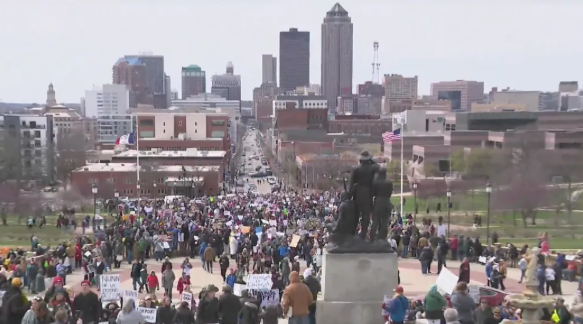
It was a festive atmosphere. The cleverness and humor of the homemade signs conveyed the pent up frustration people were carrying. There was a sweet bonhomie among the protesters, especially as we marched up Grand Avenue to the capitol. Children and dogs were everywhere. People made up solemn chants and silly songs. “Donnie and Putin sittin’ in a tree. K-I-S-S-I-N-G!”
It was during Eastertide and I thought of the words of Dorothy Sölle that solidarity is a sign, a token, of Christ’s resurrection.
When we arrived at the capitol, things went downhill. There was the all-too-predictable buzzy and unpowered sound system. The roster of speakers was too long and all of them needed some lessons from Nadia. They weren’t compelling or winsome. Mainly they were angry and haranguing — understandable, but still. Often their biggest reactions came when they dropped the F-bomb, repeatedly. There was no vision, no hopefulness. Mainly snarkiness. Was there nowhere to be found in all of Des Moines, some golden-throated orator who could lift us and make us soar? Why not have us sing together?
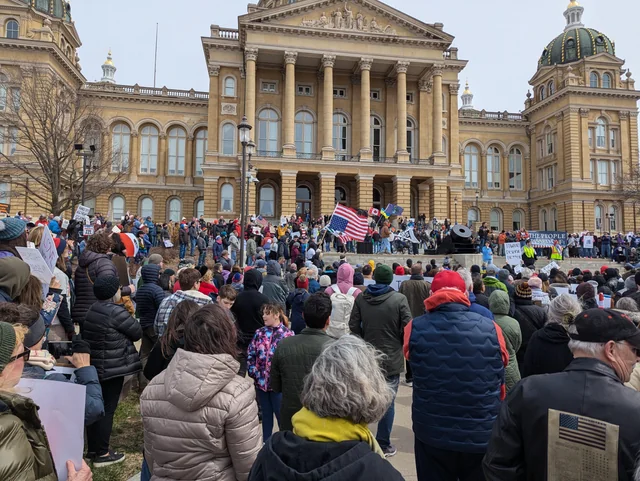
And as Nadia had predicted the night before, there were several “calls to action.” They did raise the energy level somewhat. Would we do what we were called on to do? Could we? Did my hope really reside with these people, as creative and charitable as they seemed? I wasn’t convinced.
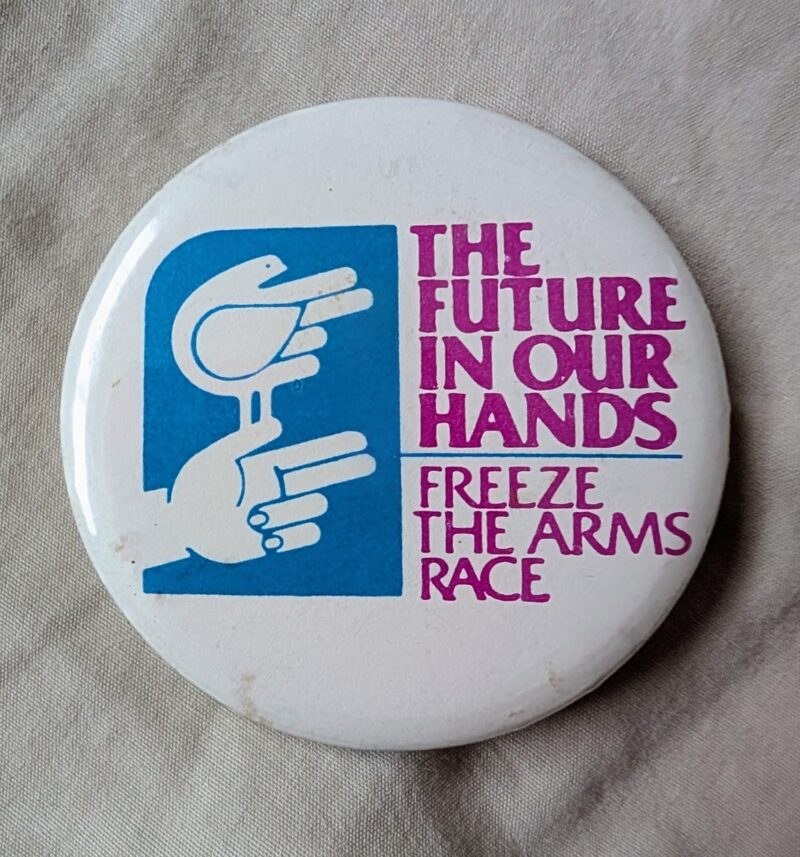
As I pondered my discontent, I remembered a protest I had attended more than 40 years earlier. A few readers will recall the “nuclear freeze” movement of the early 1980s when Ronald Reagan was stoking up the arms race with the Soviet Union. One of the speakers that day forever gained my respect when he said, “I see the banners all around and I know one of the slogans today is ‘The future, in our hands.’ As a follower of Jesus Christ, I don’t quite believe the future is in our hands. The future is in God’s hands. And that’s good news. God’s loving hands.” There wasn’t applause, nor booing. It probably was baffling, unintelligible to most there. But in a way, wasn’t it truly a statement about God’s sovereignty? This was a hopeful sovereignty. A sovereignty I could affirm. It brought buoyancy, somehow, when things seemed to be sinking fast.
*****
Maybe a week after the Des Moines rally, I was listening to the music of a group called Bi-Frost Arts. I wish I could share a “and then, when they sang this, everything clicked” moment, but my listening experience did not include a dramatic, Damascus-road event. It was more of a quiet, deep saturation.
I believe I was introduced to Bi-Frost Arts by the Almighty Algorithm. After listening to the more well-known The Porter’s Gate, I presumably was sent to Bi-Frost Arts. From what I can tell, Bi-Frost Arts could almost be an earlier iteration of The Porter’s Gate, a rotating ensemble of musicians producing beautiful, thoughtful Christian music. Should I call it “folk”?
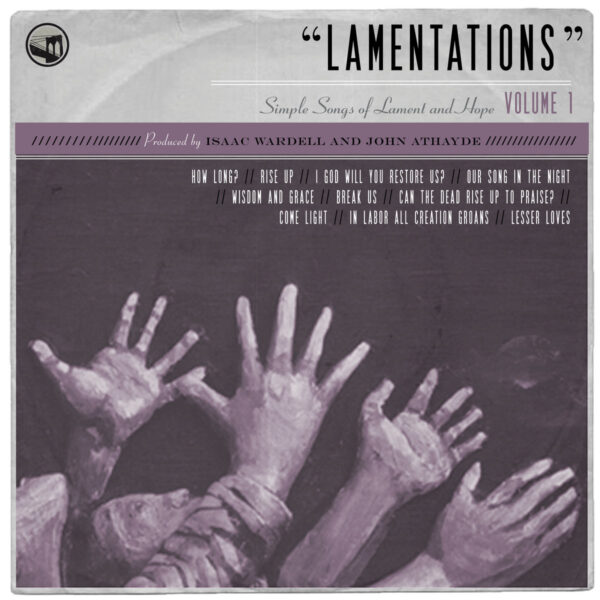
It’s Bi-Frost Arts lyrics that connect with me. I describe them as somewhat Old Testament-ish. I mean that positively. They are rooted in a deep trust in the Lord, a rich, mature connection with scripture and God. The album I was listening to is called Lamentions: Simple Songs of Lament and Hope. I’d listened to it before. And have many times since. Its tone is more melancholy than tormented, with a sense of calm and strong forbearance in the ways of God.
Somewhere I have received the impression that Bi-Frost Arts originally had some ties to the Presbyterian Church in America (PCA) — although I may be wrong. The PCA is a pretty bristling, conservative group. I hear in Bi-Frost Arts a harder-edged Calvinism than I subscribe to. There can be something unflinching and stout in their lyrics. The griminess of our world and ourselves are not dismissed. It seems like there is more willingness to sing of God’s judgement, even vengeance, or actually, I suppose, God’s sovereignty! Don’t over-read those last sentences. It’s not like Br-Frost Arts is wreaking the wrath of a fearsome God. They simply might simply be a notch or two closer to that than I am.
And maybe that’s what I needed. As I finished listening to the album, the word that came to mind was “resolute.” I felt resolute. Nourished. Fortified. Steady. Still sad and concerned, but less afraid. Stronger but not necessarily more hopeful, at least not in the near term. I wondered if they had in some way, redeemed for me, God’s sovereignty.
*****
I have not been especially comforted by the “pendulum swings” voices I have heard as we endure the Trump regime. This is the contention that Western, liberal democracy has an innate self-correcting mechanism. The pendulum will swing back. We may wish this will be true, but I’m more fearful of the contention that Western, liberal democracy was the fruit of a certain historical epoch, an epoch that is now closing and with it democracy as we know it.
I need help to be resolute and steadfast. I need grounding in something more than democracy, constitutions, the rule of law, human rights, or even “calls to action.”

Democracy may end. Freedom of speech, too. I don’t mean to sound flippant. It’s terrifying. Jesus often warns us that cataclysm isn’t as far off as our privileged lives might lull us into thinking. Millions of Christians have lived under vicious and unjust regimes — Domitian to Stalin, Leopold to Pinochet. Millions today still don’t know freedom of speech or religion. They persist and are faithful. Again, this sounds cavalier, I realize. That’s not my intention. And I’m not wanting to be a prophet of doom.
We come back to sovereignty. I still don’t plan to use the word frequently, or ever. But God’s faithfulness and relentlessness seem like near synonyms. Can I hang on to a longsuffering hope in a steadfast and loving God? I believe so. A quiet, patient assurance that in the resurrection of Jesus Christ, God’s ways and purposes cannot ultimately be thwarted?
Yes.
This resolute trust in God’s ways, coupled with my mildly skeptical hope in progress and human capabilities, is said to cause passivity and breed resignation. Critics claim it makes us just wait and watch, hope and pray. Instead, they say, in times like this what we really need are more “calls to action,” not acquiescence. I see this in the recent attempts to recast the saying attributed to Martin Luther King, Jr.: “The arc of the moral universe is long but it bends toward justice.” Our current American calamity has provoked many concerned activists to modify it with words like, “and we have to decide to be the arc-benders.” I understand this impulse. I agree with it. Until I don’t.
I know it is not likely that some mighty arm of God will literally swoop out of the clouds to squish fascists and other evildoers, although I pray for it on occasion. And despite my doubts about “calls to action,” I’m not advocating grimly enduring authoritarian rule. I understand that God often relies on incarnate action — deeds, courage, doing. I realize that this sovereign God sometimes chooses to tiptoe through history and accomplish good via people — the goodhearted folk next to me at a protest, even the shrill and trying speakers, and most especially the Church. While this doesn’t inspire great confidence within me, it is where I am left.
I trust that “God’s sovereignty” — if that’s really what we want to call it — is somehow in and through, with and by, behind and beyond human action. And because of this, at least for now, the glow of resolute hope is warming a corner of my soul.
13 Responses
This is such a sincere and beautiful piece. It speaks to me and for me in so many ways.
You have LOTS of good words, Steve.
I hear and relate to your wrestling; something I’ve been doing myself this morning. I really like your: the word that came to mind was “resolute.” I felt resolute. Nourished. Fortified. Steady. Still sad and concerned, but less afraid.
Thank you.
I’m one of that “small sliver” who take comfort and hope from the idea of sovereignty, even though I, too, cant recall if I ever used it in a sermon (that’s 20+ years of sermons). And while all you say about the way it is construed and misconstrued is certainly true, I wonder if jetisoning it from our theological vocabulary doesn’t risk abandoning what it is that allows for the comfort and hope it can convey – the belief that in the end it is not we, but the Heart and Mind of creation who is ultimately in charge of where things are headed. It’s that belief that has sustained me in ministry and life over the years. And, frankly, it’s about the only thing allowing me to keep my sanity in these days of MAGA insanity. If God is sovereign Trump can’t be.
Seems like one of those baby and the bath water things.
Thanks, Steve! Wise, well-considered, and truly helpful words. Will be exploring Bifrost Arts.
Thanks so much for this, so well said and beautifully written. I too struggle with and take comfort in this concept. I often turn to Revelation 4,5 or Ezekiel 1,10 to remind myself (or our congregation) that God is on the throne!
And yet, I appreciate that you referenced Job, in my mind too many folks who love to talk about sovereignty, predestination, election, etc. forget the end of Job (or Jeremiah or Habakkuk) where God clearly says, “you don’t fully understand me, don’t pretend that you do!” Job’s friends could have cited prooftexts to support their arguments, so could the pharisees, as can the current folks in their tradition, and yet, Scripture would call us all to more humility and being more “resolute.”
This is so thoughtful, genuine, balanced. Thanks for articulating what many of us are feeling! I naively thought the ICE killing might be the tipping point for Trump supporters. Wrong. I no longer think an invasion of Greenland would do it. Maybe Canada? Mexico?
I share your difficulty with God’s sovereignty in the face of cruelty and injustice. It would appear that it is now the USA’s turn to suffer the humility, insecurity, and injustice that most of the world ( and some within the US ) have endured. Is this God’s punishment or is it the inevitable result of our insistent US entitlement? God has seen this play out over and over throughout history. Although Bible writers occasionally portray God as temperamental or arbitrary, similar to all other pagan gods, the overriding portrayal seems to be that of a long suffering, ultimately fair non-interventionist. We should be scratching our heads over these difficult scripture passages! Is ultimate victory not the point of the Jesus story? Or even the Abraham sacrificing Isaac story? Our God does NOT punish arbitrarily or impatiently. Nor does God require payback. Right makes might.
Thank you so much for this, Steve. I deeply appreciate that you are bearing the burden of recovering the Good News of God for us in Christ from the distortions of the Gospel which are not good, and from the “Whole Gospelers”, We have to take on all the attempts to use narrowly selective biblical readings to smuggle in our own versions of religion, moralism, and civic piety.
Thanks for this, Steve. As I read it I was reminded of a reading that was part of Augsburg University’s Advent Vespers:
“It helps, now and then, to step back and take the long view.
The Kingdom is not only beyond our efforts; it is even beyond our vision.
We accomplish in our lifetime only a fraction of the magnificent enterprise that is God’s work.
Nothing we do is complete, which is another way of saying that the kingdom always lies beyond us…
We cannot do everything, and there is a sense of liberation in realizing that. This enables us to do
something and to do it well.
It may be incomplete, but it is a beginning, a step along the way, an opportunity for the Lord’s grace to
enter and do the rest.
We may never see the end results, but that is the difference between the master builder and the worker.
We are workers, not master builders; ministers, not messiahs.
We are prophets of a future not our own.”
— Bishop Ken Untener (1937–2004)
Thank you for sharing this; along with Steve’s ruminations we feel needed companionship and support on our present journey in search of faith and hope.
Oh my. Thank you for sharing this. Yesterday, I was reading Cornelius Plantinga’s chapter, “In the Interim” in his book, Under the Wings of God, where he writes, “Could Jesus Christ appear among us in some way that our poverty stricken minds can never imagine in a scenario that would simply erase our smug confidence about where the lines of reality are drawn? [¶] If we believe in the kingdom of God we will pray and we will hope for those without much hope left. And one more thing, one more tough thing. We will work in the same direction as we hope” (64-65).
A kingdom beyond our efforts. Beyond our vision. May we work in the same direction as we hope.
I really appreciated this piece, and was struck as well by your mentioning Nadia in the title, since just before reading your good piece I had watched/listened to Nadia’s sermon of yesterday on her substack: “Phosphorescence; a Sermon For Dark Times” A rich juxtaposition! (https://substack.com/@thecorners)
Emily,
I, too, really appreciated Steve’s article. After wrestling so thoughtfully with God’s sovereignty, I especially resonate with his concluding words, “the glow of resolute hope is warming a corner of my soul.” Yesterday in worship, our pastor had an amazing sermon about how God is especially present in the darkness, and now you direct us to this amazing sermon by Nadia Bolz-Weber.
Thank you! Weeks like these, God knows, we need all the light we can find.