
On January 14, eighteen saffron-robed Buddhist monks walked through my town. We residents of Fort Mill, South Carolina—at least those who routinely access some form of social media—knew they were coming. They’d started their Walk for Peace in Fort Worth, Texas, with Washington, DC, as their ultimate destination. It was day 81 of the monks’ 2300-mile journey. They’d been averaging 20 miles a day.
Knowing I’d be one of many going to see them, I arrived two hours before the monks’ scheduled lunch stop at a canteen in a 2000-acre nature preserve. The parking lots were already full. Volunteers directed cars into pastures where horses usually grazed. Waiting for two hours in the rain made me glad I’d worn a hooded windbreaker over my puffer jacket, sweater, and turtleneck. As I walked the grounds, I saw my neighbor with her two daughters huddling under blankets as they sat in camp chairs. She’d let the girls skip school. “This is important,” she said.
A thousand people converged on the nature preserve. Hundreds more people stood along the sides of the twelve-mile route the monks walked that morning. Still more would watch them make their way to North Carolina and beyond.
As I saw the flashing blue lights of the police car escorting the monks, I felt the crowd’s energy change. People moved forward, vying for better vantage points. Eight layers of humanity stood between the monks and me. A welter of umbrellas and arms stretching to snap photos blocked my view.

I thought of Zacchaeus. Where’s a tree when you need one? But I got a glimpse of a few of the monks’ calm, bright faces. One monk with a black hoodie over his robe wore a broad grin. I wondered who gave yellow roses to the young monk bringing up the rear.
The crowd shifted as the monks entered the canteen to rest and eat. Those near the large plateglass windows could watch. Someone announced on the PA system, “See the monk touch each table. That’s a blessing.” I cringed at the idea of treating these men like zoo animals.
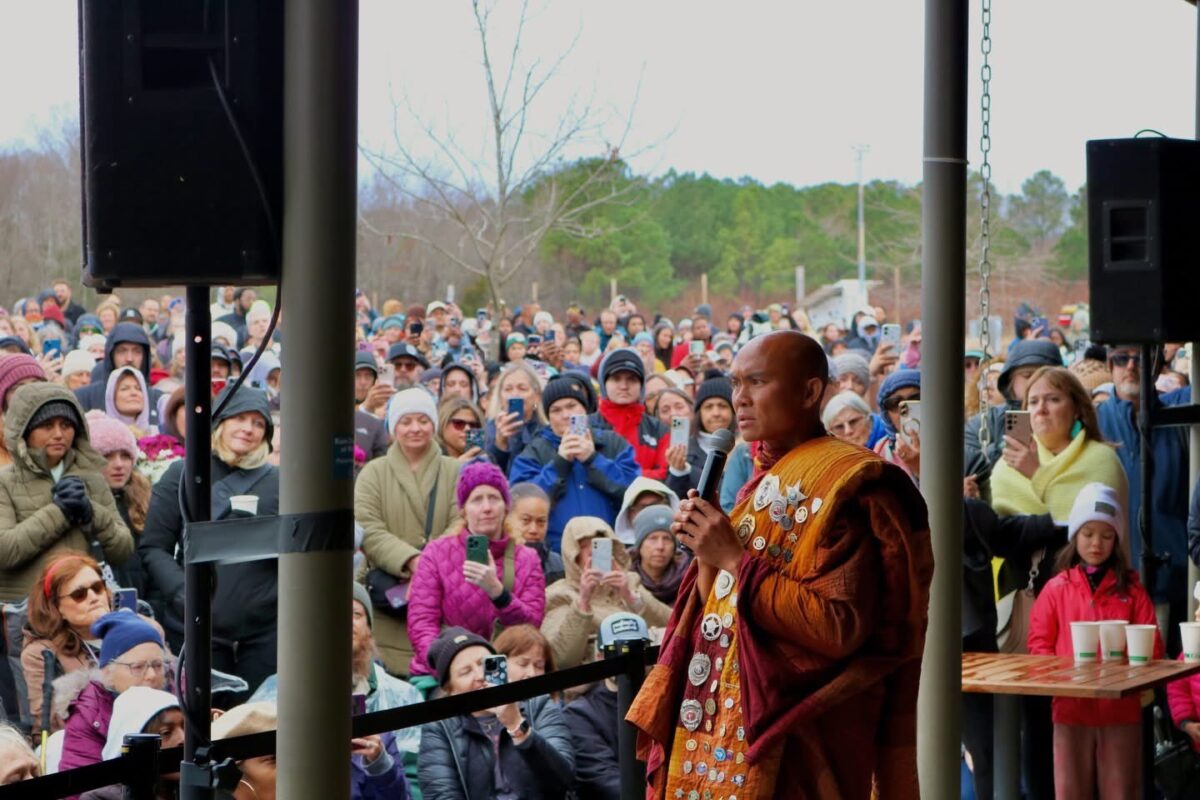
After the monks had eaten, the walk’s spiritual leader, the Venerable Bhikkhu Pannakara, gave a simple message to the throng. Peace starts with each one of us, then spreads to families, communities, and from there to the world. One minute of peace can become an hour, then a day, then a month, then a year. Stop multitasking. Be more compassionate. As the monks passed out “blessing cords” (what kids call friendship bracelets), they told people to start each day with the mantra, “Today will be my peaceful day.”
That afternoon I tried to find out why the Venerable Bhikkhu Pannakara is called venerable, and what type of Buddhism these monks practice. I found that he is vice president of the Huong Dao Vipassana Bhavana Center in Fort Worth. Vipassana meditation seeks to hone awareness of our bodily experience. By learning to pay attention to their bodies in a disciplined way, practitioners achieve embodied transcendence. This makes room for reflection and change.
I assume that these monks are meditating even as they walk. I hope that helps them through weather that would make those of us who lack embodied transcendence miserable. As I write this they are walking in midday temperatures hovering near freezing.
I am touched that one of these monks is 70 years old. I am sad to know that one monk who started this journey lost his leg in a pedestrian-vehicle accident before he’d reached the Texas-Louisiana border. I am deeply moved that men from Loas and Taiwan and Vietnam risk drawing attention to themselves in our present ICE age.
A local reporter characterized Pannakara’s response to questions about what the monks will do once they get to Washington, DC, as Forrest-Gump-ian: “‘I think I will talk to them,’ he said of the crowds there, ‘and then go home.’” The monks know that people will ask, “How can walking bring peace?” Their answer: “Everything that has ever mattered began with something impossibly small. A single seed. A first mindful breath. A quiet decision to take one step, then another.”
Not all good seed yields fruit. As a Christian, I cannot think about crowds and seeds without recalling the Parable of the Sower. The crowds that went out to see Jesus abandoned him when staying close became too costly. Whether the monks’ Walk for Peace is more than a social media fad will depend on the next steps we members of the crowd take to create a more peaceful nation and world. Thousands of people have cared enough to spend a few hours seeing monks walk through their towns and cities. Will we care enough to make that spectacle something more than cultural theatre?

7 Responses
Thank you, Caroline, for sharing this experience with us. How wonderful to wake up to this message of peace.
Hi Carol, Thank you for your in- person account of this amazing walk for peace. Ralph and I were in Florida when this happened. We would have liked to have been a witness to this action for peace. Thank you for your article. Jane and Ralph Merlo
Thank you for sharing this peaceful march. I hesitate (proud yet fearful) to share what I learned from my daughter who lives in Minneapolis. She is a Buddhist and white and brave. She and her partner have joined a group who are finding non-white people, who are afraid to go out to grocery stores and are going hungry, to buy and bring them food. Including to elementary children who go to school across the street from where she lives which is on the edge of a Somali district. She carries a whistle to warn people if necessary. Yesterday she said the air was filled with helicopters and it felt like a war zone. But she is also calm and doing what she can. She said there are pockets of violence which are shown on the news but generally people are more cautious but life seems normal in many places. Pardon my expression but seems like overkill of help(?).
This is getting way too personal for me.
She said they felt it was something small they could do.
Quote from a monk in this post. “Everything that has ever mattered began with something impossibly small. A single seed. A first mindful breath. A quiet decision to take one step, then another.”
Thank you for sharing this example of courage and compassion. So often those who are truly brave see their actions as “small” when they are huge compared with others are doing.
A great post and grateful people are appreciating what the monks are trying to do. Since Buddhism is a way of thinking and not a religion, we all should be praising them for what they are teaching. In the eighth century, Padmasambhava, the founder of Tibetan Buddhism, prophesied significant events stating, “When the iron bird flies and horses run on wheels, the Tibetan people will be scattered like ants across the world”. I think we need more monks and regular people walking for peace.
We heard a very similar call to “start something small but important” from Jamar Tisby at Hope College. I left wondering if Jesus cared more that I totally agree with all Reformed Confessions or that I care for the poor and oppressed and speak up for justice? The first requires hubris, the second requires courage.
Caroline, thank you. Simply, thank you.