
Where Do You Belong?
Several months ago, my wife and I re-watched the movie Mean Girls with our teenage daughter. Written by Tina Fey, it’s a smart, comedic window into high school life.
The film follows a character named Cady Herron, a new transfer to North Shore High whose family has recently relocated to the United States from Namibia, as she navigates social life in a different culture from her own. Her first friend is a girl named Janis, who scrawls a map of the school cafeteria on a piece of lined paper as she warns, “Where you sit in the cafeteria is crucial, because you’ve got everybody there.” As Cady scans the map, the camera pans around North Shore’s lunchroom and comes to rest, one by one, on the various social enclaves. Tellingly, the song that accompanies the scene is titled, “Where Do You Belong?”

This is the question of every human life. We ask this when we walk into a school cafeteria for the first time or move into a new apartment building. It’s asked in the crowds that fill village squares and city sidewalks. It’s asked by everyone who arrives in an unfamiliar town or a different country looking for a new start or a better life. We ask it as we find ourselves in the midst of a global displacement crisis in which more than 123 million people around the world have been forced to flee their homes because of violence, natural disaster, and economic or political upheaval. We see it on the news, as the conflict over immigration policy and our treatment of migrants, turns overheated and violent. Where do I belong?
Welcoming the Stranger
I think that one ancient practice we Christians urgently need to recover in our time, so poisoned with alienation and hostility, is hospitality.

The late Catholic priest and spiritual writer Henri Nouwen, in his book Reaching Out, names the transformation from hostility to hospitality as one of the fundamental movements of the spiritual life:
In our world full of strangers, estranged from their own past, culture and country, from their neighbors, friends and family, from their deepest self and their God, we witness a painful search for a hospitable place where life can be lived without fear and where community can be found. Although many, we might say even most, strangers in this world become easily the victim of fearful hostility, it is possible… for Christians to offer an open and hospitable space where strangers cast off their strangeness and become our fellow human beings.
We associate hospitality with the stuffy dinner party that perhaps your parents once threw, served with the silverware that rarely leaves its cabinet in the dining room, convened with people they want to impress but don’t actually like. Or, we may think of the “hospitality industry”: hotel chains and restaurants, tours and resorts.
In reality, hospitality is at the heartbeat of biblical faith.
In the extended sermon that comprises the book of Deuteronomy, Moses commands the people of God to practice hospitality, and roots it both in our story and God’s character: “For the LORD your God. . . loves the strangers, providing them with food and clothing. You shall also love the stranger, for you were strangers in the land of Egypt.” (Deuteronomy 10.17-19) God’s people welcome strangers, in other words, because we were strangers and God loved and welcomed us. We love strangers because the God of gods, the Lord of lords, loves strangers. Hospitality is at the heart of who God is, and what God does.
In the New Testament, Jesus’ life and ministry was defined by hospitality. This is why the scholar Robert Karris quips that in the Gospel according to Luke, Jesus is pretty much always headed to a meal, at a meal, or coming from a meal. St. Paul actually names hospitality as a qualifying character quality for leadership in the church (1 Timothy 3.2).
So, I wonder, what might it look like for Christians, in this hostile time, to live the hospitality of Father, Son, and Spirit?
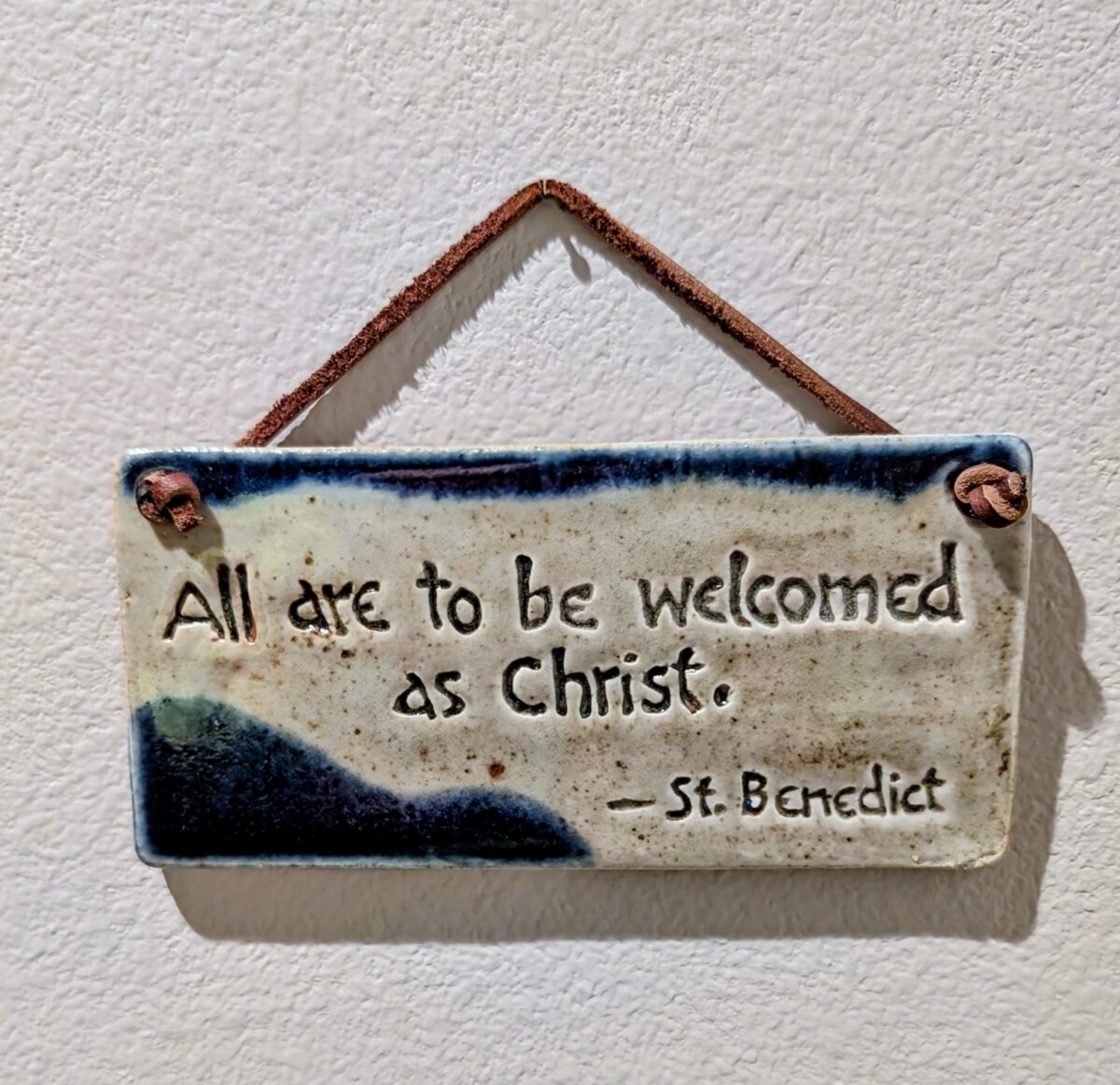
One of the facets of biblical hospitality I find fascinating is its unassuming transcendence. Scripture insists, again and again, that when we open our door to strangers, God turns up. Abraham plays host to God and God’s messengers (Genesis 18.1-15). Sitting on the slope of the Mount of Olives, Jesus teaches his disciples that when we do — or don’t — feed, clothe, visit, heal, and welcome others, we are — or aren’t — doing those things to the Lord himself (Matthew 25.31-46). And the book of Hebrews reminds, “Do not neglect to show hospitality to strangers, for by doing that some have entertained angels without knowing it.”
I don’t pretend to be an expert on conflict resolution, immigration policy, or global humanitarian crises. But I do want to meet God. I do want to welcome Christ. So I think the Egyptian monastic Brother Jeremiah has the right idea: “We always treat strangers as angels — just in case.”.

6 Responses
Thanks Jared,
What haunts me most, and breaks my heart, is how un-Christian, how anti-Christian, this immigration “crisis” is. Jesus 2026 would have an immigration parable for us, no doubt.
This is, perhaps, delusionally optimistic, but since our political system actually benefits from polarizing, distorting, and inciting, a council of church leaders must rise up and draft/propose a balanced, compromised, imperfect immigration policy that moves us away from intentional misinformation and towards resolution. (Models are out there now.) A lot of us are looking for something constructive and hopeful to get behind. A petition with 100 million signatures before midterms maybe?
Thanks for this wonderful reminder of the command to show hospitality. It is too bad that many Christians beleive that most of the undocumented people here are criminals, rather than just seeing them as human beings created in the image of God and in need of hospitality and care. I’m thankful for the people in Minnesota who are out standing up for their neighbors, even singing songs to them as they walk in the streets to let the people in thier houses know that they are loved and cared about.
This is a timely piece. Keep writing to your legislators voicing your objection to your tax money being used to racialize, criminalize, and brutalize immigrants both legal and illegal.
At the main entry to the United States stands the Statue of Liberty.
Its words of welcome inscribed on a plaque in its pedestal to hopeful immigrants and stricken refugees have not changed since 1886:
“Give me your tired, your poor, / Your huddled masses yearning to breathe free, / The wretched refuse of your teeming shore. / Send these, the homeless, tempest-tost to me, / I lift my lamp beside the golden door!”
I’m afraid these United States are now turning these words of hospitality into a mockery.
I have long loved Henri Nouwen’s book “Reaching Out.” He talks about hospitality in various spheres of life, including in the classroom. When I taught languages at Calvin years ago, I always included some of his wisdom in stating my attendance policy. I stressed that when students were absent, it was not only that they were missing important class material and interactions, but also that our community of learners in that classroom was missing THEIR presence and participation; we were a learning community together and all of us were important parts of that group.
Thanks. In extremely aphoristic style, I’d say that hospitality is the practical correlate (or the praxis, if you like) of salvation. Thus, far more significant than kind treatment of strangers or visitors or immigrants.