
Editor’s Note: Recently, when faith leaders from around the United States came to the Twin Cities of Minneapolis and St. Paul to protest the activities of ICE, they met first at Sarah Brouwer’s church for training and organization. Sarah shares a bit of what it’s like on the ground in Minneapolis, how her background led her stand up and speak out against ICE, and a brief theological reflection on what’s happening in Minnesota.
ICE Agents have been occupying my state for over sixty days. I’ve been to the sites where my neighbors Renee Good and Alex Pretti were shot and killed by their own government, here under the guise of removing “dangerous immigrants” (I refuse to use their dehumanizing terminology). My kids’ school went into lockdown because of ICE presence. I’ve witnessed ICE at my kids’ bus stop twice, once when they were detaining two of my neighbors. I can’t even write about all of the horror stories I’ve experienced and heard because it would put real human beings and families at risk of being torn apart or killed. The Trump Administration and all of their cronies in government are perpetuating violence and hatred, lawlessness and evil against their own people – immigrant and citizen and everyone in between.
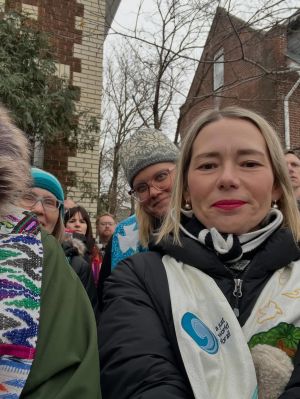
I’ve always felt a fiery spirit in my body. There’s been an awareness and stirring in my soul since I was the chubby new kid in second grade, having moved from another state. Being an outsider, even for a moment, can orient your heart and direct the posture of your life toward empathy. I was also a pastor’s kid, and being at church at least twice per week, surrounded by people who showed up simply to cherish me as they would Christ himself, was like a sacrament. I learned about who God was by growing up immersed in unconditional love, and fed at the welcome table. In life, the water can be hard to swim in, and in our culture the table can be barren, but among the strangers and neighbors the Spirit brings into our communities, we are shaped and molded into God’s people.
Twenty years ago, when I began seminary, I trusted in the promises of my childhood, and while I couldn’t have imagined where my life would lead, the same spiritual impulses continued to carry me and pique my curiosity. I’m proud of my seminary, because even though they’re not perfect, I was required to take two courses on anti-racism. One of my teachers, Vivian Jenkins-Nelson, was nineteen when her parents welcomed the Rev. Dr. Martin Luther King, Jr., into their home. Her personal story of his prophetic voice and brilliant mind stayed with me, and later I got to be one of Vivian’s pastors at Westminster Presbyterian in Minneapolis. Another one of those classes brought me to the Rainbow PUSH Coalition on the South Side of Chicago, where I met the Rev. Jesse Jackson, and heard about his work for justice. He took the time to sit with us and teach us soon-to-be clergy about the importance of not just his work, but ours. At the age of 25, I had a faint but growing awareness of our nation’s cruel past and how the faith I loved was distorted to oppress, marginalize, and kill God’s people. But I was still hopeful, because our shared faith had also guided and sustained prophets and reformers, abolitionists and resisters, and those were the shoulders of giants I wanted to stand on.
As many young people do, though, I asked probing questions. Thankfully wise folks welcomed them, and they taught me and companioned me while I wrestled to hold more dissonance. As it turns out, that is, at least in part, what it means to be a lifelong disciple of Jesus Christ – learning to hold a whole lot.
At the age of 27, my husband and I moved to St. Louis, Missouri, to serve a church as an associate pastor, and, while there, Michael Brown was killed by a police officer. I remember holding my new baby, TV on, and watching the images of Brown’s lifeless, untended body lying in the hot summer sun for hours, while his own family stood by, wanting to hold onto him. Neighbors rose up in Ferguson, and the media called it riots – but it was really just people fighting for their lives, and for their own babies. Then, a year later, we moved to Minneapolis. In 2020, we were proximate to George Floyd’s murder, and neighbors rising up, again, demanding an end to the lynching of black bodies. Amid chants of, “I can’t breathe,” we couldn’t breathe without smelling the burning gas station, or tear gas. We saw the military tanks driving down our beautiful street to “keep us safe,” but we didn’t feel an ounce of safety. Amid the chaos, though, I gained the gift of clarity – a glimpse into all that my neighbors had experienced for centuries, and what Jesus himself endured in his own life. I held onto the pain and dissonance like a blessing, still unfolding.
Since 2020, I’ve remembered the words of Bryan Stevenson, the author of Just Mercy, about his work defending wrongly convicted death row inmates. He wrote, “Proximity to the condemned and incarcerated made the question of each person’s humanity more urgent and meaningful, including my own.” In the years since, Stevenson has reminded us that proximity alone does not create justice for our neighbors, but being nearer to them, or, at the very least knowing their stories, and understanding our collective history, allows us to see one another’s humanity, and hold the dissonance of both pain and hope that another world is possible.
Jesus also had a lot to say about proximity to neighbors. In Luke 10, we hear an expert in the law ask Jesus how he gets into eternal life, and Jesus responds, “By loving God and loving our neighbors as much as we love ourselves.” The legal expert asks, “Who is my neighbor?” So, Jesus tells the parable of the Good Samaritan, and as it turns out, the person who ends up saving another’s life, isn’t really a neighbor, but a stranger – a person from Samaria who likely put their own life at risk to act more like a neighbor than anyone else.
And that’s what my neighbors are like in Minneapolis – even the ones I don’t know.
What I’ve learned from Minnesotans is that we take neighborism seriously. There is no illusion of safety here – we have realized we can’t buy it, that we have to be it for one another. And what I’ve learned from people of faith here is much the same – we can’t just talk about our faith, we have to risk it on behalf of one another. I’m reminded of the words of Aboriginal activist Lilla Watson, “If you have come here to help me you are wasting your time, but if you have come because your liberation is bound up with mine, then let us work together.” And the words of Robin Wall Kimmerer in Braiding Sweetgrass, “All flourishing is mutual.” Neighborism, faith, and liberation are reciprocal practices, and that is risky nowadays because we have a government who would rather have us hate each other.
Immigrants seeking a lawful pathway to citizenship are showing up at immigration court, and being taken by ICE on their way out. So, they don’t show up, and then they lose their status, and then they get hunted down in their homes and dragged away from their children. These are not violent criminals but people with petty misdemeanors like traffic violations, the same as I have gotten myself. It’s all a vicious cycle created intentionally, in the same way Mary and Joseph showed up in Bethlehem to “register,” then became a threat to Herod, and fled as refugees to Egypt, thanks to being tipped off by the Magi from the East who were the same kind of neighbor-strangers as the Good Samaritan.
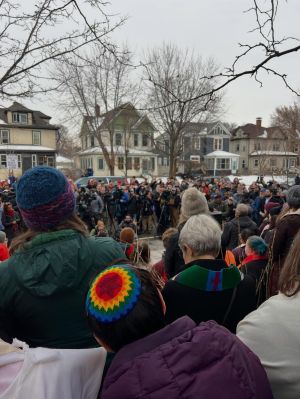
It’s all true. The story of our faith. The occupation of Minnesota. The dissonance. Sometimes I think Jesus became the Messiah because he was the only one who couldn’t look away anymore. That sentiment has been haunting me, and guiding me, and it’s the image I want to leave with you who are reading this. We need you to not look away, but to believe us in the same way you believe Jesus was betrayed by his friends, his faith, and his government, and executed on a cross as his mother wept.
We also need you to believe in the story of resurrection, which in the Greek is anastasis, or uprising. Do not look away from people of faith and goodwill, professional organizers and soccer moms, free people who refuse to live as anything else. They are quietly resurrecting networks of care and resistance the likes of which I have never seen. Stranger-neighbors on signal are saving hiding immigrants by sneaking around with food, raising thousands of dollars for rent, taking shifts to keep eyes on schools, standing outside immigrant-owned businesses, hosting impromptu vigils, babysitting kids, and more. Clergy have been quietly and feverishly organizing to meet emerging needs, placing our bodies on the line in -30 degree windchill, the same way Jesus put his body in the Jordan River at the beginning of his dangerous public ministry. Regular people are understanding sabbath in new ways, putting an end to their shopping habits and divesting from the billionaires who benefit from the work of immigrant siblings then let them disappear as though these human beings are merely pawns of the empire. And some of the people of faith I’m writing about here are not white Christians but brave Somali Muslim neighbors called “garbage” by our President. They have been leaving the safety of their homes to put fragrant sambusas in our gloved hands, feed us, and remind us we are all children of the same God. My Muslim neighbors have resurrected new faith in me, when the dissonance is more than I can bear.
Many times I have felt like Thomas in the upper room, waiting to see Jesus’ wounds before I’m willing to go outside and put my own life on the line. But, I don’t want to hold back the movement – don’t let it be me who allowed more crucifixion, and certainly don’t let it be us.
As Bishop Mariann Budde reminded us just a year ago, when she spoke up for our immigrant neighbors at Trump’s inauguration (the only person to speak such clarifying truth on that day), we can be brave. With courage we learn to hold more and more truth. Even when we see such cruelty, even when we are so disappointed in one another, even when our hearts are breaking, the vocation of people of faith is to repent and transform, die and rise, build the spiritual capacity and mental fortitude of our ancestors, so we can understand injustice, bear witness to the crises of modern life, and incarnate God’s Kin-com, come.
May we understand our calling to fulfill Jesus’ greatest commandment: to love God, and to love our neighbors as ourselves.

18 Responses
Thank you so much for highlighting the faith in action of the people in Minnesota. It’s an encouraging example for all of us. May we all do what we can to show true love and care for our neighbors. Prayers continue for the endangered and those who care for them, particularly in Minnesota.
Thank you for your honest, courageous, and clarifying commentary on what is happening in your city. Praying for a blessing on your work and on all who seek to love neighbor well. “Grant us wisdom, grant us courage, for the living of these days…”
Thank you for telling their (Minnesotans) story so vividly. I’m personally finding it hard —God help me—to keep my anger righteous.
I am so proud of the mass majority of Minnesotans, my daughter being one of them, who are living up to, according to Wikipedia “Minnesota nice, a cultural stereotype applied to the behavior of people from the U.S. state of Minnesota, implying residents are unusually courteous, reserved, and mild-mannered compared to people from other states.”
Who are fighting back with kindness in welcoming the foreigner (sanctuary state), feeding the hungry, marching peacefully in multitudes in subzero weather all while feeling they are in a war zone…as you Sarah have also just said. I just needed to add my 2cents. Thank you again for ALL you say and most importantly DO! Continued prayers for ALL. Note: I just read a beautiful prayer including for ICE on RJs Facebook page.
Thank you for your witness.
Profound that your post comes after a sermon which rattled me beyond measure yesterday on the good Samaritan. If you possessed the ears to hear what was being spoken, there was no doubt that each of us is called to put something on the line to stop the unjust actions in our communities: our bodies, our wealth, our minds, and most of all, our love. Two of the closing points were “grace is a costly demonstration of unexpected love” and “obedience is a lifestyle”. May we all do our best, as you are doing, to live this out daily. Just so there is no misunderstanding, not a political word was spoken, but the Word spoke clearly.
Thank you for your faithful actions and powerful words. I don’t know whether the person who claimed that Minneapolis had been nominated for the Nobel Peace Prize was serious, but surely those putting themselves out to be the safety that others need should be recognized, remembered, and emulated.
Thank you Sarah.
So proud to call Rev. Sarah Brouwer my pastor. Come join us on Sunday and online.
In many ways illusion is only one small step away from delusion. And delusion is dangerous. May our eyes and ears remain. open to the complexities of love … and the command to so.
Thank you for telling your story so powerfully.
Thank you Sarah. For all you are doing and for bearing witness.
Thank you for sharing the experiences you are having in Minn. Watching the new reports on TV is so difficult. Yet, experiencing it in person is so much more challenging. Keep up your good work.
Thank you for sharing your personal story and for loving and supporting your neighbors so selflessly. May your call resonate deeply and result in actions that reflect God’s Kin-dom.
Thank you for sharing this update from your part of the US.
Beautifully written. Inspiring. Do remember to love yourself as your neighbor as this is a marathon, not a sprint. You go girl.
I pray for all hearts and minds to come to the realization of the Truth! There is no other way to the Father, but by that of Christ crucified. 🙏🏼🕊️✝️🌎🌍🌏
I have noticed in the last couple of years that Minnesota nice is not as superficial as it used to be. We are neighbors and care for each other. Black, brown and white together.
Thanks so much for an inspiring article. Down the Mississippi in St. Louis, ICE is here, everywhere, not always recognizable. But they know we are here, too. Recognizable. Accountable. Strong. Unrelenting. In God’s Name.