
My daughter and son-in-law welcomed Oliver Jeffrey into the world on January 22, making me a grandmother for the first time. My husband, Jeff, and I were able to hold him when he was only two hours old.
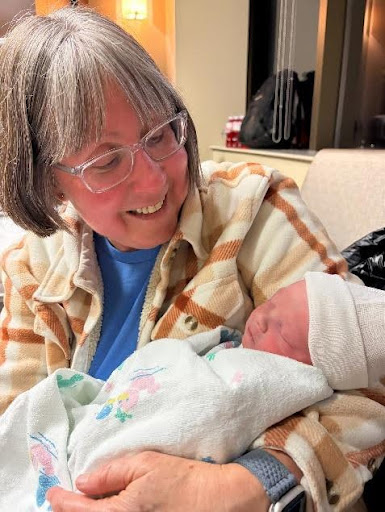
Let me tell you, I don’t think there has ever been such a beautiful baby in the history of humanity 😊! I am completely unbiased!
Jeff and I relished our time with Oliver throughout the following two days, reluctantly sharing him with his uncles and paternal grandparents. . . and his parents, of course!
Three days after he was born and we said good-bye through tears, my husband commented that the umbilical cord stretched across the generations. I don’t think he knew how spot on he was. The tie after the umbilical cord is cut goes beyond an emotional one. It’s physical too.
The word chimera is probably familiar to you from Greek mythology where it referred to the fire-breathing creature with a lion’s head, the body of a goat, and a serpent’s tail that was slain by the hero Bellerophon.
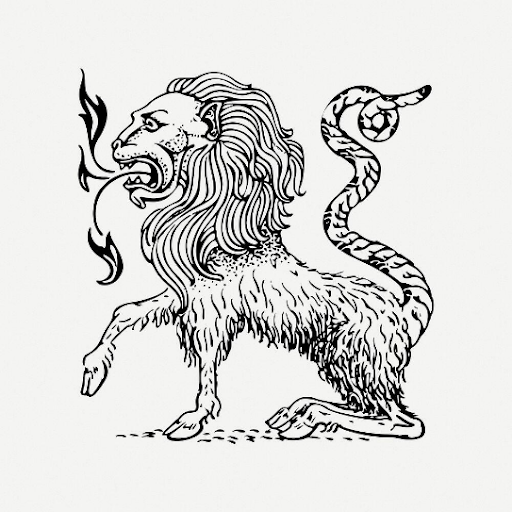
Did you know that humans are often chimeras too?
Microchimerism is defined as the presence of a small, persistent population of genetically distinct cells from one individual in another. Microchimerism can be artificial, as when a person receives an organ or tissue transplant, or natural. The most common form of natural microchimerism occurs during pregnancy, when intact, living fetal cells cross the placenta and enter the mother’s circulatory system. Scientists believe fetal microchimerism occurs during all pregnancies, that the frequency of cell transfer increases with gestational age, and that it continues through breast feeding.
Interestingly, scientists have strong evidence that the transfer of cells during pregnancy is bidirectional. Maternal cells move into the fetal circulation too, although it seems maternal microchimerism is less common than fetal microchimerism.
Some scientists suggest that cells moving across the placenta may even originally come from the fetus’ maternal grandmother or older siblings!
While microchimerism was discovered 70 years ago and the fact that it occurs is well-established, the role these alien cells play is less clear and the focus of several laboratories’ research. Research suggests that microchimeric cells have both adverse and beneficial effects.
In 2007, scientists found that maternal microchimeric cells could differentiate into functioning islet beta cells, the insulin-producing cells of the pancreas. There was some evidence that these maternal cells might be attempting to repair beta cells in children with type I diabetes.
The presence of persisting fetal cells in mothers seems to protect women from breast cancer. Although the evidence for other types of cancer is not as strong, some scientists suggest that the presence of fetal microchimeric cells might have a generally beneficial role in cancer.
Other studies found that the presence of fetal microchimeric cells may aid wound healing in women.
On the other hand, the presence of persisting fetal cells seems to increase a woman’s risk for some autoimmune disorders. Scientists wonder if this might, at least in part, explain why women are at four times the risk for autoimmune disorders compared to males.
Because microchimeric cells are found in brains, some scholars with more philosophical interests ask whether the presence of these cells requires us to reconsider our self-identity. Are we unique? Do these cells reframe how we define ourselves as humans? They even ask if the presence of microchimeric cells provides some kind of interconnected consciousness or whether the persistence of these cells blurs the line between life and death.
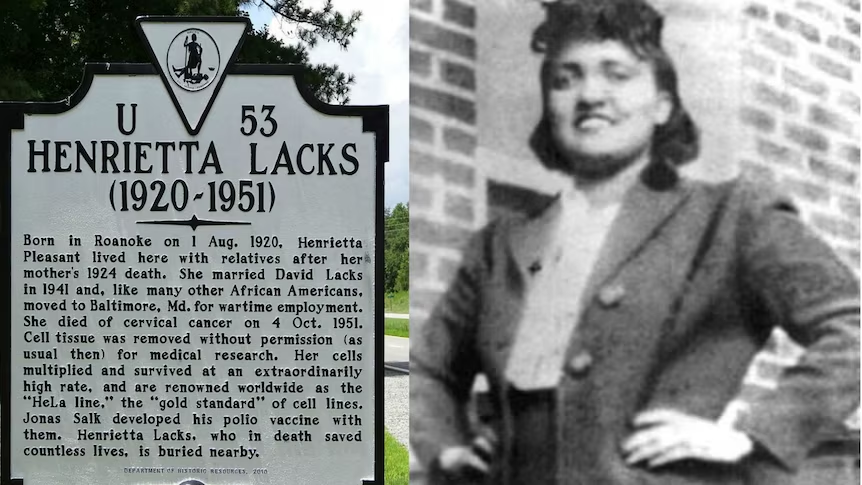
I find these questions fun to think about, but I see them as a bit of a stretch. For example, I can, and have, taken cells from a living person and cultured them in the laboratory. Their continued growth does not make a person immortal. The first human cells to be cultured in this way were HeLa cells taken from Henrietta Lacks’ cervical tumor in 1951. Ms. Lacks passed away in 1952, but her cells have been and continue to be used in laboratories across the globe. Her cells are very much “alive”, but she is not.
Instead, I see the presence of microchimeric cells as a beautiful reminder of our common humanity. These cells speak to the connections we have with our family members. My connection with my children is complex, layered, and strong. My daughter’s connection with little Oliver is already complex, layered, and strong and that connection will strengthen.
In Christ, our connections with one other extend beyond our biological relatives. We are all part of one body. Christ’s body. Our connections are complex, layered, and strong. In our deeply divided culture, we need to be reminded of these connections more than ever.
10 Responses
Thank You Sara.
Sara, thanks for reminding us of how amazing our bodies are, how much we have yet to understand, and the wonder of life!
Last month I was blessed with holding my great grand nephew Riley Crew!
Sara, I am glad you put in the line that we have to go beyond biological relatives because I love and care about my adopted son as much as I do about my biological sons. My son, David, was adopted simply because he was without a family and not because we could not have children because I did already have one son. Yes, God does wonderful things with biological ties but we are all children of God no matter where we come from. Praise the Lord for his majesty over the biological creation but also of his majesty over the heart.
I’m tearing up! By your writing on biology! And that was before the last paragraph.
On this Candlemas, the Feast of the Presentation, I’m thinking about the nursing infant Lord Jesus and his mama, the Blessed Virgin Mary and microchimerical cells.
The Lord be with you Sara, and all whom you love! Your post was moving and prophetic! I am going to send a copy to my representatives in the House and the Senate!
Thank you for immersing us in the pure joy that so many RJ readers know–the joy of holding their first grandchild for the first time. We all need a burst of joy like that! And thanks for bringing that joy full circle to the mysterious body of Christ in whom we are all one. I want to sing something!
Sara, this is so beautiful! Thank you. I, too, am tearing up reading about biology. I’m forwarding this!
Thank you Sara for this great reminder of how interconnected we are. Your reference to Henrietta Lacks brought to mind the story behind this discovery. The book, The Immortal Life of Henrietta Lacks is a reminder of a dark side of science that occurred as a part of this discovery.
Reading RJ during a break from drafting an obituary and eulogy for my recently-passed mother, 100.5 years old (she was particular about the accumulated months, as well as years), and trying to keep the must-have details of the obit apart from the stories and memories to speak well of in the eulogy. Your essay speaks strongly to my musings about ancestry and inherited or acquired characteristics, and the science overwhelms romanticized or emotionalized notions, of how nature and nurture can be entertwined, truly so. Thanks for this.