
If you live in, or at least pay attention to, the world of religion or church—as many of us in the Reformed Journal family do in some way or another—you can’t go but a day or two without encountering some kind of commentary on what currently dominates the discussion of religion and church in America: the decline of organized and institutional religion, the rise of the nones, and the perception of conservative political allegiances and Christian nationalism within religious circles and opposite views outside of it.
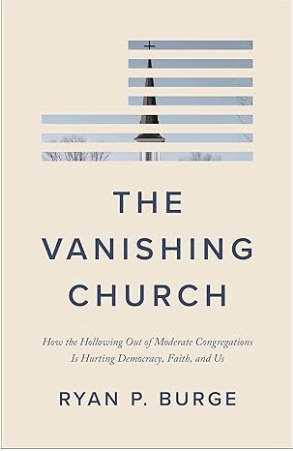
Enter Ryan Burge, a sociologist who has carved out a singular online profile (and 28,000+ Substack subscribers) as a prominent purveyor of data about religious life in America. In his new book, The Vanishing Church: How the Hollowing Out of Moderate Congregations Is Hurting Democracy, Faith, and Us, Burge goes both global and granular with the numbers—and what he’s discovered, he writes, is decidedly not good news, not just for those in the church, but also for those outside of it.
What Burge’s data shows is what almost all of us have seen experientially—the numerical decline of the church in the United States (yes, he is a U.S. sociologist, but for our friends in Canada, I know you’re experiencing this, too, though perhaps in different ways than those of us south of your border). And not just numerically but in its impact: what he calls the “hollowing out” of American religious life as a safe place to belong, even apart from, often even before believing. Forty years ago, he observes, “there was a place to feel welcomed and embraced no matter how much or how little one believed in Jesus Christ that particular Sunday—or how one cast their ballot on Election Day. But that’s no longer the case.”
With his ubiquitous charts and graphs, Burge surveys five decades of religious fracturing and polarization, focusing on evangelicals, mainline Protestants, Catholics, and the religiously unaffiliated. His conclusion is stark: “American religion has become an ‘all or none’ proposition—conservative evangelical religion or none at all.” This, then, “leaves tens of millions of theological and political moderates with no place to find community and spiritual edification, or to work collectively to solve societal problems”—the religiously homeless.
The 1990s, Burge argues, were the turning point in American religion, the decade in which the lines of participation took their most dramatic turns. For example, the “numerical peak” for evangelicals—a frequent focus of Burge in this book—was in 1993, when 3 in 10 Americans identified as evangelical. And, it was also when they were the most politically diverse and when their political affiliation was relatively evenly split between the Democratic and Republican parties. Meanwhile, the share of young people who identified as Christian declined dramatically. He writes that “between 1991 and 1998, the share of eighteen- to thirty-five-year-olds who said they had no religious affiliation went from 8.1 to 20.5 percent.” It was also the decade, Burge argues from the numbers, when “the moderation of the mainline was seen, for the first time, as a real political liability” that “pushed a growing number of Americans, especially young adults, to no longer align with any religious tradition at all.”
If you read books through your own personal lens and experience—as we all do in part—I can’t help but reflect on important debates and discussions happening in the Reformed Church in America during the 1990s. We kept insisting we were and could remain “ecumenical and evangelical.” We voted as a General Synod to send the denominational magazine to every household in the church, “a kitchen table around which we could all talk.” (Disclaimer: I was the editor of said magazine at the time). We promoted a denominational fundraiser with the theme, “We belong to God and to each other.” Here we were, driving an agenda of broad-based unity at the very time the wider church was polarizing. Were we counter-cultural in the best ways, or clearly (but not to us) riding the wrong horse?
What Burge sees in recent data is a deepening polarization with a diminishing basis in belief. For example, Americans increasingly look to their churches to affirm their political views: “There are people who have begun attending evangelical churches more for their partisan leanings than their theological views.” (Guess that will explain some things we’re currently seeing.) “Religious practice has become a thing of privilege,” he writes, as higher education and income relate to increased church attendance and religious commitment. Burge states that what is finally at stake in this changing religious landscape is nothing short of “the fate and future of American democracy.”
Having said that, his conclusion, however, is that “not all is lost.” There is a plea to recommit to and maintain a shared vision that binds the community together. Yet, even if it is precisely what our polarized debates seem to need right now, I found it to be the least compelling of what Burge offers in this book. I’m just not sure the data points that way. And it seems that for decades it hasn’t. In that, I share Burge’s lament that this current reality is indeed “hollowing out” what we might be as a culture.
Burge has written one of the most important books in our current cultural climate to understand religious decline and polarization in the U.S. Read it for yourself. Draw your own conclusions and, especially, form your own responses. For in Burge’s words, “I have never been more hopeful and more afraid for the future of the United States.”

5 Responses
Thanks Jeff—a very interesting article.
Thanks, good review! I’ve been following Burge for years and he does top-fight work (I think he’s a political scientist, not a sociologist, however).
I agree with your final point. I don’t think communities “come together” out of a commitment to togetherness or civility or because they want to be a unified community. Those things are too cold, abstract, and lack energizing power. People come together, unite, commit to one another, around more substantive entities, values, and leaders. They need a strong, captivating vision of something beyond the community to form that community.
Jeff, thanks for a solid review of an important book. I seem to see Burge’s graphs and numbers somewhere every day. As you say, they don’t paint a rosy picture for the church in the USA, especially the mainline churches. Still, I’m not distraught, perhaps because I’m now retired. As I heard 2 Corinthians read this morning, it seemed like it might apply to the mainline churches in the US. “We are treated as impostors and yet are true, as unknown and yet are well known, as dying and look–we are alive, as punished and yet not killed, as sorrowful yet always rejoicing, as poor yet making many rich, as having nothing and yet possessing everything.”
Thanks, Jeff. The data is helpful. Perhaps the culture is being hollowed out because the people are being hollowed out. If we let AI do our thinking for us, jump into a social media silo, or let our fiery rage turn our minds into ashes, we become the hollow men and women that T.S. Eliot wrote about. A good place to start and end is living in Jesus and having Jesus live in us. In place of empty philosophies and deceit (Colossians 2:8), we need the One who can fill us (Colossians 2:10).
A comment by C.S. Lewis helped me to better understand that people start to attend church for many different reasons, and when those reasons disappear, they either stay in church for different reasons, or they leave. Lewis, writing after WWII, wrote that he was not discouraged by the dramatic decline of church attendance in Britain. He wrote that most church attenders before the war were not really Christians, and the post-war decline in church attendance was merely revealing the real state of Christianity in Britain. It seems to me that we are experiencing something similar in American evangelical and ecumenical churches. I wonder if Burge would agree?