
Not long ago, I was talking with my husband, and our opinions differed on how to handle some small matter. Once, I would have been driven frantic by such a disagreement, unable to manage the hurt of feeling unheard, while my husband would have been unable to comprehend why I was so upset. But after 21 years of marriage, we’ve learned something about navigating such challenges. We could listen to each other, even if we didn’t agree, take a step back from immediate reaction, and even laugh at ourselves a little. After a pause, a new idea came up that helped bridge the distance between us. Our bond would keep evolving, stretched but not broken by our differences.
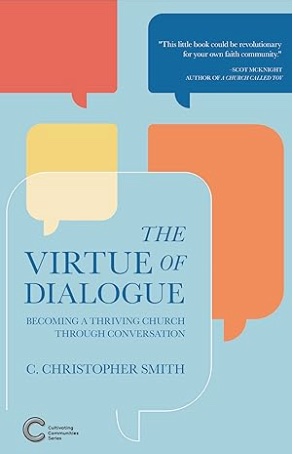
I thought about this experience as I was reading The Virtue of Dialogue, a revised and updated version of a book first published in 2012, now appearing as the second entry in the Cultivating Community series from Englewood Press. The series aims to aid the process of congregational formation, which, in some ways, is similar to building a good marriage. Both involve aligning the desires of more than one person—a messy process, as C. Christopher Smith points out in the series introduction. How can we collectively move toward the goal of becoming more like Christ, not through manipulative or authoritarian tactics, but by embodying Christ’s patience, compassion, and love? Talking to one another in a way that can carry us through periods of disagreement while we grow in understanding would seem an essential part of the process.
In this short booklet, Smith outlines the history of Englewood Christian Church in Indianapolis, where he has been a member for over 20 years. Englewood and its neighborhood have undergone significant transitions over the last several decades, and Smith observed that inaugurating a weekly congregational conversation time, undertaken when the church’s demise seemed possible, enabled remarkable developments. It has truly become a force for healing, both within the congregation and in relation to the wider community, though that took time to unfold and was not without casualties. As civil discourse seems to be breaking down everywhere, from the family dinner table to the political forum, Englewood’s story is an encouraging example of what can happen when people commit to a process of hearing one another and following through on it, despite fragmentation and conflict.
In the 1990s, when regular Sunday night conversations began, Smith says they were “extremely volatile.” People yelled at each other; some left the church. Early discussions of the nature of salvation were very divisive; merely floating the idea that “God’s work of salvation might be bigger than saving individual souls” caused dissent. But slowly, in the course of talking about truth, about the Kingdom of God, about the life of the church as described in the Epistles, those who remained were eventually able to see beyond their existing assumptions. It wasn’t a matter of reaching full agreement, but of finding a deeper sense of trust in God’s guidance and presence in all circumstances. From this root, branches extended into more conversations during the week, into working groups, practical initiatives, and business ventures. What started as a once-a-week circle of church members became something much bigger.
I found this story intriguing, but it left me wanting more. I would appreciate fuller descriptions of the conversations, with more concrete examples, perhaps actual or reconstructed dialogue from different points in the process. What did the facilitator do to shape the conversations, especially when conflict arose? How were the topics chosen? How exactly did the congregation learn to navigate tension with “patience, gentleness, and kindness”? How did they agree on the conversational norms that help keep things civil?
Perhaps there is a lack of specificity in these areas because each congregation that decides to engage in conscious conversation will have to figure them out in its own way. A helpful general principle is that of hospitality—the gesture of receiving another person as a gift. Smith writes, “Like infants who do not yet know that the parts of their body are connected and can be orchestrated to do wondrous things, many churches really do not know their own members and the manifold gifts they bring.” When we can keep in mind that our goal is for different parts of a body to know each other better and allow individual gifts to unfold, then a door of possibility opens, through which the central vision of Christian faith—“the hope of the reconciliation of all people and all creation”—may be glimpsed.
The Virtue of Dialogue is not a weighty tome of information and instruction, but a starting point for exploration. Each brief chapter is followed by discussion questions for congregations that wish to reflect on their own history and on how they might evolve forms of dialogue appropriate to their situation. Appended at the end are some sample conversation questions, Englewood’s list of conversational norms (a work in progress), and recommended reading. The booklet can be read in a couple of hours, but the work arising from it can and should last for many years.
Practicing conversation with my husband has often been messy indeed, and at times seemed on the verge of disaster, yet it has truly been an experience of formation. We are softening in some places, firming up in others, as we slowly discover what is lasting amid a process of constant change. It has given me a concrete experience of how Christ’s activity can become apparent when people are willing to lower their defenses to create space for love—surely the basis for any healthy communal life, whether it involves two people or ten thousand. As part of the Cultivating Community project, The Virtue of Dialogue can inspire congregations of all sizes and in any circumstance to consider how they might take steps in that direction, too.

2 Responses
Thanks, Lory. It’s a sign of the polarized times that even the word “dialogue” can be a conflict-creating word. For many of us Christians on the more-conservative end of the spectrum, the word dialogue often connotes “endless” talking with no resolution meant to buy time with the hope that everyone will eventually come around to the (often progressive) beliefs of the ones who want dialogue. I don’t mind the word dialogue and I think it’s important to keep talking with those you disagree with, but I can understand the frustration on the part of conservatives. When an institution is dealing with a controversial issue, those who are in the minority (whether conservative or progressive) seem to prefer dialoging so that the majority is kept from making a hard-and-fast (and objectionable) decision. Those in the majority (whether conservative or progressive) just want to make a decision. At least that’s how I’ve seen things operate.
Good points, David. You articulate how endless talking can be for many people a defense against actually having to trust in God’s guidance. For me, the strength of this booklet was how it described dialogue as not an end in itself, but a means to opening up toward necessary change while remaining grounded in that trust.