
Sunday morning coffee and I am missing church. I woke early, frogged around in the kitchen, checked backyard birds, watched the sky and neglected the time. A deadline on Tuesday and I’ve procrastinated myself into distraction, leaving work that I really should be doing over the weekend. Near daily barrages of new authoritarian wickedness and stupidity mix with necessary frustrations of a job I love and cherish. It’s not healthy, but the better question is whether it’s sustainable. The time I have and the time I need are more and more a fight to navigate competing distractions.
It blew hard on Friday, starting overnight. Rotten ice on Mendota blew apart and Friday morning greeted us happily with raucous rowdy waves piling up the dregs on the southeast shore – a dramatic change from static months-long capture of winter ice and a celebration sign of spring for a winter-wannabe sailor jonesing to step the mast and play in the wind.
Saturday was surprisingly calm given Friday’s wind and knowledge of a spirited late winter storm building over the Canadian prairies and incoming to the Great Lakes. I finished some chores and rationalized that a walk in the woods would salve my rising burn-out. I felt hopeful silliness as an adult-onset birder. I grabbed my binoculars, thinking I might find some unusual early spring migrant.
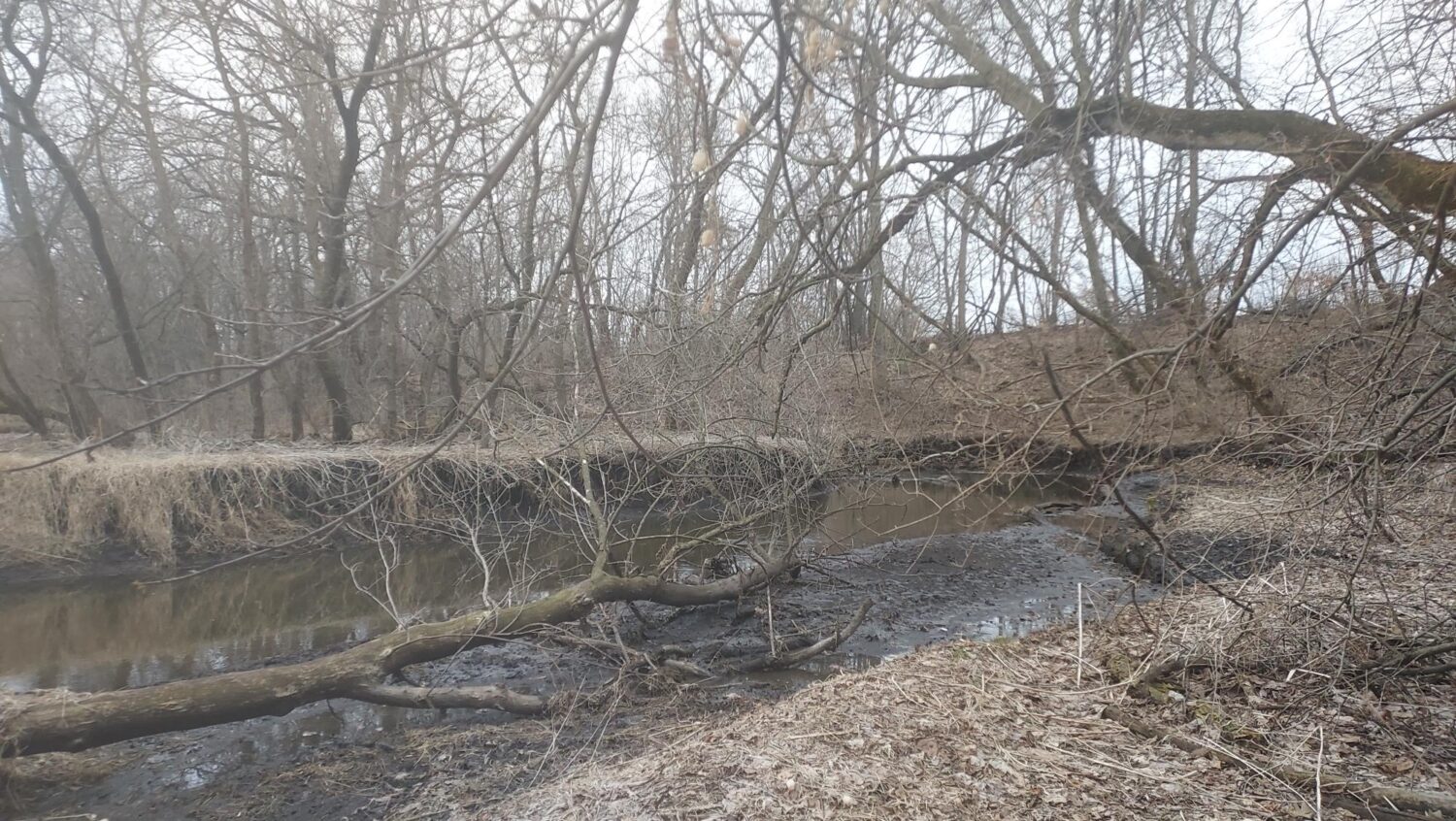
The first bird I saw beyond baseline chickadees and English sparrows was a red-bellied woodpecker. Not a migrant, but a favorite nonetheless for its colors and drama. The path followed Six Mile creek upstream and into its ravine through a familiar Midwestern mix of oaks, maples, and black cherry. Upslope, bur oaks, stalwart spreading and permanent, witness an early history of fire or pasturing but now crowded with upstarts wanting their place in the sun. Downslope in the floodplain, massive old prairie cottonwoods, bending and twisting, dance in wet-soil time.
The path, indeed the whole forest floor, was layered with last summer’s oak leaves flattened by winter into an Escher-esque repeating pattern. An abandoned toddler’s sippy cup with enough weathering to suggest that its overwinter berth was right there at the base of a sapling.
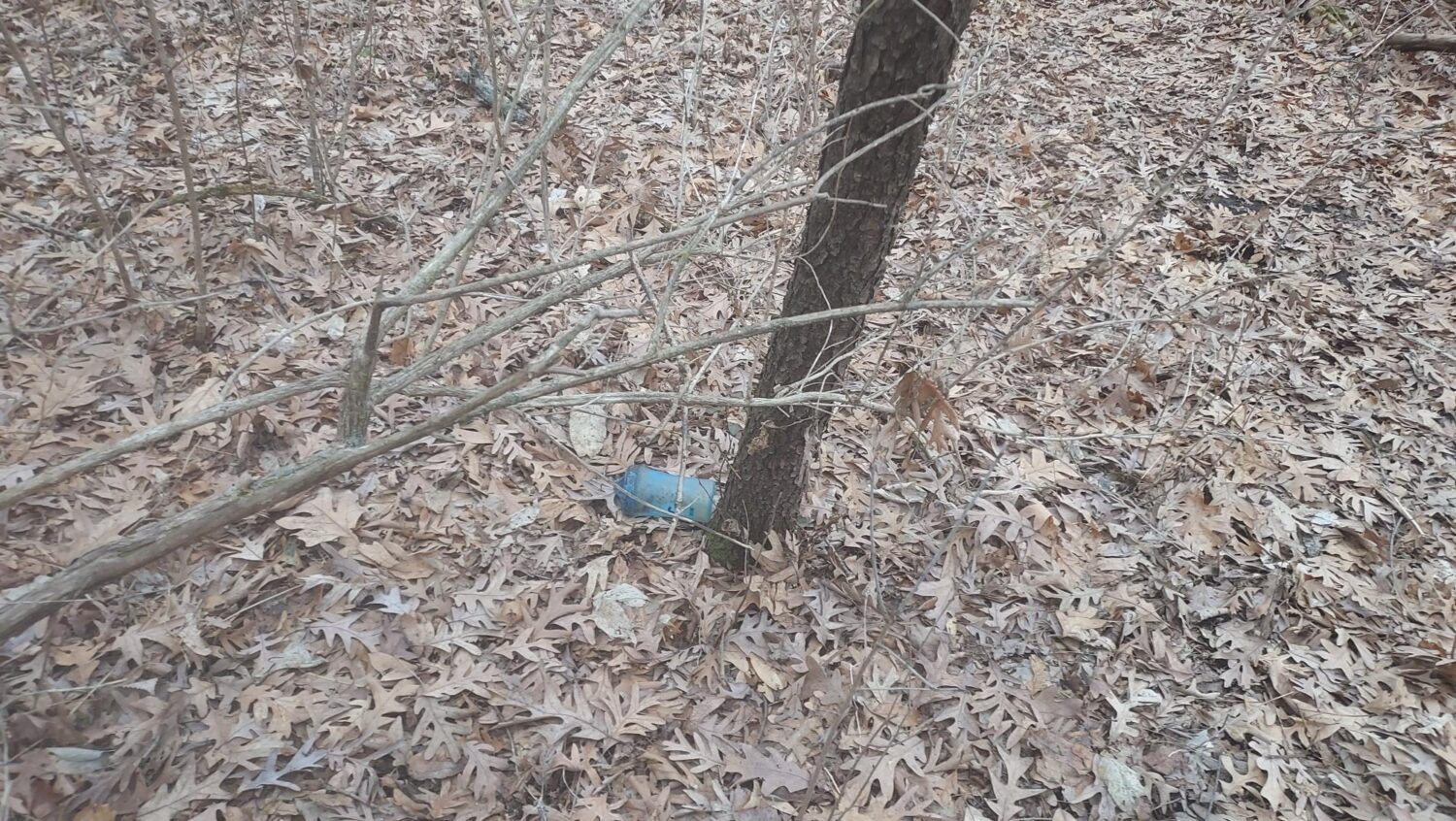
I followed the path up the edge of the ravine. Midday was raw and gray and I was underdressed despite my layers. Fingers ached in my gloves. Plants still dormant. The woods, though were alive with American robins, jockeying for position in the canopy, picking through the leaf litter, probing the muddy patch out where the cornfield edge turned a corner. It was like I had stumbled into their boisterous family cookout and I was the awkward outsider.
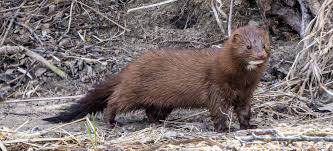
I saw movement along the creekbank and put my binoculars on it. A mink! A large one too, carrying something in its mouth, maybe a fish or a crayfish. It disappeared into a hole in the creekside rocks. I see minks pretty frequently, poking around near these local creeks. I think that’s a good thing – a healthy presence of wild predators.
At the corner, where the trail angles to the main road, I turned around to bushwack back to my entry. A tip for navigating Midwestern woods is to look up into the middle distance and to imagine the most efficient path given the terrain and vegetation. If you then go there, you will invariably find a deer trail to follow. When I do this, I often chuckle to myself that the deer are as lazy as I am – except that their energetic calculations have higher stakes. Particularly during raw March.
My navigation routed me back through a hillside of mature oaks, a stand where deer browsing and summer shade have suppressed the saplings and small woodies leaving a savanna-like open understory under large spreading mature trees. We humans find these places attractive and pleasant, so much so that we manicure our public parks, our golf courses, and our lawns to mimic them. There’s a theory that the attraction is a legacy of our earliest hominid ancestors. That we moved to the savannas when we became bipedal. That the open understory enhanced our ability to see the lion hunting us and that the big trees gave us a place to escape. I think my brain is at its most active and lucid alone in the woods. Even so, root processes are churning. I am memory, more than I may know.
I hear tapping upslope, so I head in that direction hoping to bag another of our winter woodpeckers, likely a downy or a hairy. The deer trails here are visible as paths were the winter-flattened oak leaves were disturbed by foot-dragging deer. The tapping, a Piliated woodpecker, big and bold, there in a cherry snag.
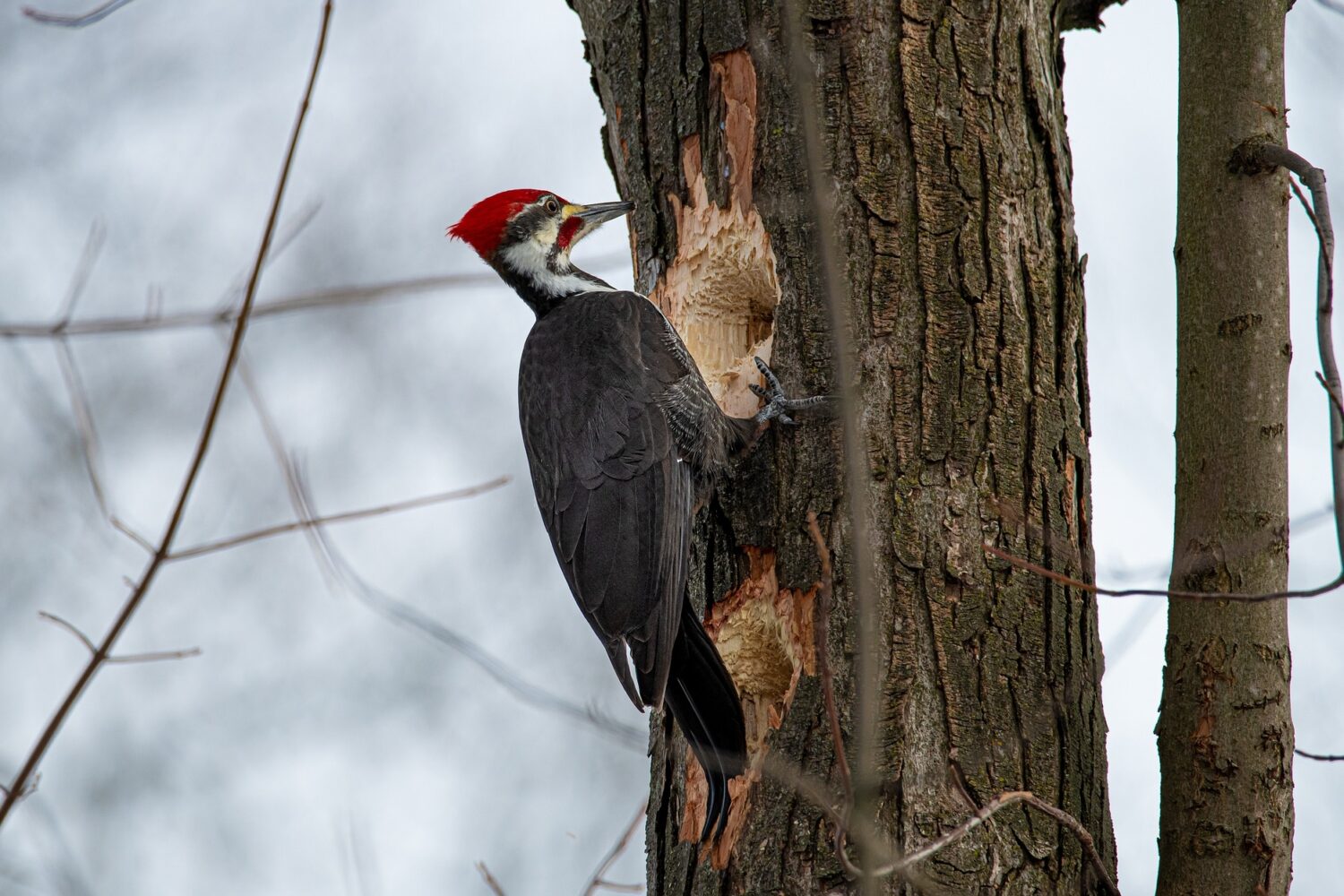
Pileated woodpecker. Oof.
I stopped. Looked again through the binocs.
Birders speak of “nemesis birds,” birds that one, by rights, should have seen given their efforts and outings, but birds that evade them nonetheless. Often frustratingly so.
I remembered a young biologist, a pure joyful soul. She had been part of our group and had done island work in the Apostles a few years back. She fought with heroic optimism against a consuming illness as her friends and co-workers enveloped her in the tenderest demonstration of the human scale of love. She was a bird nerd who, oddly enough, had never encountered a pileated woodpecker. When she relapsed, her friends (knowledgeable birders) tried to find her one on a gentle local outing. When she became bed-ridden we called the wildlife rehabbers, seeking one we could bring to her.
We failed. Her nemesis bird remained.
I remembered the upstairs bedroom in her parents’ home, the double hung windows open and airy in a Milwaukee neighborhood close enough for breezes coming in over the Big Lake. I remembered wishing I could conjure a pileated woodpecker on the sill. The last time I saw her. I remember praying with her mother in the driveway, grateful to be led by one of my grad students. I remembered the funeral mass.
I didn’t intend for this. Didn’t imagine that churning over oaks and minks and robins and woodpeckers could be so co-opted. I didn’t imagine dropping my heart to weather among the raw March oak leaves, there at the base of a cherry snag.
I navigated back to the parking lot with my day scrambled. I went home and read a remembrance I wrote at the time.
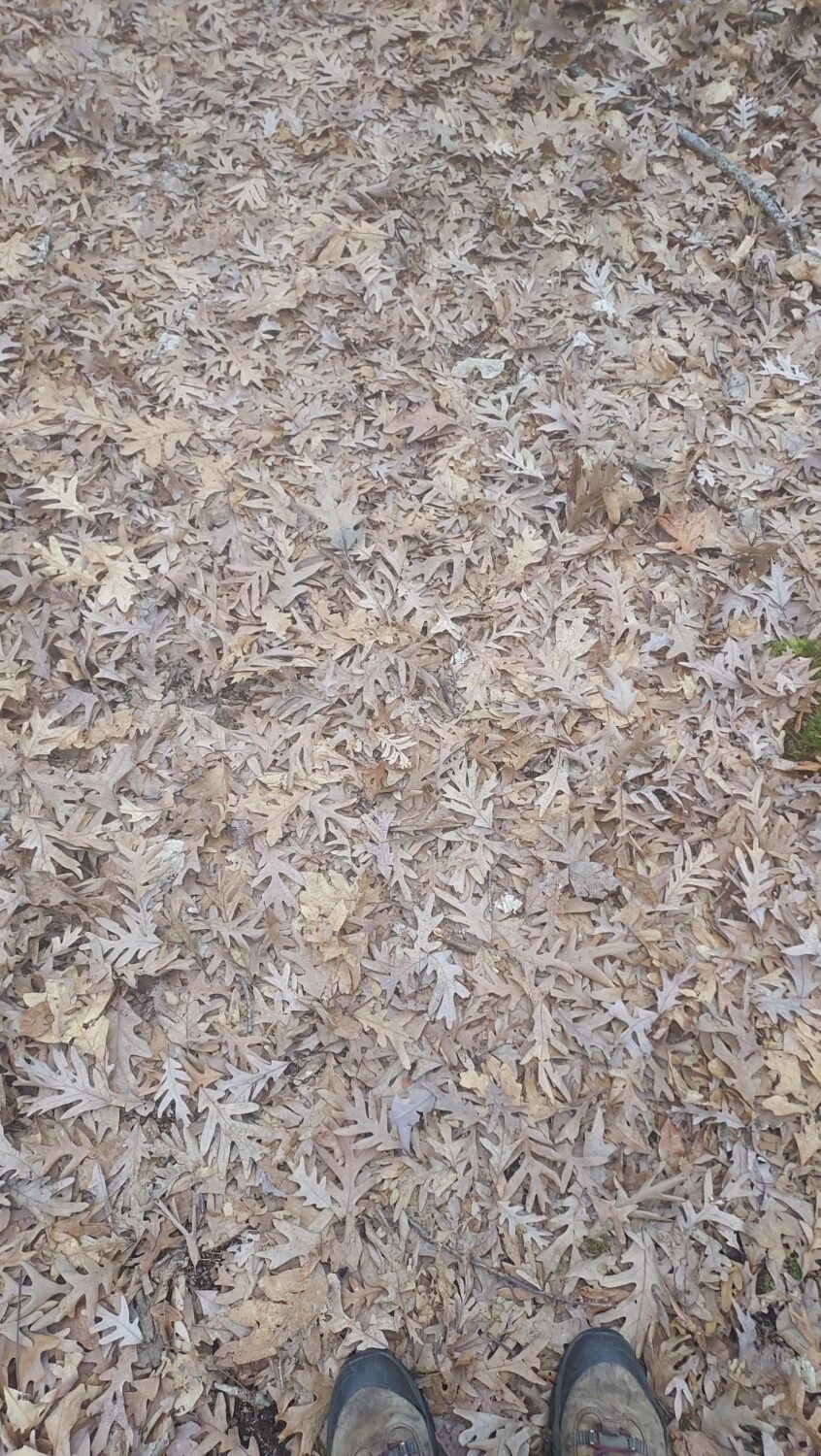
When I started my walk, I noted that the raw March woods was superficially indistinguishable from the raw November woods. Dormant plants, leaves down and brown, gray and cold. Both heavy with the context of their phenological transition. Even so, you know the difference. You know the weight of going dormant, hunkering down, digging in and stealing oneself against the impending long winter. Conversely, you know fundamentally the weight of March, about summoning the reserves and waiting for the soil to warm, waiting for the near-term riot of life that’s just over the horizon – when every cell in every organism begins churning itself onward. You know raw March because you are animal too.
This is faith of a sort. I understand some part of my walk thanks to my training, a greater part thanks to a poking around in Midwestern woods since I was a boy. Some part though, some intuition, maybe some reaction, is our shared humanity seen through a glass darkly. It’s the space we need.
Dane county enlisted the help of a seventh grade social studies class to provide a name for this property (charming video about it here). They chose a Ho-Chunk word, Waakikižu, which translates as “community” or “togetherness” a definition no doubt including nature and humanity as kin. That’s the wisdom to carry.
Its darker now than when I woke. The promised storm is building and I can hear thunder to the east. Freezing rain and ice locally. Snow to the north and here later tonight. Schools are closing. Better get going on my deadline thing.
Seems I’ve spent a Sunday morning navigating distractions again.

8 Responses
And well spent. Mine is the scarlet tanager.
I’m intrigued by the “Ho-Chunk word, Waakikižu, which translates as ‘community’ or ‘togetherness’ a definition no doubt including nature and humanity as kin.” The word sounds like the name of a Native American chief named Waukazoo or Wakazoo, who once lived near what is Holland, MI. According to a Michigan Historic Site sign near Lake Macatawa, “On June 1, 1849, the Waukazoo band moved to the Grand Traverse Bay area, founding the village of Waukazooville, which was annexed by Northport in 1852.” The Waukazoo band were displaced by the arrival of some of our ancestors.
Thanks for taking me along on your meanderings and musings among the trees and the birds. But my “spring fever” now seems to be stimulated. I also note your short “bio” each time you post, because I, too, enjoy a good plate of whitefish!
Thanks for the rambling. I’m soon departing West Michigan heading to Nebraska to take in the Sandhill Crane migration- my sign of spring and hope.
We saw 2 sandhill cranes on the wetland behind our condo here in NW Grand Rapids on March 12, but they were only here for a few hours….. Alas!
I am memory, more than I may know”… and more than I usually remember…
Thank you for opening our eyes and senses in the woods… Brings me back to my childhood.
Came in from my morning walk to read this beautifully written article. Had so many of these exact thoughts as I walked. This afternoon we will walk again…together as a couple we will watch for those “spring time” treasures that she so enjoyed.
I am struck by how your words can describe our anticipation of Spring, and how you gently and kindly described my neice, as she navigated her illness. She truly was a nature girl through and through.