
Chaco Canyon, in northwest New Mexico, is not really a canyon. It is a wash with a 150-foot high rock wall on one side that holds the remains of remarkable ancient dwellings.
It is absolutely one of my favorite places on the face of this planet. For years I taught a class titled “Peoples and Cultures of the Southwest” that always included a field trip to Chaco.
Although Chaco Canyon and the surrounding area has been protected since the early 1900s, it is now being considered for oil exploration and production. Already more than 90 percent of the federal land around Chaco Canyon is leased to the gas and oil industry. However, efforts are underway to roll back a ban on drilling within ten miles of the canyon itself.
I would like to tell you a little bit about this area and the obvious reasons it is such a ridiculously dumb idea to “drill, baby drill” there.
Going Back in Time
The earliest evidence of human beings in the American Southwest dates back to around 7000 BCE. “Kill sites” — the remains of a large animal with spear points in it and remnants of a fire — have been discovered in Folsom and Clovis, New Mexico. These people were likely hunter-gatherers, migrating south, who killed, cooked, and ate an animal at these and other sites.
Jumping ahead a few thousand years, the people eventually transitioned from nomadic hunting and gathering to more permanent living areas that included some agriculture and eventually trade. Around Chaco, these settlements date as far back as 800 CE. The earliest settlements were pit houses, dug into the earth and covered using trees, branches, and mud. There was exponential population growth in the area.
This gave rise to the building phase in Chaco Canyon. It was the center of Puebloan civilization. Using dendrochronology—the dating of wood through tree-ring analysis that can be accurate within six months—researchers have determined that the canyon’s timber dates between 1030 and 1100 CE.
Chaco Canyon was not an isolated settlement. It was the hub of a complex system of ancient roads, spiraling off for miles in every direction. Once, they not only connected similar communities but served as trade routes, possibly as far as Mexico and Latin America.
Around 1130 CE there was a 50-year drought and once again around 1250 CE. Most scholars agree this forced the inhabitants to move to places with water, along the Rio Grande, for example. Chaco was virtually empty of inhabitants by the late 13th century.
Much later, there is evidence that other Indigenous peoples, including the Navajo, briefly inhabited the ruins. Many present-day Pueblo people trace their ancestry to Chaco. For them, it remains culturally alive, one of the most sacred places on earth
Today in the Canyon
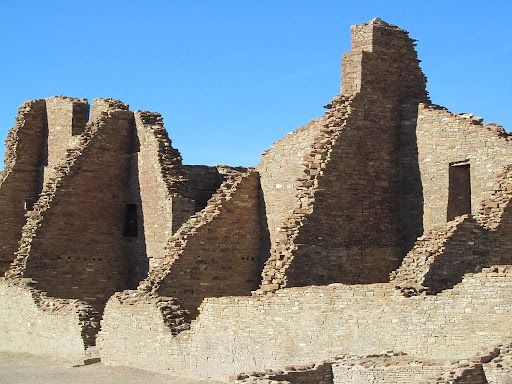
Chaco Canyon is home to the largest, most numerous and best preserved Native American ruins in the United States. It holds some 2,400 archaeological sites with 16 major population centers. This includes Pueblo Bonito which contains some 600 rooms and kivas. A kiva is a sacred underground meeting place for cultic practices. Pueblo Bonito was four stories high in places with walls three feet wide at its base. It is estimated to have housed as many as 2000 people. Some suggest it was the largest structure in North America until the advent of skyscrapers.
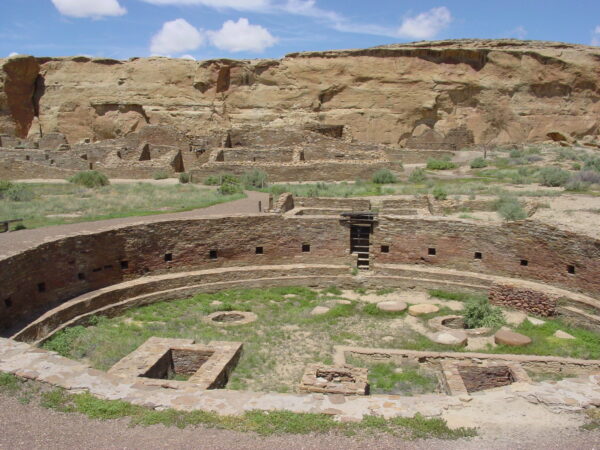
To reach Chaco Canyon one needs to navigate 20 miles of dirt road. In rainy conditions it is virtually impassable — some of my students can attest to this! This 20-mile gauntlet limits the number of people visiting and the size of vehicles able to enter the canyon. This demanding access protects the pristine area and the invaluable ruins there.
Forty years ago, when people were still allowed to explore at will, we once stumbled upon an ancient stairway up the mesa wall, carved out by the inhabitants. It included foot holes as well as “pistol grip” handholds. Today, all the handholds have been broken off, showing how easily these ancient treasures can be damaged.
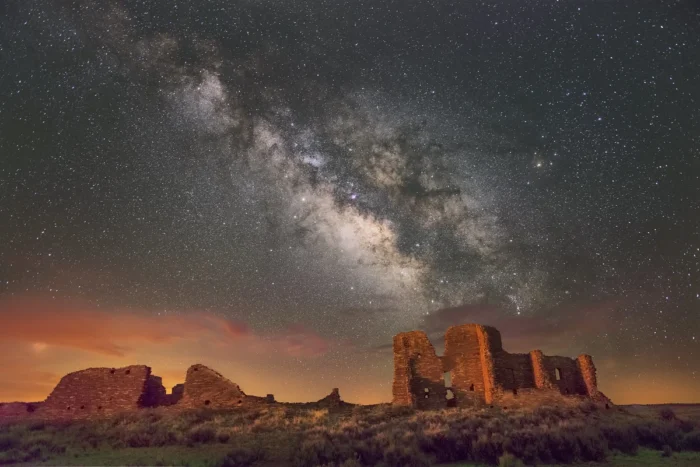
The area is untouched by light pollution. A dark night campground includes a program where amateur astronomers set up their telescopes for viewing solar systems and novas.
Fajada Butte is a solar calendar, where three huge rock slabs, each weighing more than a ton, cast shadows over several carved spirals on the mesa wall. The shadow, called a “Sun Dagger,” accurately marks the fall and spring equinox.
What Shouldn’t Happen
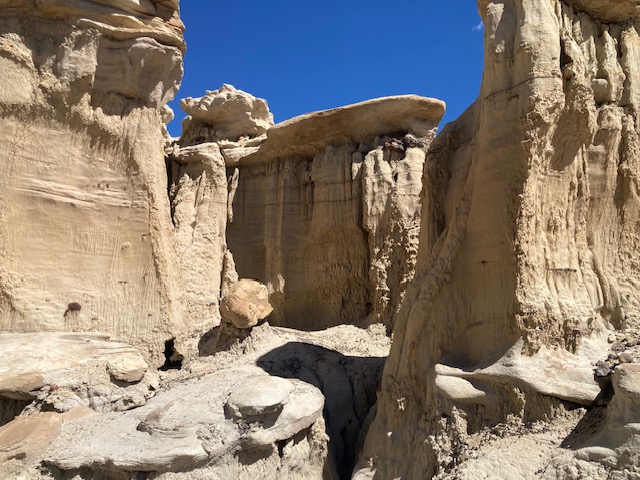
The area around Chaco is generally called the Bisti or Da-Na-Zin Wilderness. This is the area that the Trump administration wants to open up for more drilling. It is extremely hard to describe the area, so I include a variety of pictures to give you an idea of its unique and fragile character.
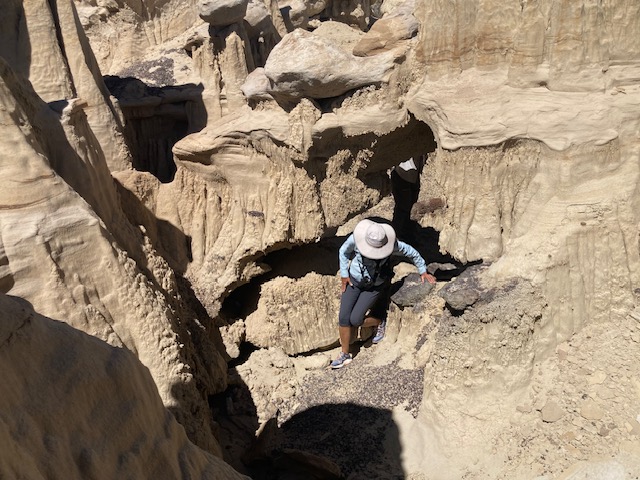
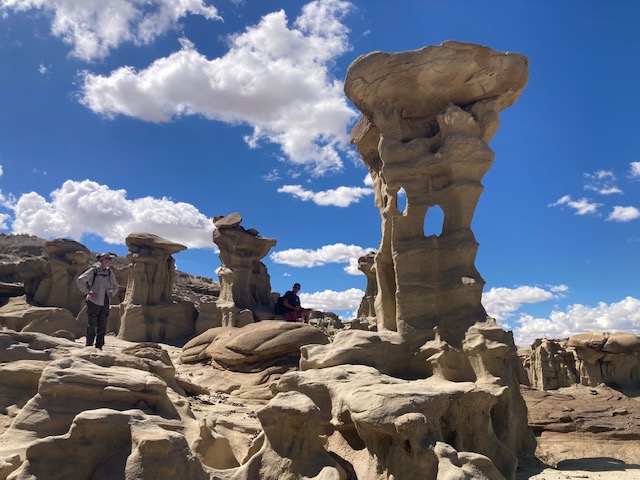
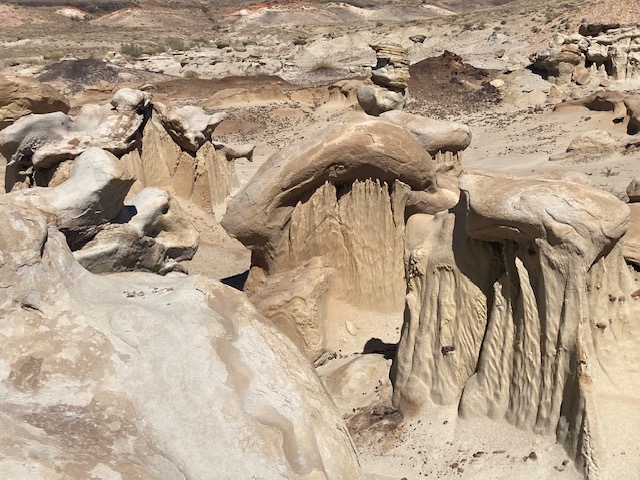
When drilling happens in the Southwest an extensive road system is built. There’s truck traffic, pipelines, pumps, and methane exhaust pipes that continuously spew flames. Trailer parks and other services for the dozens and dozens of workers are necessary. This is already seen in the Permian Basin in southeast New Mexico/southwest Texas, and also in the Four Corners area where numerous natural gas drills operate.
Around Chaco it would damage or destroy the natural beauty and the archaeological sites. The dark skies, treasured by star gazers, would be filled with smog, dust, lights, and flames. And for the Indigenous peoples, there is really no telling what it would do to their traditional sacred land.
I hate writing about this. It gives the current resident of the White House even more time and mental energy than I already give him. I wish it would all just go away. I have never demonstrated, marched or attended a political protest. It simply does not fit my introverted personality. But with the possible destruction of Chaco Canyon looming, I think the time has come for that to change.
17 Responses
Your protest begins with the agony of writing of this post, Don. Well done! May it bring even more substance to an avalanche of protest on this No Kings Day.
If there is a petition to sign, send a link! This is so well written on so many levels. Your knowledge and passion for the people and the land comes through loud and clear. — even for an introvert. This country’s 250 year celebration (also a good thing) is a drop in the proverbial bucket compared to the history before it under our feet. It is indeed all sacred. Thank you Don, for penning your passion. That it shows up on here March 28 did not go unnoticed.
“And if not you then who”??
Clearly, you love the land and its beauty. Even introverts can attend a protest. It’s too late once the drilling starts. Too many people choose to remain silent. I encourage you to move forward and push yourself beyond your comfort zone.
Fyi. I attended a no kings rally today. Even held a sign!
Energy company EOG Resources Inc. has been one of the major players in seeking drilling permits in the Chaco Canyon area. You might contact the company and also check your investment portfolios. The RCA Synod of Albany formerly held EOG stock until we decided to divest of fossil fuel companies. The Reformed Church in America retirement funds managed by Fidelity remain heavily invested in fossil fuel companies.
Thanks Don. What would it take for us to recover a sense of the sacredness of the land? I ask myself that question all the time. Your witness is an invitation for the rest of us to wander in the wilderness and open our hearts to the presence of God. By the way, I walk the wilderness now; my days of running are over. How are your kness holding up?
Two new hips and knees hurt. No running here. I do bike some.
At a hotel outside of Albuquerque, the breakfast room had a number of Indigenous people who appeared to be there for some kind of tribal conference. We had just viewed a challenging temporary exhibit at the Georgia O’Keefe museum in Santa Fe, done by Tewa artists, which led me to ask one of the women a question about the loss of native language. She told me she was Chaco and then went on to tell me that their native language was declining, but not disappearing off a cliff. How is it that you, then, write this blog today? Traveling in these areas one can not miss the fact that these lands are sacred places to so many people, yet we deface and destroy, making them fight again and again to retain them. Thank you for taking a stand – it is an act of defiance.
Thank you for writing this. I have visited Chaco Canyon and other sites in that area and have felt the spirit which pervades them. What a terrible thing to destroy!
Dear Don, I echo the thanks of others for your raising this important concern. New Mexico is indeed the land of enchantment, and there certainly is something about a historic site such as Chaco Canyon that is sacred and pleads for protection from the greed and recklessness of the current administration.
As to protesting, I’m an introvert/extrovert blend, and today — for the first time in my life — I joined a bunch of other old codgers for a No Kings protest along a major street in SE Grand Rapids. It was almost ‘fun” to observe the reaction of those driving by — ranging from a thumbs down or a finger up, to staring straight ahead with both hands glued to the wheel lest we strip them of their livelihood, to carloads honking and waving and cheering all along the way. I actually felt good about participating, but alsosuspect that my participation do not move the national health meter level even one milimeter.
Don, keep raising you voice as you have here. But also, surrounded as you are by native leaders who are experienced and reasonably effective in “working the system,” how about sharing your concern and passion with them, and offer to help them in whatever ways they would consider helpful! Go for it, and blessings!
Don, I went to my first protest today – in 20 some degree weather, but it felt good just to let my views known. Thanks for writing about your concerns.
It’s a archeological treasure and I wish we could leave it alone for its descendants and for future visitors.
Realities: NM doesn’t need the oil/gas, nor the tax revenue. NM has the 2nd largest almost untouchable Permanent Fund (70 Billion) of the 50 states! This fund is set to grow to 110 Billion in 10 years. “NM is not a poor state, but poorly run.” 50th in education, poverty, homelessness everywhere, Route 66 runs through the war zone. In NM since 1981, and touring Chaco x time’s, I am stunned by the museum case which documents a solved crime committed by visitors from an unnamed Institution. Privileged to befriend the Pastor of the Stanley, NM Baptist Church. At the time, Pastor of the Governor King family. He loved the Back to God Hour KOB radio sermons, wanted published copies. Finally after decades…Epstein investigations… Never to be paved road to Chaco can be muddy and rough. When visiting, stop in, say hello. Love the blue sky, the food and rich cultural mix. Tracking the daily sun rise ‘appear’ to move now, north from south on the Sandia Mountains. Colossians 1:15-23 is orientation and a daily refreshing base. Great place to retire and live despite conditions.
Thanks for alerting us to Chaco Canyon. People who visit usually want to go back, again and again. This is a space worth protecting, so we need to do whatever it takes to preserve Chaco Canyon.
Added this place to my” bucket list”. Would love to visit sometime.
Please. Ill be a tour guide
I first heard about Chaco Canyon at an AP World History reading, 15 years ago. The speaker told all of us (a few hundred in the audience) that Chaco Canyon is one of several places in the U.S. that we really needed to visit to gain a full sense of the human experience in North America. I agree. It is a sacred place.
On another note, I saw that you spent many years at Rehoboth. My great aunt, Renzina Stob, was a missionary/teacher at Rehoboth for a good 50 years, from around 1910 to about 1965. I believe she was the principal of the elementary school there for about 30 years.