
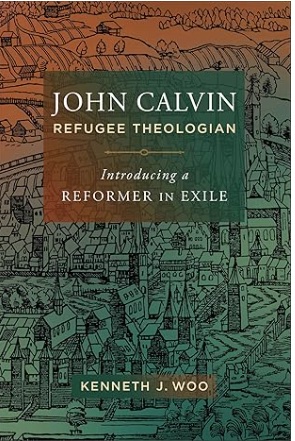
In 2009, a collection of late essays by the great Dutch Reformation historian Heiko Oberman (1930-2001) was published under the title John Calvin and the Reformation of the Refugees. The title essay argued that Calvin’s life and thought could be fruitfully understood through the lens of his status as a religious refugee, exiled from Catholic France, ministering to and alongside fellow exiles in Geneva.
Oberman did not live to further develop his thesis. But now, Kenneth J. Woo has published John Calvin, Refugee Theologian: Introducing a Reformer in Exile (Baker Academic, 2025). Woo elaborates on Oberman’s insight to deepen our understanding of Calvin’s theology, biblical exegesis, preaching, pastoral practice, and polemical engagements. Woo’s book arrives at a moment when refugees are at the center of many crises in our world, including here in North America. Does it offer a valuable perspective on both Calvin’s life and our own circumstances?
Woo’s own background makes the discussion and debate about refugees existential for him. All four of his grandparents were refugees from China after the Communist takeover, as he explains in his introduction. As a professor of church history at Pittsburgh Theological Seminary and a pastor in the Reformed Church of America, he might naturally harbor the desire to be more fully seen and understood within the American branch of the tradition that flows from Calvin’s Geneva.
However, the bulk of the book is devoted to a detailed analysis of Calvin’s writings in order to ferret out and connect his many references to exiles and refugees, and to contextualize them within the turbulent religious and political history of the mid-sixteenth century. He notes, for instance, how Calvin’s teachings on providence and predestination might offer special consolation to exiles who struggled to belong. He observes that Calvin recurs again and again to biblical characters (Abraham, David) who lived faithfully in exile from their homelands.
Many of these observations are helpful for understanding Calvin. But how fruitful are they for understanding ourselves, especially those of us who are not refugees, yet who may be called upon to respond to others who experience exile or displacement? Calvin might encourage us to accept and protect refugees as he did. But that, of course, would mean refugees who were neither Catholic nor Anabaptist–not to mention Jewish, Muslim, Hindu, Sikh, or Buddhist. Those Calvinian refugees might be French, English, Scottish, Polish, Italian, or Spanish, but they would all be European, not Haitian or Somali. And definitely no one named Michael Servetus!
I am not yet persuaded by Woo’s book that there is much in Calvin’s thought or practice that can help us broaden the scope of our stance toward refugees and exiled peoples, welcoming (or not) them. But inspiration might be found elsewhere in the Reformed tradition. The French Protestants in the village of Le Chambon, who risked their lives to hide Jews from the Nazis, spring to mind. The memory of their ancestors’ persecution was one of the factors that made this radical hospitality seem natural and intuitive to them. Perhaps in Minnesota today, we are seeing a revival of that spirit.
It doesn’t always work that way, of course; given the chance, the persecuted often make perfectly fine persecutors. But when it does work, it’s worth asking what it was in their inherited faith that bent the arc of their lives in the direction of welcome. Woo’s intent, as he makes clear in his final chapter, is to begin this discussion. It behooves us to continue it.
2 Responses
I just ordered Woo’s book, so haven’t yet read it. I did, however, bring to publication Heiko Oberman’s collection of essays on John Calvin and the Reformation of the Refugees, so I’m familiar with the argument. I wrote the introduction to Oberman’s collection. As many have noted, Calvin is a tough nut to crack, especially compared to say, Luther. Luther wrote and talked about himself all the time, so it’s not hard to make connections between his biography and his theology. Calvin was reticent. Oberman was quite explicit in his conversations with me before he died. Oberman had a clear hunch that the refugee angle was relevant, even crucial to understanding Calvin. But there wasn’t a “smoking gun,” no detailed description by Calvin of his own exile experience. Maybe Woo has ferreted out more than Oberman had found by 2001. We know Calvin was a religious refugee and certainly, by the mid-16th century, there were tens of thousands of religious refugees across Europe (even more by the mid-17th century and starting to go to the Americas as well). So the concepts of “refugee” and “exile” could well be useful to compare the stories of Abraham, the Exodus, David, the Babylonian Captivity, the ensuing Jewish diaspora and the experience of Jews (and Jewish-Christians) after the events of 70 and 135 AD/CE, with the experiences of early-modern European Christians. Calvin is relevant for this discussion but only a part of the total “refugee/exile” picture.
Thanks for this response. I’d be interested in your take on whether Woo has uncovered any dispositive evidence for the refugee thesis. From a historiographical perspective, many of his arguments strike me as less direct: “If Oberman’s claim is true, this evidence would be consistent with it.” But the same evidence might also be explained in other ways.