
Todd Korpi’s AI Goes to Church is an engaging resource for Christian leaders exploring the implications of artificial intelligence for their ministry, even as it reflects the uncertainty of the moment.
At its core, AI Goes to Church is a rallying cry for Christians to engage the digital environment, bringing the virtual, web-based world within folds of Christian missiology. That thesis is well within Korpi’s wheelhouse: He is a dean of digital ministry programs at Ascent College and leads research at Digital Mission Consortia. Korpi’s approach is pragmatic and theologically-informed. His premise is that if people are spending more and more of their time in virtual environments, then those environments must be a meaningful part of Christ’s claim to the universe. As Korpi puts it, “one of the most significant frontiers in which the Spirit is at work is precisely where most of us spend a great deal of time—in digital environments and interacting with digital tools” (p. 12). Throughout the book, this insight serves as Korpi’s refrain.
Increasingly, generative AI is built into the very structure of that digital environment. So Korpi urges Christians not to be caught flat-footed in understanding the emerging AI-driven social and spiritual landscape. In AI Goes to Church, Korpi seeks prepare Christian leaders “to better navigate living our faith in our common AI future” (p. 8). He takes pains to serve as an honest broker in imagining what that future could look like, carving out a middle path between unrealistic optimism and fearful rejection, taking up both theological and practical considerations along the way. The front end of the book provides a helpful onboard for newcomers, including a history of artificial intelligence and a description of its more public-facing applications. For the most part, the book outlines Christian ways of understanding AI, rather than detailing specific applications; however, readers in small churches might appreciate Korpi’s attention to the potential of AI solutions for their context.
On what terms should one evaluate such an ambitious book—one of the first deep cuts into the implications of AI for Christianity? AI Goes to Church does not offer a tightly-argued or necessarily even consistent line of thinking. As a whole, the book introduces as series of frameworks for understanding some aspect of artificial intelligence, without developing any of them enough to fully take hold. For example, a chapter on AI and ethics briefly outlines six theological “grounding principles” for engaging artificial intelligence, then immediately adds nine “additional principles” to consider. It is not clear how those principles relate to the book’s concluding chapter, which lists another seven principles for artificial intelligence in pastoral ministry. There are too many directions to sustain a clear sense of what grounds these principles or which Korpi ones believes are most important. At times, Korpi suggests Christians just need to steward AI in the right way and for the right reasons—and that Christians might even be at the forefront of how the West understands AI (p. 6, 29). At other times, he seems to recognize that Christian leaders are reeling in a world created and defined by tech companies.
This ambiguity continues through Korpi’s first theological interpretation of AI, where he draws through-line from the curse in Genesis 3 to human innovations, such as the printing press, cotton gin, and assembly line (p. 28). That thread seems promising for sorting out the complex motivations and consequences of transformational technology. But for the most part, Korpi reduces these innovations to an instinctive desire for less work. As he puts it, “the evolution of AI is part of an a deeply encoded, instinctive desire within us to… lessen our toil and outsource the burden of human labor on our own creations” (p. 28-29). Certainly, one immediate effect of AI innovations has been to make some tasks easier. And two of Korpi’s strongest chapters address the future of work and pastoral care. But if AI really is like the cotton gin or assembly line, Christians will need to think carefully about how the emerging AI environment has roots greed, pride, exploitation, and the consolidation of institutional power. Because Korpi side-steps these concerns in describing the technological and theological origins of AI, they fit only awkwardly into a short chapter on AI and social justice.
So in some ways, AI Goes to Church seems to be searching for its footing. That search might reveal more about the scope of technological, economic and cultural disruptions that are rocking Christian institutions right now, rather than weaknesses of its author. At its best, AI Goes to Church invites readers to stand alongside a skilled and deeply knowledge Christian thinker, as he works to piece together how ministry is changing, and the challenges and possibilities on the horizon.
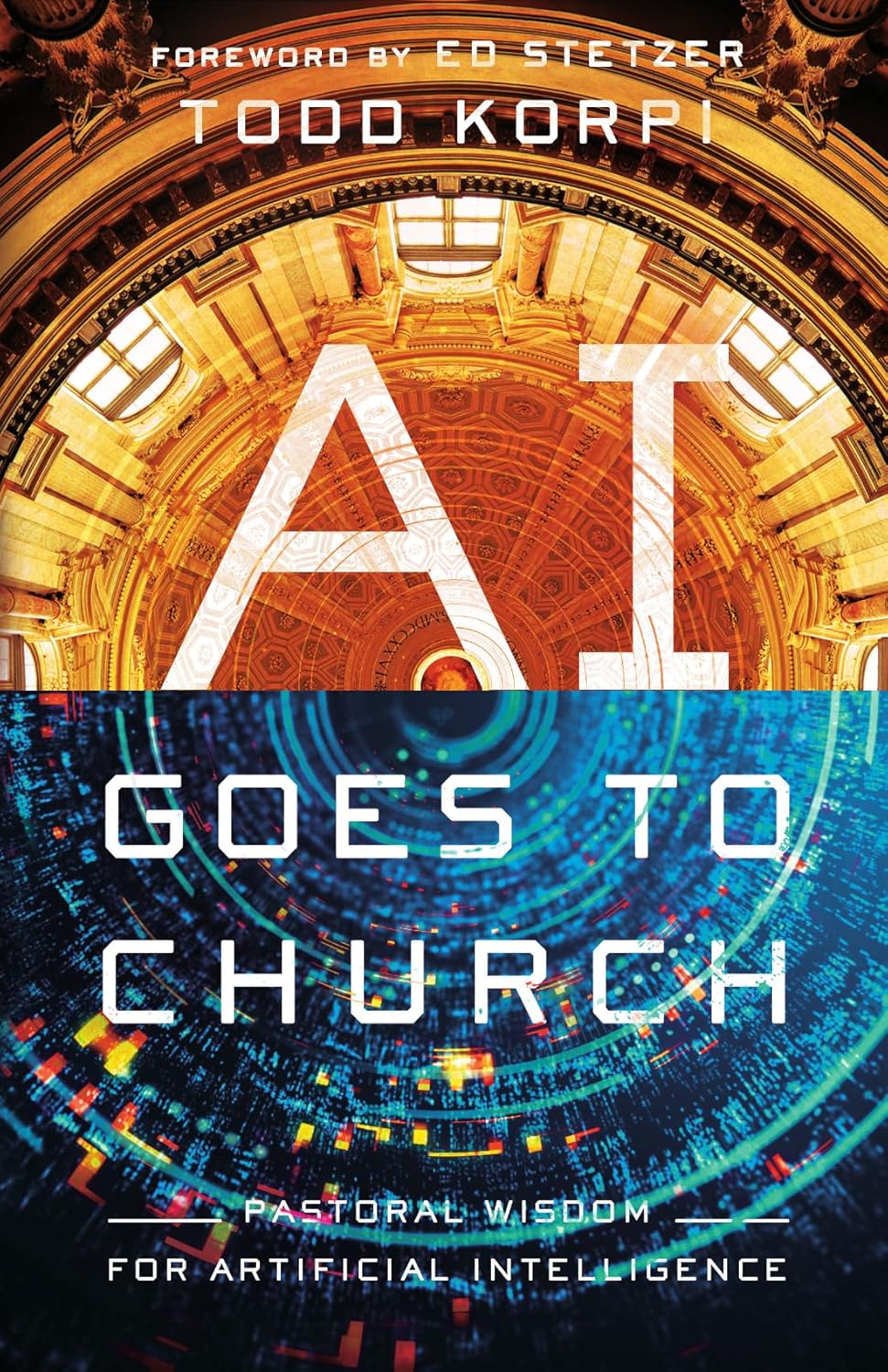
AI Goes to Church unpacks one of the most significant technological advancements of our time―artificial intelligence―and what it means for the ministry. More than just another tech fad, AI presents both profound challenges and extraordinary opportunities for the church. This book equips pastors, ministry leaders, and thoughtful laypeople to engage with AI through a biblical and theological lens, fostering human flourishing while remaining grounded in Christ’s teachings.
Writing in an accessible, nontechnical style, pastor and missiologist Todd Korpi seamlessly integrates theological reflection with practical application. Whether you’re grappling with ethical concerns, curious about leveraging AI for mission, or simply seeking clarity in this rapidly changing landscape, this book provides the guidance you need to steward AI wisely in service of God’s kingdom.
With its emphasis on thoughtful, lasting principles over fleeting technical hacks, AI Goes to Church serves as your road map to faithfully navigating the complexities of faith, technology, and human flourishing.

2 Responses
Thanks for the helpful review. Just FYI, AI will fix some of those typos…
Thank you for this. First halting steps are better than no steps. Keep us posted on better developments, especially your own!