
On Christmas Eve 1968, Willam Anders and the rest of the Apollo 8 crew were orbiting the moon, the first humans to do so. From lunar orbit, the crew spotted the earth rising over the lunar horizon. On the spur of the moment, Anders took photos of our planet, photos that may have changed the world. Among them, “Earthrise.”

Some say that photo was “the most influential environmental photograph ever taken” or “the beginning of the environmental movement.” Anders himself later said, “We set out to explore the moon and instead discovered the Earth.”[1]
I wonder, then, if the Artemis photos sent back from the Artemis II mission last week might have a similar effect. I hope so.

In 1968, humans had never seen their earth like this, as a whole, from a distance. So beautiful. So fragile. So oddly small against even a miniscule framing of space’s vast expanse.
Yes, the photo may have helped catalyze a nascent environmental movement. The reason, though, goes far beyond environmentalism. People understood viscerally perhaps the single most crucial principle humans have been striving to learn: we are all connected, all in this together, woven in a single garment of destiny.
We have been, over the course of human history, poor pupils of this lesson. I wonder, as we lurch from outrage to outrage, cruelty to cruelty, swamped in a miasma of lies and fears, yearning desperately for something better: are we ready for a fresh lesson in connection?
Next week, the Calvin Festival of Faith and Writing will welcome botanist and author Robin Wall Kimmerer as one of our plenary speakers.[2] Kimmerer’s star has risen mightily since her 2013 book Braiding Sweetgrass became a bestseller in 2020, followed by her 2024 bestseller The Serviceberry. Kimmerer’s signature blending of science and indigenous wisdom clearly answers some deep longing. She celebrates the indigenous principle of reciprocity between humans and the more-than-human world. The earth gives to us, so in gratitude we give back. Based on Kimmerer’s popularity, some part of our soul recognizes: this principle is right. We need this.
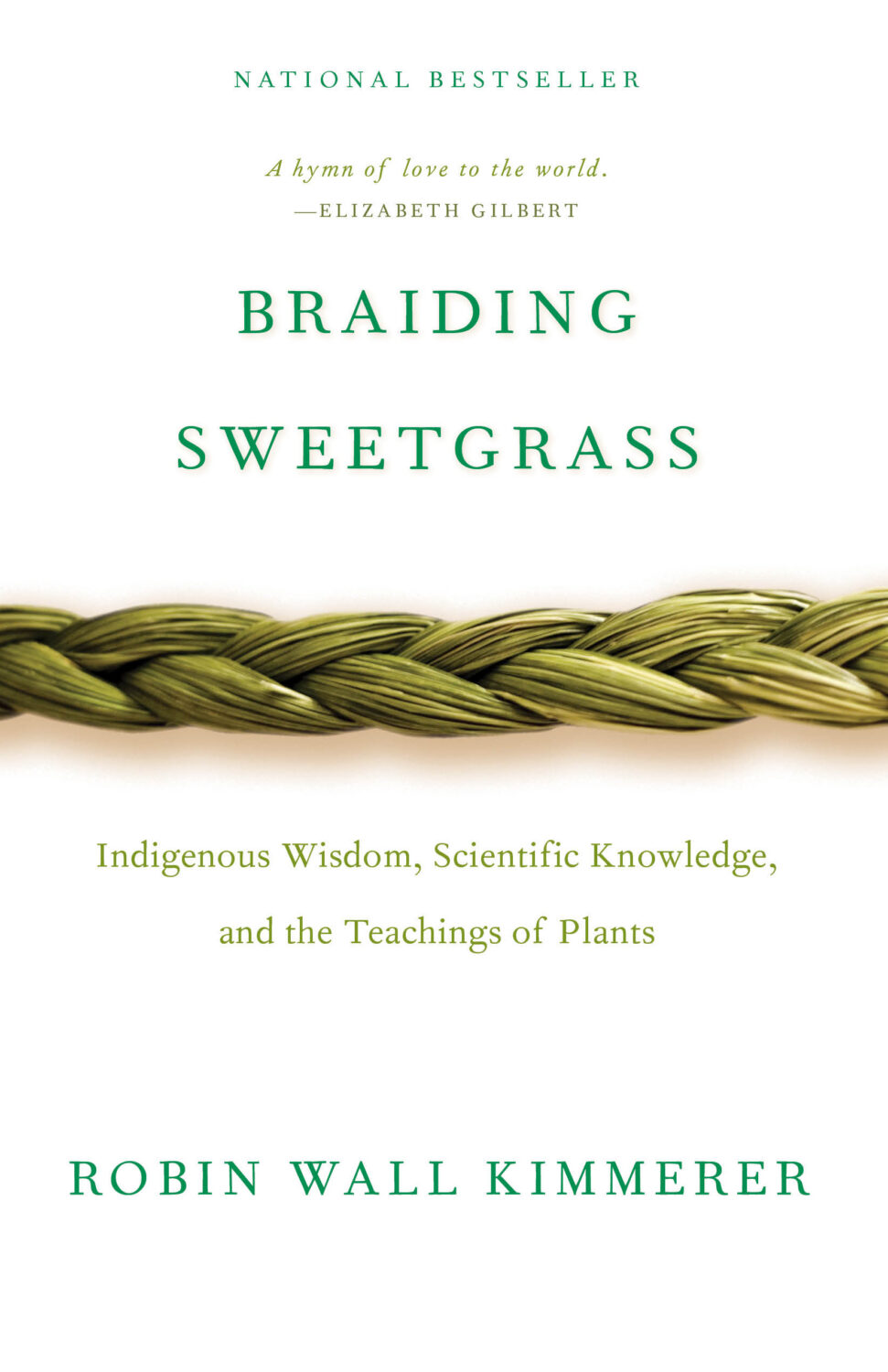
I see Kimmerer’s work as one bright river in a marvelous convergence of wisdoms happening right now, at this moment in history. Science, ecology, indigenous traditions, religion, even (barely) political philosophy and economics—all converging on the same old/new idea: we are all interconnected, interdependent. We are neighbors, we are kin.
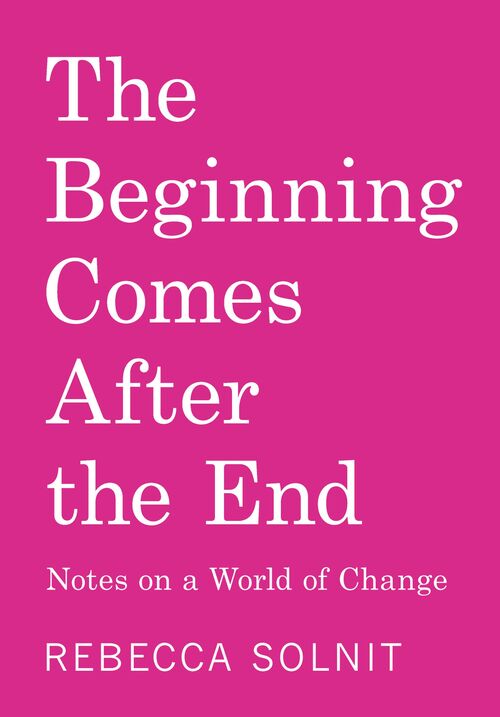
I’ve been dimly perceiving this convergence for a while in my reading and interactions, but of course I’m hardly the only one. Essayist Rebecca Solnit’s new book The Beginning Comes After the End gathers some of her recent thinking on this convergence. The book’s overall task is to survey how far we’ve come in the past 70 years. Yes, the last ten years seem like brutal regression, but it’s a backlash to cultural changes, Solnit argues, that will march forward, changes that break down the old hierarchies of race, gender, class, that bend the arc of justice, that strain ever harder toward honoring all people and all life.
In an essay Solnit posted in her newsletter Meditations in an Emergency, she explains her theory of two worldviews (Reformed people take note: one of our favorite terms!). She writes, “At the very heart of almost all our crises is a conflict between two worldviews, the worldview in which everything is connected and the worldview of isolated individualism, of social darwinism and the war of each against each. I call the latter the ideology of isolation.”
The ideology of isolation loves hierarchies, exclusions, rigid distinctions. It assumes that life is a brutal contest and the goal is to get your own, to win. The ideology of isolation ignores consequences because it refuses to acknowledge that what we do affects others and the earth. Even if it does: who cares? This is the same worldview, of course, that has recently argued (vociferously) that empathy is a sin.
The opposite worldview Solnit terms the “cosmology of interconnection.” In the essay she proposes that “the cosmology of interconnection has grown more powerful and influential over the past several decades, thanks to many forces…” She goes on to list antiracism, feminism, gay rights movements, environmental activism, universal human rights initiatives. Her book expands on the essay and goes into further detail on these movements.
One signature evidence of these two worldviews clashing, of course: what happened in Minneapolis this past winter. The forces of separation and cruelty expected to meet little resistance or to bulldoze whatever resistance occurred. They were wrong. Neighborliness, even at great personal risk, prevailed.
Intriguing, but where is religion in all this? Is religion part of this convergence, as I hopefully suggested a moment ago? On this question I refer to a recent essay by religious ethicist Liz Bucar on her Substack. Bucar analyzed Solnit’s recent New York Times interview, where, asked who would be our next hero, who would be the counterweight to the mad king and all he stands for, Solnit demurred:
“I often think one of the great weaknesses of our era is that we get lone superhero movies over and over that suggest that our big problems are solved by muscly guys in spandex whose superpower is the ability to inflect and endure extraordinary violence. When actually the world mostly gets changed through collective effort. It brings up something really beautiful that Thich Nhat Hanh said at some point before he died a few years ago, which is: the next Buddha will be the Sangha. The Sangha in Buddhist terminology is the community of practitioners.”[3]
Bucar proposes that this statement, along with the rest of Solnit’s public writing, constitutes public theology, the “most theologically rich political conversations I’ve heard in years.” Both Solnit and Bucar affirm that in order to go forward, we must also reach back to older wisdoms. Both also tend to favor Buddhism when fishing among religious traditions for wisdom (Solnit is something of a practitioner, Bucar is not). Bucar in her essay also cites principles within Judaism, Islam, liberation theology, and the Ubuntu tradition in southern Africa. In her book, Solnit considers at length the Civil Right movement in the US and Martin Luther King Jr.’s writings and speeches in particular. Thus, in both Bucar’s and Solnit’s accounts of religious contribution to this convergence of wisdom, they cite Christian participation only very selectively.
I don’t take this as an offense. I think they’re quite right to be selective. I do take it as a challenge, though. For centuries, Christians have been obsessed with distinctions, separations, hierarchies, dominion. Some Christians still are. Christians in America especially have been all too eager to find Christian justification for that ideology of isolation, especially the racial, gender, and economic expressions of it.
Is Christianity inherently a religion of separation? Sheep from goats, humans from nature, God from both? Certainly, we have within the Christian tradition, particularly in the prophets and in Jesus’s life and teaching, all that we need to live out the fundamental truth of interconnectedness. The great hymn of “all things” in Colossians 1 is only one example, that soaring passage in which Christ is “reconciling all things to himself.” Our fundamental interconnection, we believe, centers on Christ.
In our practice, too, we have a long tradition of loving and serving the neighbor. Solnit’s two-worldviews essay is even titled “When Love Thy Neighbor is a Cry of Resistance.” Yes, it always has been, from the time of ancient Israel to Jesus’s day to now. Elsewhere in her interview, as Solnit continues to observe how change happens through long-haul communal effort, she remarks (to many readers’ delight):
“A huge amount of important work … is done by nice ladies. And I think a lot of people with platforms, and a lot of the left, wants social change to look like the French Revolution or Che Guevara or something like that. And so the fact that nice ladies actually change the world, maybe it’s about the fact that changing the world is more like caregiving than it is like war.”
Score one for church ladies!
I don’t know how to wean Christianity off the ideology of isolation. But I think Solnit is right that caregiving—we could also call it reciprocity—based on a profound sense of kinship, this is and always has been the right direction. Christians do have a long tradition of on-the-ground service and caregiving. We distort neighborly service in a million ways, but in our best moments we faithfully follow the model of the Savior. In doing so, we live out that principle of kinship and connection.
The challenge for us at this point in history, as MLK commented, is “to lift the love ethic of Jesus above mere interaction between individuals to a powerful and effective social force on a large scale.” MLK thought Gandhi was the first person to do this.[4] I wonder what he would say today?
Could it be that large-scale living out of the love ethic is now our communal challenge, across religions, science, political and economic theory, ecology, urban planning, business, and every aspect of human endeavor? Will Christians help this fragile planet, its hapless human inhabitants, all of its abundant life by perceiving our interconnectedness and shaping our lives and our social systems upon it? Or will we resist what Julian of Norwich perceived, long before anyone saw photos of this planet, when she held in her hand a hazelnut-sized ball and understood that all things have being only by the love of God?
[1] The Wikipedia article on the photo cites the sources for these quotations.
[2] You can still purchase tickets to the Thursday evening lecture.
[3] I’ve thought about this idea from a different angle for a long time, since I teach a course on epics. I’ve also written about it in the context of contemporary storytelling.
[4] Quoted in Solnit, The Beginning Comes After the End, p. 36.

23 Responses
Thank you, Debra, for this expansive reminder of our interconnectedness. I loved reading RWK and also resonated with Rebecca Solnits essay. Grateful for words that feel more like mediations and root us to our collective wildness and the power we share for growth and restoration. Sorry to miss out on this years Festival!
What a timely, insightful meditation. You put the two competing stories of this last week, especially, into a profound perspective that not only challenges us but also inspires hope. Thank you, Deb!
Of course, Christianity, at its core is a profound faith relationship with God and with one another … including the stewardship of all creation. That is a far cry from the cultural institution which we have created. If we maintain Christianity as a lifeless self-serving “religion” we will inevitably continue to conveniently isolate ourselves from all the “others” in our midst. Mahatma Gandhi rightly reached this conclusion, saying, “If Christians practiced true service, they would turn the world upside down with the power of Christ’s example.”
Excellent, dear teacher. I need to meditate on the “large scale” thought a bit, because that too can be misleading,but I am grateful for the connection of Sangha and church ladies. (As a pastor of forty years, I am a huge fan of church ladies.) I think about the catatastrophic influence and dominance of the Church Growth Movement in my own denomination, the RCA, since 1978. The purpose of the congregation is to grow. New church starts are to be preferred over existing ones because they are more successful in recruiting new Christians. Our denominational goal is to have x number of new church starts and x hundred thousand members by year x. But slow, patient nurturing of congregations as alternate communities, especially small ones with a preponderance of church ladies, as the Sangha, what’s that?
Thank you for making these connections, as you so often do.
Thanks, Dan. Yes, church growth is basically empire thinking. Often done with good evangelical intentions, those good intentions easily tip over into growth for growth’s sake. We are allergic to small, but small is often how God works best.
Empire thinking indeed. Also ecologically unsound. Ghurch growth as an end in itself, growth that must keep replicating, like the Capitalist economy, or like high yield single-crop factory farms, or like cancers.
Thanks, Deb! I feel the challenge of living into these 50 days of Easter in a different way this year after being very intentional in spiritual practices during Lent. You articulate that challenge of being communal, a nice church lady, when I just want to stay home, cross-stitch and read.
Oh, Jan, me too! I just want to stay home and drink tea and read and embroider. I need every ounce of courage to go out into the “arena” every day!
John 10:16
“I have sheep in other pastures . . .”
A missionary challenge to go out and ‘bring them in’?
Or a global, universal statement of fact to consider, to discover and engage and learn about/from/with?
“Yes, the last ten years seem like brutal regression, but it’s a backlash to cultural changes.” I find hope in this obsevation by Solnit. The backlash is brutal and seems at times overwhelming, but its intensity is an indication as to how powerful the movement for change really is, how close we may be to realizing our interconnectedness, our kinship.
HiTom!
Annie here!
We should talk!
This is what I’ve been writing since Octoberof1987
Debra, I am jumping on your band wagon of support of Robin Wall Kimmerer’s gentle speaking of reciprocity. I just finished listening to her voice in her book, Serviceberry.
Two of them grace my yard (trees not books).
As a proud mother, I’ll repeat something I’ve shared here before. My daughter, who lives in Minneapolis, was one of the those who quietly helped temporarily house a colleague and immigrant fearing for her life. My daughter and her partner made food for the Somali children at the school across the street. They marched with signs: “We love our immigrants.” They practice Buddhism. They were giving back to the immigrants (reciprocity)who gave to the Minneapolis community-diversity of their food and culture. Loving your neighbor knows no boundary of religion or culture. It’s “do unto others as you would have them do unto you.” Giving back or sharing what you’ve been given.
Thank you your excellent and timely contribution today.
Also thank you for the links to Bucar and Solnit. They will be my next reads.
Thank you for sharing the beautiful work of your daughter and partner. Blessed are those who do the work without fanfare, simply out of faithful love.
Talk about convergence and interconnection: Revelation 7 always gives me a lump in my throat, as does the ending of *The Last Battle,* when Aslan welcomes the Tarkaan Emeth, who had served Aslan while worshiping the cruel Tash. I hope I’ll be able to hold it together when I preach tomorrow on Rev 7 and cite Aslan at the end. Still more, I hope I live Rev 7 a bit more. Thank you–again–Debra.
Jim, is your service streamed? I’d like to tune in to your lump-creating Revelation message.
Thank, Henry. It is streamed and then available at Jube’s website one or two days later. To be honest, Rev 7 is a take-off point for the first in our series “What I wish someone had taught me about Jesus, the church, and the Kingdom earlier in my life.” preached by our four-person preaching and worship leading team. While I do give a contextual into to the letter/chapter, It’s not so much an exegetical sermon on that passage–my fave, btw–as a backdrop for how I came to learn about and yearn for an ever deeper and broader appreciation of God’s Church, our “great cloud of witnesses” on earth and before us. Some fine teachers, pastors and friends moved me away from a parochial view of our “almost perfect” and pretty well “best” church to be embraced by lots of sinners and saints in of varied “tribes, peoples and languages” throughout my life. We’ll see how that flies in about two hours. Thanks again and blessings. jcd
Btw, Henry, Revelation creates the lumps, not necessarily mijn preek.
Bringing the peace of Christ and shalom to others: the church ladies. Thank you for bringing all of this together, our connectedness to each other, the earth and skies, and the world far beyond our front door.
Looking forward to Robin Wall Kimmerer’s Festival address next week Thursday!
Yes, thank you for your sponsorship, Henry!
I want to join this enthusiastic party around Jesus’ call to love one another, but I have my questions. (1) If we use a distinction between ideologies of connection and isolation to analyze what’s going on, are we just establishing another division instead of a connection – with connector-types being set “over against” evil isolationists. (2) I like the emphasis on thinking of world changes happening through the small and communal (like church ladies), but even church ladies can get caught up in rivalries. There seems to be enough sin in the world to adversely influence everyone, including those who want to connect to others. (3) I’d also like to hear more about how the principle of reciprocity is different from the transactional ways of our current president. (4) There are plenty of truths in the gospel that supply energy for coming together, but where do we find a place for the other parts of the gospel that seems to focus on driving apart. Even the beautiful worship of Revelation 7 which includes every nation, tribe and language is found in the same book that has dire warnings for those who won’t be there. (5) I’m sure good can come from a convergence of wisdoms, but I’m assuming that some “wisdoms” should be excluded, for there is a difference between the wisdom of the crucified Jesus and the wisdom of this age that crucified him. Sorry if this feels like pouring cold water on something so many of you are excited about. Maybe I’m just one of those ideologues of isolation, but I’m hoping not.
Thanks, David. These are, of course, all valid concerns for sure. I think of good ol’ Kuyper and his dialectic of common grace and “the antithesis.” I’ll try to give a very brief gesture toward answers. 1) The difference here, I think, is between invitation (“join us”) and “we will destroy you because you are the enemy.” Cf the rhetoric of our current Secretary of “War.” 2) Well, yes. Of course. No ideal is lived out in perfection, even in church kitchens. Nevertheless, one can hold to an ideal. 3) On this one, see Robin Wall Kimmerer’s book The Serviceberry. She addresses this question directly. 4) Very true. This one requires a much longer response, one that gathers more expertise than mine. Suffice to say here that God’s longing is for all things, all creation, all people to be redeemed. We are warned that may not happen. But that is, I believe from scriptural witness, God’s longing. 5) Well, yes. We are talking about wisdoms that do converge on the fundamental principle of connection. That which crucified Jesus is, of course, not wisdom at all but envy, violence, and division. Thanks for your important and thoughtful response.
Thanks for your reply. I’ll have to check out Kimmerer’s book. As for #4, that’s the question I often have in my heart. I do believe it’s God’s longing, and Reformed folks like to think God gets what he longs for, but the scriptural witness here is less than clear. I find it best to talk about both God’s connecting and separating work, even though I want to give priority to the connecting.