

While having neither the bandwidth of a Cappadocian Father, nor the passion of a Tertullian, I would at least like to offer an oblique response to Steve Mathonnet-VanderWell’s engaging and provocative blog “Heresies I Have Loved: III.”
I was raised in a Reformed Church parsonage in a small town in eastern Nebraska. It was an era when oil, gas, and irrigation pipelines had not yet traversed the farm fields, but the Old and New Testaments had direct pipelines into our hearts and homes.
The scriptures often seemed complex, puzzling and fearsome, but at the same time, were comforting, exciting, and challenging. Despite biblical stories of holy wars, populations decimated, and heads served on platters, the community of faith to which I belonged seemed to take it in stride.
I suppose some thought that if God ordered destruction, it must be ok. Others chalked it up to “things we don’t understand.” Still others, while not excising the stories from their Bibles, likely removed them from their purview—out of sight out of mind. Is it possible we were then living in more innocent days with less critical thinking and less serious reflection?
The issues Steve explores are more germane now than ever before, since today’s aggressive fundamentalism and blatant Christian nationalism seem to consider the “blood and thunder” narratives in scripture no longer sources of embarrassment, bemusement, or questioning. They rather are becoming the foundation for a modern holy war in the name of Jesus.

Take for example, Mr. Pete Hegseth, who was given the task of leading the Department of Defense. He re-baptized it as the “Department of War” and recently called for an additional appropriation of two hundred billion dollars to fund it, announcing: “It takes money to kill bad guys.” Then, if not in the same breath, but with the same intent, he said that all Americans and their families should get down on their knees and pray to Jesus Christ for help. I pray for our men and women in the military, but it appears Hegseth is less willing to ask Jesus for help in achieving peace, than in prosecuting war, an assignment “the innocent Jesus,” to borrow a phrase from Emily Dickinson, might find difficult to accept.
Last week, a pastor friend, currently visiting the Netherlands, sent me a picture he must have taken on a museum visit. It depicts the biblical story of Salome, with John the Baptist’s head on a platter. This artist offered one of the more discrete versions of this event, with a napkin covering John’s face, but allowing the outline of his features to show through.
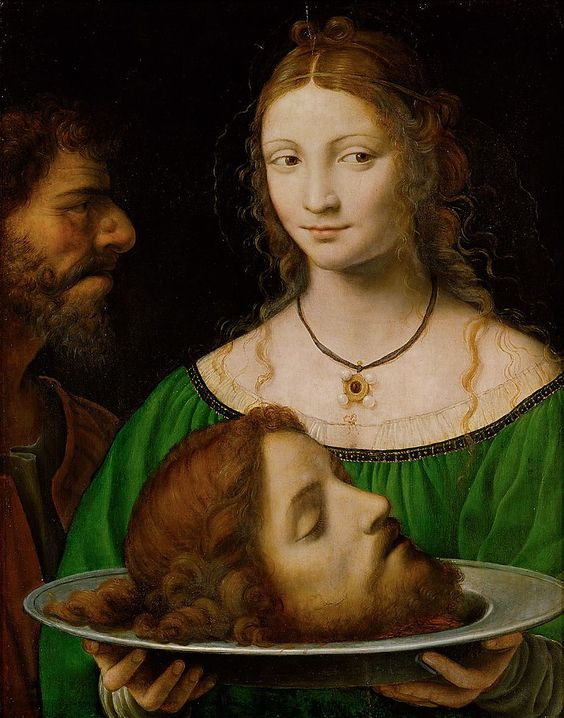
Several decades ago, while visiting a Greek monastery, I came across an even more vivid portrayal of John’s demise printed on a postcard and sent it to my friend, knowing that he was currently under attack by some disgruntled church members. The “encouraging” message I wrote to accompany this gruesome picture was “Keep up the good work!”
Faithfulness to Christ, according to the New Testament, does not call us to unleash our hostilities, but to possibly endure suffering. It might be instructive for seminaries to place some of those classical paintings of John’s fate on the walls of their classrooms.
Steve’s insistence that our churches do a better job of teaching congregations how to read and understand scripture, resonates with me. The epic furies released in the Old Testament must be discerned and assessed in light of the incarnation, of the One who “emptied himself . . . And being found in human form, he humbled himself and became obedient to the point of death—even death on a cross” (Philippians 2:6-8).
God is calling us to bear witness to Shalom in the midst of the furies. Keep up the good work.

7 Responses
Hi Norm,
I don’t know of any place in the gospels where Jesus is reported to desire to kill his enemies.
“Shall we rain down fire?” Jesus’ disciples asked of Jesus, when the Samaritans opposed him. “I have come to save, not to destroy,” was our Lord’s reply.
Thank you Norm (and Steve) for a stimulating and timely exchange. We should also remember that the Old Testament, including the power of its battles and victories, has always been important for the African-American community. I was once in a classical committee meeting where we talked about purchasing Bibles for a prison ministry. Someone said if we just got the New Testament we could provide a lot more of them. But a wise pastor (remember Stan Vander Klay?) said that since most prisoners were Black, and likely came from families where the Old Testament was read, it would be a serious omission to leave it out.
I recall one of my college profs saying to read OT history as description, not prescription . . .
Bravo!
Thank you, much appreciated!
Thanks for this piece … your affirmation of Steve’s comment about churches doing a better job of teaching folks how to read the Bible is vital, and, I might add, thoroughly Reformed … sadly, far too many folks have never moved beyond the simple readings of Sunday School wherein all is light and lovely, or harsh and bitter, depending on the mood of the congregation and/or the tradition in which the minister/teacher were reared. Both of the aforementioned alternatives weaken the text and the faith thereof.
Anyway, my thanks for this thread … and, of a personal note, I’m 81, haling from Sheboygan, WI, Hope Reformed Church … one of my childhood ministers there was a Kolenbrander – any relation???
Thank you for mentioning your recollections of how the Old Testament stories might have been processed by your childhood community in Nebraska. Many of us learned during suppertime Bible readings, intermediate grades Bible classes, and Tuesday morning catechism classes, about Joshua and Caleb’s land claim campaigns west of the Jordan River to drive out the Canaanites, Hittites, Hivites, Perizzites, Girgashites, Amorites, and Jebusites. It made sense for us children to reflect on the similarity of those stories to our 7th grade US Age of Expansion history lessons, and to believe that God escorted the settlers who claimed territory west of the Mississippi River, while Christ guided the weapons of the soldiers who drove out variously named tribes from the frontier land with authority from the 19th century Senate’s make ’em-break ’em treaty shenanigans.
Pete Hegseth is Made In U.S.A., and acting in conjunction with who we have been. He might get a postcard from a Moscow Christ Church friend which encourages, “Keep up the great work, subduing and/or eliminating civilizations for Christendom!” with a picture of the fully assimilated Susette Bright Eyes La Flesche Tibbles on the front. Or maybe a postcard from a former Forest Lake High School friend, turned pacifist in middle age, which quips, “The only good major is a reformed and relieved-of-command major!” with a picture of George Crook on the front.