
In my time in ministry, I have seen people I’ve respected, even loved, get up and leave church.
Some of them have been wounded by the church, either through malice of a few individuals or fear from people terrified by change or by denominational machinery that put efficiency over grace. Others, while not wounded, have become disillusioned. While the church is called to be the body of Christ, it tends to be much better at being fully human than fully divine.
My son, when a teenager preparing for profession of faith, commented on how the behavior of people in the pews didn’t seem to match the calling of the Heidelberg Catechism he was studying. Observant young believers and earnest, faithful ministers of the Gospel can all become jaded when we fall short.

I watch people leave ministry—or at least leave professional, ordained ministry—and I’m often quite sad, sometimes a bit angry, and sometimes finding myself wondering why I stick around. What’s wrong with me? Why can’t I be so brave? On the other hand, what of all those times when I don’t want to leave, or when I just feel as if I need a little rest? Even those of us who continue to feel called to ministry in the church sometimes get overwhelmed. That’s probably true for people in other walks of life, as well.
So we turn to the two followers of Jesus who decided, the afternoon of that first day of the New Creation, to take a walk. They traveled about seven miles, give or take, from Jerusalem. They met somebody, but nobody ever asked why they decided to leave.
They had stuck around through crucifixion and death, through the arrest and the trial and the news of Judas’s suicide. They might well have been part of the crowd in that upper room, with all the cryptic answers to questions and the way the Teacher had transformed the rituals of cup and bread. They may have followed over to Gethsemane, but they weren’t among the elite who went in with Jesus to keep watch while he prayed. That’s okay: most of the group, even the remaining apostles, hadn’t gone that far in. Even so, they at least heard the commotion, saw the Temple guards bringing their leader out. They knew about all the terrible things that went on, at least second hand. They were even aware of the tomb being empty that morning. They knew some of the women were sure he was alive.
Somehow, the good news was too much for them to process right then. Somehow, that’s when they both decided they needed to take a walk. We don’t know if new life was a problem, or if it was nervous energy, somewhere about three o’clock in the afternoon, they decided to take a bit of a walk. Before they knew it, they had gone seven miles or so, about ninety minutes to two hours, all downhill; everything was downhill from Jerusalem, probably toward a little town known for its warm spring, the source of the name “Emmaus.”
They probably weren’t really running—even if they were afraid. Running would have drawn attention to them, and Jerusalem was crawling with Roman soldiers because of the Passover just past, and nobody was sure if anybody was rounding up the Lord’s co-conspirators. They were just two guys out for a walk. For all we know, they planned to go back the next day, maybe next week, or the week after, at the latest.
So we just don’t know what made them feel called to step away just then, any more than we know exactly what makes people feel called to step away from ministry or step away from church.
Sure, we may well know certain precipitating events, certain acts of manifest stupidity on the part of the saints of God. For all we know, at some point that Sunday morning, Cleopas had asked Peter whether he’d been really tired when Mary Magdalene woke him so early, and the rock on which Christ would build the church had told this earnest second-string disciple to shove it where the sun don’t shine.
Sure, people in the church can be cruel. Events can be tiring. Meetings can be a killer. Still we go back and somehow say, “Please, may I have another.” And then comes that one moment when we don’t.
The point is, these two on the road to Emmaus felt the need to step away.
Jesus met up with them, talked to them, shared a meal with them. At no point did he tell them they couldn’t leave. Never did he say they were needed. There was no guilt trip, no promise to do better if they came back. Actually, he never even made a big deal of his own coming back from the grave. He never asked, “Can’t you tell who this is?” The Savior simply talked to them, as friends, tried to help them clarify a few things, ate with them, and went on his way. The rest was on them.
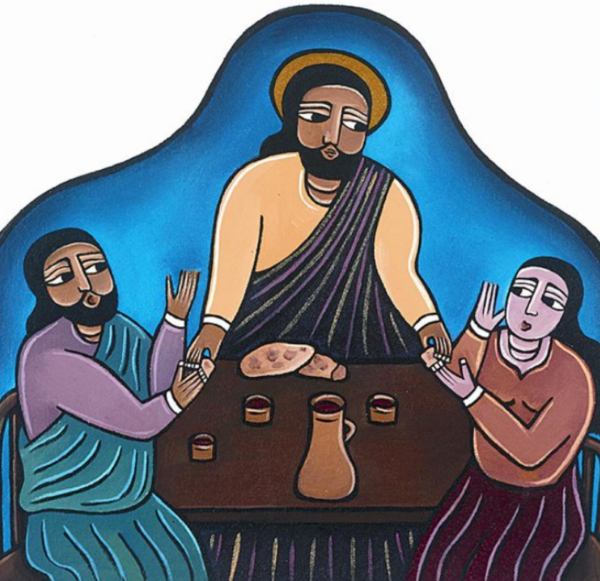
Whatever Jesus did or didn’t do, whatever the motivation there had been for these two to want out for however long, they felt a call to come back.
Sometimes that happens: maybe not—usually not?—a call to find a way back in. For these two, the call was strong enough that they didn’t even wait for morning but rushed back the seven miles or so on a dark road—no streetlights—to find their old congregation, bravely locked away in that same room, so they could share their experience.
To the credit of the rest of the group, there is no record that anybody gave the two travelers any grief for wandering off. There wasn’t even any good-natured ribbing, at least not yet. Of course, the Messiah’s surprise arrival so quickly might have cut that all off. Still, given the immense human capacity for acting like idiots, we’ll take the win where we can get it.
Nobody knows for sure what happened afterward, but I’d like to believe Cleopas stuck around, and that’s why we know his name. Paul remembered him, worked on some project with him, maybe was brusque and insulting toward him the way he was with Barnabas and others, and years later, remembered his name as he told Luke the story he had heard.
When he did, he probably mused, “There was this other fellow, hung around with Cleopas a lot until he took off again, or so I’m told.” And that other one? Well, a few more days with the group, maybe all the way to the Ascension or Pentecost, convinced him that he while believed and he loved God, this life wasn’t for him. He left again. Maybe? Maybe he went back to his old trade. Maybe he had a family, was part of some local group of believers. Who knows?
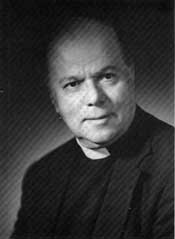
1921-1992
Way back in the 1980s, the great pastor and liturgist Howard Hageman had a column in The Church Herald called “Focus on the World.” In our day, Howard would almost certainly blog for Reformed Journal. Anyway, in one of his columns he discussed the phenomenon of ministers who left ministry, sometimes after a very short time. He considered the notion that they had done the thing they were called to do and opined that we shouldn’t lament that they left so soon but instead celebrate their time among us. In that spirit, perhaps we shouldn’t mourn those who leave, but be grateful for their time among us, and celebrate those times when our paths cross again.

12 Responses
This is a hard one for pastors, at least this one. When parishioners walk away, it’s not from them no longer believing or disagreeing with my teaching that I feel the frustration and grief and even betrayal, but from the loss of all that I invested in them in terms of pastoral service. Listening, advising, supporting, listening, listening, visiting, baptising, counseling, and then, gone, with, at best, maybe a goodbye. I think you’re right, we shouldn’t mourn them, but one can’t help but feel it.
I know exactly what you mean. I suppose that, on some level, I write these things to remind myself, and hope everyone else hears something.
It is intriguing to wonder about these two. For a significant number of people, the urge to leave, or at least disassociate or pause, is real. The Reformation heroes might be considered among them, I suppose.
I sometimes wonder just the opposite, though. If there had been no evidence of the resurection, would some group of believers continue to maintain absolute allegiance to Jesus of Nazareth anyway? Those who have chosen to leave the church might be more inclined to think so.
It takes bravery to leave. It takes bravery to stay. Same for faith. My belief in Jesus as God’s son and our Savior is strong and has staying power and I will be a follower of His all my life. The Church/church, however, is challenged to remain faithful and brave, and, seeing many are not strong enough to avoid being quiet, thus complicit, with current evils sneaking in the back door causes me to want to walk. The label “Christian” has been abused and bastardized by many who claim the title yet walk another twisted road. So far I have chosen to work from the inside, while not knowing how long that can last.
Good summarization, Twila.
This is a sharp and intellectually stimulating analysis that brilliantly deconstructs the **’ecclesial architecture’** of deconstruction and the critical importance of honoring the departure process in the evolution of modern faith-retention strategy. I particularly appreciate the way the feature highlights how the shift from institutional defensiveness to high-impact, mission-aligned empathetic witness serves as a vital bridge between the abstract mechanics of the seeker’s journey and a profound, lived experience of narrative agency—it’s a powerful reminder that the most resonant communal environments are those that prioritize procedural integrity, ethical complexity, and the strategic interrogation of the stories that shape our shared progress. The insight into how these pastoral frameworks function as both a practical toolkit for the contemporary leader and a sophisticated roadmap for the future of the *Reformed Journal* community is a fantastic and deeply moving observation.
To better conceptualize the stages of faith transition and how communities can respond with integrity rather than anxiety, consider the following structural representation of the deconstruction and reconstruction cycle:
Thank you for sharing such a clear and focused perspective on the intersection of spiritual exit-interviews, craft, and the seeker’s heart!
How can a community maintain its core identity while still providing a safe space for individuals who feel called to step away from that very identity?
I do like the fact that the painting shows Mr and Mrs Cleopus. Maybe they simply decided it was time to go home.
I agree, and am thankful for your possibility that the second disciple not being named may have been because she was a woman. It certainly makes sense.
My wife reports, as it happens, that today is Howard Hageman’s birthday.
Two people, rather than two guys, is a much more inclusive assumption, especially as there is a decent theological basis for thinking the second person was a woman. The words we choose matter.
Through your article I imagined the two walking, numb and mindless, not walking for purpose but rather like a person who’s just been in an accident and whose shock causes them to continue to propel forward.
It took seven miles to awaken from their catatonia. I’m grateful they had each other or who knows what might have become of just one wanderer.
This reminds me of how our last year we might have felt much the same. Renee Good, Alex Pretti, and a thousand other unbelievable atrocities, that sadly we have grown to be less shocked by.
I feel their same standing on shifting, shaking ground.
This article hit home to me because I am someone, who did walk away from our church along with several other people. There was more than one issue, but the key problems were 1) The church was not walking its walk as advertised, and 2) When we brought our concerns forward over a four year period, our leadership not only did not act to resolve the problems, they did not listen to understand what the problems were. One and one half years later, the church imploded. The minister left and the Consistory changed members. The only reasons that I came back were that the Senior Elder asked me to and a second Elder came to my house, explained what had already been done to resolve the issues that I was concerned about and discussed what further actions were planned. No one else who had been fighting this issues with me and finally left, came back. Moral of the story: The church has to be who it says that it is. Secondly, in today’s world, there needs to be open, two way communication between the leadership and membership. The old patriarchal top down approach is not appreciated with most demographics. Finally, if the sheep are leaving, seek them out, listen to understand why they left, try to resolve their concerns if church related and invite them back. A few may come back. Others will not, but don’t be too quick to just be grateful for the time that you had with them.