
I’m driving to the community theater for a rehearsal when I notice a heavy feeling in my gut. I take a couple of breaths to relax myself, then I focus my attention on the felt-sense in my body.
I know it is telling me something, so I pause after parking. I sit with the sensation with intentional compassion. The reason for the heavy feeling becomes apparent: anxiety about an upcoming conversation. I allow myself to be present with the feeling, acknowledging that anxiety is a natural response. In a few moments the tension dissipates, and I go on with my day.
Not long ago, I would have missed this entirely—either unaware of the sensation or too hurried to attend to it. That changed when I was introduced to bio-spiritual focusing.

Once a week I connect online with a partner. We companion one another in a specific process to isolate and be present with sensations that are carried in our bodies — like the anxiety I felt during that casual drive to the theater.
Anxiety is in the air.
I have been leading online discussions to help folks develop inner peace and resilience during the stress of current US administration. I find there is a gap in so many sources about spiritual life, particularly in response to suffering or anxiety. Authors recognize the importance of inner work if one’s calling, such as justice work, is to be flow from a solid center, a spiritual grounding. But few explain how to do it effectively.
Many authors and speakers promote methods of dealing with negative emotions that are about ignoring them or replacing them with “religious” thoughts, spiritualizing them — any variety of efforts to push them away or dismiss them. The trouble is, the feelings won’t go away. Inevitably, when ignored they will reemerge as anger, violence, fraught relationships, even addiction.
Often we are encouraged to talk about what is troubling us, trusting that exposing the anxieties to the light will remove their power. That can happen to a point, but anxieties persist.
Through his extensive clinical experience, Eugene Gendlin, Ph.D. stumbled onto a method that led him to develop the “focusing” approach. It takes in the whole of a person’s experience, especially the sensations within the body. Every emotion and life event is felt there. Yet in our culture we have been taught to ignore this physical and sensory aspect of our experience.
But thinking about a problem is not the same as sensing how it lives within us.
When we notice the felt sense of anxiety or other sensations, in the body, we are respecting the capabilities that are wired into us to deal with reality. Quieting the mind and body enables us to get a sense of what is happening inside. Focusing has us sit with it compassionately, not trying to solve it or expect anything from it. Giving this compassionate attention often allows a shift to emerge and be felt in the body.
Building on Gendlin’s work, Edwin M. McMahon, Ph.D. and Peter A Campbell, Ph.D. have written and taught extensively on what they call “bio-spiritual focusing,” (BSF). They seem to integrate the connections between psychological healing and spiritual (Christian) transformation. As they describe it, bio-spirituality “is enabling people to let go into the truth of themselves, especially their brokenness, in order that they may bodily experience grace within the process of their growth into wholeness.”
Ultimately BSF is a very simple process of quieting oneself, going inward and noticing anything that keeps you from feeling fine. Identify what needs your attention most, and offer your compassionate presence for a while. Then notice whether you feel differently afterward. It is more effective with a partner, but it can be done alone, any time. It gets easier with practice.
It can be especially helpful for children. BSF allows them to learn to honor their bodies and sensations instead of stuffing their emotions due to pressure from adults.
Having practiced BSF regularly for a couple of years, I can attest to its effectiveness. I would call it revolutionary. It challenges the mental/analytical perspective that prevails in Western culture and religion. It heals from the inside out.
I often sense the presence and movement of God while focusing. Like many intimate, interior experiences, it defies explanations or formulae. Healing becomes possible. Regardless of what healing or hidden divine work I consciously detect, I am honoring my whole self in the moment.
Here’s another example.

I was anxious about the condition of a family member who required surgery, antibiotics, and treatment for a serios condition. I went through the process of focusing with my BSF partner. Afterward, I journaled:
The image of being with her at the nursing home (180 miles away at the time) was enveloped by divine compassion and love. Her favorite coral color overlaid the image and permeated our togetherness, holding us as one. It bathed us interiorly, nurturing and embracing us.
As I sat with that oneness and embrace with [her], I sensed that the beauty and color and softness (of her skin!) of our recent times together are not gone. They are part of me and of her. And she is being embraced now even as she sleeps, whether she is cognizant or not, by that Love that holds us—both her and me, and all of us—together. She may be slipping away, either temporarily or for the temporary absence from us, but she is not gone now or ever. She is part of me that will never leave. And I am part of her. This is the nature of love. Of Love.
It is natural to wish that bad feelings will go away. But ignoring them or trying to force good feelings never relieves us of underlying anxiety.
I have learned that in being present to the knot in my stomach, I may find myself asking what it wants to tell me. An answer may or may not come immediately. Or, after gently holding the hot sensation in my head, I may come to recognize connections with what I am experiencing in my life. The critical question is, can I, with a caring presence, sit with what is keeping me from feeling fine?
This is challenging territory. It isn’t always easy. Bad memories and old voices lurk in the interior space. But with the help of a spiritual director, a BSF partner, or a therapist familiar with this or similar approaches, we can realize the potential for healing and growth by using BSF along with other practices and tools.
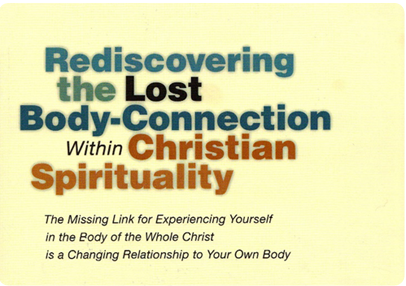
As McMahon and Campbell write in Rediscovering the Lost Body-Connection Within Christian Spirituality, “Anyone who regularly perseveres in [BSF] will find that it provides a concrete structure, the practical disposing and psychological climate which allow God’s grace to make you whole enough so you can love as God loves within the gifted process of growing more congruent and whole inside yourself. . . the inner landscape changes. Living the truth always frees.”
For more information, go to the Biospiritual Institute at www.biospiritual.org.
Online partner photo by Helena Lopes on Unsplash
Hospital photo by Jon Tyson on Unsplash
6 Responses
In have many family and friends who used to believe that the “arc of the moral universe was long but bent toward justice and peace” but now struggle to experience the presence of God in the unfolding of that universe. You are suggesting one way that all of us can go deeper into our troubled experiences and times and begin to find traces of the presence of God. Thank you for that.
You’re welcome. Presence is key, for sure.
Deb,
Thank you. While reading your post I could not help but think of the BSF I grew up with (Bible Study Fellowship) and the BSF of today’s social media (Best Sister Friend) and deeply appreciate the BSF you share today (Bio-Spiritual Focusing) that is so desperately needed to bring the balance of shalom and wholeness both to our interior self care and to our relationships so often strained by anxious and worry-filled thoughts and responses with one another.
You’re welcome. Balance and wholeness sound like healing, right?
Thanks for this, Deb.
It seems Christianity has always treated anxiety as a spiritual weakness to be removed or replaced by a certain discipline. Perhaps that removal “works” for some, but how would we know because it makes us spiritually “weak” if we admit that it did not work. “Just pray harder.” Or “Pray away the gray.” That creates its own anxiety.
We are just beginning to understand the interconnection between physiology and spirituality/psychology. It reminds me a bit of the effect of tears actually releasing brain chemicals to relieve sadness.
It all sounds a bit like hocus-pocus, but then, to unbelievers, so does prayer.
Thanks again…. Very intriguing. Another level of belief in the incarnation.
Yes, RZ. There are so many ways of avoiding what’s happening inside that have been deemed acceptable or even righteous. It’s understandable. But the beautiful thing is that taking the time to look inward with compassion is a holy quest that leads to healing. Often the body holds the clues that something’s up. All a function of just being human, as God made us. Thanks for your comment.