
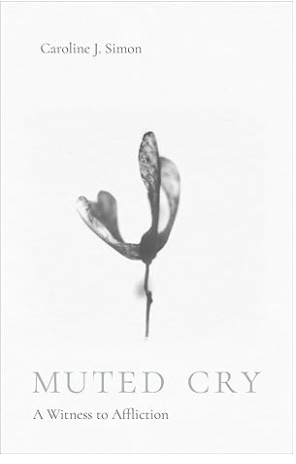
Caroline Simon’s brother Bill needed her help. Like many people with layers of health, financial, and emotional issues, he did not necessarily ask for her help. Caroline was his younger sister, a philosopher no less, married to a minister. Bill was an auto mechanic with dreams of becoming a police officer, the oldest brother in a family with an alcoholic father. And his life fell apart. Slowly. Pathetically. Dismally.
When I read the emergency room physician’s chart notes that say, “patient is in no apparent distress,” I wonder how my encounters with patients and families who are a mess could not be described as distraught. Bill is a mess. Perhaps it is more accurate to say that in this case, Caroline is the one in distress as she accompanies her brother through his last years of life, years of deterioration and poor personal choices.
Muted Cry: A Witness to Affliction is Caroline Simon’s testimony of being attentive to her brother’s needs while honoring him with respect and care. The testimony of the book, she says, is a reflection of her own engagement with difficult themes so that the reader can be “better prepared than I was to recognize affliction when it arises in your own life or the lives of those around you.” She offers her story not as a philosophical treatise or essay on theodicy, or even as a sibling who could have said, “I told you so,” many times over. She’s a younger sister who cares for her brother.
Caroline is a philosopher—a self-aware, deeply caring woman of faith who experiences the brutal effects of systems—health systems, family systems, economic and government systems—that make her brother’s life even more miserable despite his typical, sarcastic response to her that he is “living the dream.” She does not lecture him or us; she feels the distress while also drawing wisdom from Dorothy Day and Simone Weil in an attractive way that gives breathing space to the drudging, self-sabotaging decisions her brother makes while she continually bites her tongue. A social worker tells her that adults have a right to folly. The philosophers remind us of the sacred longing for the good and for greater meaning beyond the cause-and-effect rationale for our afflictions. Weil especially assists Caroline with the dilemma of her brother’s shame and need for self-respect, tapping into the human predicament that is her brother.
We are our own predicaments, too. Confessing our compulsions to compensate for whatever scripts we have internalized, we expend enormous effort to appear whole and unhindered. Caroline tells us she is dyslexic; attaining an advanced degree in philosophy is her way of gaining authoritative competence. That intimidating status seems to mean nothing to her brother, of course, except that he cannot compete with that. Even with this level of achievement, dealing with the nitty-gritty of hospital rules (during COVID, no less), working with applications for disability status for her brother, and diving deep into the renal failure world of dialysis and transplant waiting lists, while also working as a university administrator, takes all that she has. There are the additional costs of transportation, hotels, health and home equipment, and so many other things that take more patience, wisdom, love, and persistence than her own sense of duty alone could cover. And even more, she considers donating one of her own kidneys to her brother in a Lenten atmosphere of self-sacrifice and self-awareness of the murkiness of their relationship and his life choices. We are far beyond the philosophy classroom here.
One of the stories I most appreciated was Caroline’s response to someone who asked if her brother “knew Jesus as his Lord and Savior.” It reminded me of multiple times when I was serving as a hospice chaplain, when I heard this question from those who seemed to need reassurance about someone’s salvation more than the person they were talking about did. Caroline assures her friend that Bill was baptized and has a comprehensive, complicated, committed relationship with Jesus. The question seems so removed from acknowledging our participation in Christ’s broken body and its “distressing disguise” that parcels our life into having the winning card. A more fitting question might be like one Caroline seems to hold in her reflections: have I comforted the afflicted and walked humbly with God and with my brother/sister/neighbor? She wonders if she did enough.
Kate Bowler offers some words in a prayer she’s titled, “for the ones who bear witness.” She says, “Blessed are the noticers…The witness-bearers. The story-holders. The ones who tiptoe to the edge right alongside us, knowing that the very act will break their heart in pieces, too. Choosing us anyway” (from The Lives We Actually Have).
Blessed are we who benefit from Caroline and Bill’s story.
4 Responses
Thanks, Cindi, for this reminder that we are our brothers’ and sisters’ keepers. Caroline Simon’s “Muted Cry” is not only a witness to affliction but an encouragement to be helpful to others, especially to family members in need of love and care.
Thank you, dear friend
Beautiful, Cindi. Thank you for writing.
So beautifully and intelligently done. Thank you for this excellent work.