
Warning: this blog contains slight spoilers of the film “Hamnet”.
“You can’t imagine anything nastier than a congregation pretending to laugh.”
That’s a line my grandfather, Herman, wrote over thirty years ago, bewailing the loss of the church’s ability to laugh. He was recounting a conversation with a pastor, who used to make people roar with laughter at poignant jokes sprinkled throughout his sermon, but who lamented that these days (circa 1990) a joke might get a chuckle from a few people, “but the rest sit there like they are going to send a letter to classis about this scandal tomorrow.”
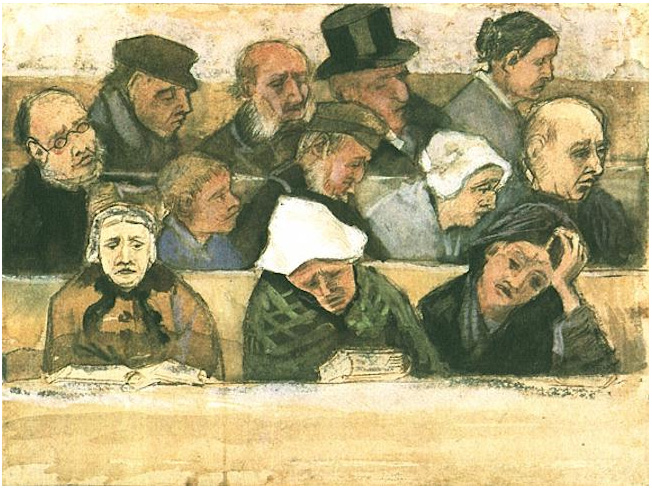
What accounted for this loss of laughter? “We are in the middle of a recession, and there is so much division in many churches that some of their members want out to form even better churches. It’s all such serious business.” Herman remembered classis meetings in which healthy debate was interspersed with jokes and laughter, especially when someone began sermonizing overlong. These days, wrote Herman, “one still finds a certain playfulness in the old guard, but the young bucks now sit seriously listening to reports — because there is nothing more engaging than a good report!”
Some thirty-odd years ago, Herman wondered if people felt they couldn’t have fun in such a miserable world, if the only expression people thought appropriate in the midst of war, recession, and church splits was serious contemplation. And yet, he mused, one can’t help but imagine Jesus giggling a bit with a child on his lap. And he queried, “If there will be no more tears shed in the new heavens and the new earth, what do you think will take their place? Can’t we get a head start now already?”
A day after reading this recollection, published on my dad’s blog, “Middledom,” I listened to a podcast in which Andrew Root discussed the film “Hamnet.” He was discussing the debate about whether Hamnet was “grief porn” – an overly tragic depiction of loss designed to manipulate our emotions in an obvious way. Root theorized that people responded negatively to Hamnet, accusing it of being manipulative, because as a culture we can’t stand negativity. We fear suffering and discomfort and grief, believing there is no value in such experiences. Seeking only positivity and that which makes us feel good, we skim through the surface of life, content with Instagram videos of puppy dogs and Coachella performances. If we fear connection with suffering and grief, we cannot enter into a story with such grief at the heart of it, and so a film like Hamnet is meaningless, except as a manipulative encounter to which we did not give our consent.

The irony, says Root, is that at the end of the film, the characters experience a profound moment of shared grief. Agnes, wife of William Shakespeare, walks into the Globe Theater to watch the first performance of Hamlet, believing it to be a comedy. She comes to understand that it is in fact a tragedy, her husband’s own grappling with a grief she did not think they shared. The crowd, responding to the tragedy of Hamlet’s demise, pays homage to her own grief, holds her and her grief in their collective emotional response. And in that shared space, she can begin to process and release her grief. Root’s diagnosis and prescription of our society is clear – against the impulse to bury grief beneath the floorboards of sixty-second feelgood videos, we need such spaces of communal grieving to help us confront the reality of death and loss in a healthy way.
I’ve been thinking about this juxtaposition of reflections, one on the loss of laughter, the other on the loss of weeping. In both instances, the authors acknowledge this loss within the church, but also declare the church to be the remedy, the place where deep emotions can be experienced and processed together in community.
The church exists amidst a deep paradox – because Jesus has died and was raised to life again, we have hope in the face of despair. We know that joy can be found even in the darkness, and that laughter bears witness to the hope to which we cling.
And, because Jesus has died and was raised to life again, we need not fear death, or the emotions which remind us of the presence of death. We can grieve, fully and deeply, precisely because we have hope. We can confront the reality of death because we know that death is not the end.
In his book Testimony, Tom Long writes that worship functions, in part, as a “language school.” The words and music and actions of worship become the soundtrack for the rest of life, shaping how we engage with the world, each other, and God. Worship, in other words, gives us more to be human with.
What would it look like if we saw the mission of the church to be, in part, protecting and cultivating our ability to feel in a society content with the contentment provided from inane content? How can we give people both the language to express deep feelings, and also the space, permission, and safety to do so? Not in an act of manipulation, but in invitation of people’s true selves, so together we bear witness to our faith in the God who weeps in the face of death, and who causes people to laugh in surprised delight when life springs up anew.

4 Responses
Thanks, Laura. I chuckled when I read your opa’s quotes. I could hear him say such things…we knew him and your oma, as Herman and Stiny, when they lived in Sarnia. They were friends with my sister and husband. We shared much laughter, in amongst serious discussions, when we visited them. Lamenting the lack of outward emotion in church, and elsewhere is, indeed, a sad state of affairs. Thanks again
Thank you, Laura. Thought provoking in a wonderful way.
Thank you. It’s like what Paul said so succinctly in 2 Cor 6:10 – “as sorrowful, yet always rejoicing.”
Thank you, Laura. We need to be reminded of this in our times of so much to lament.