
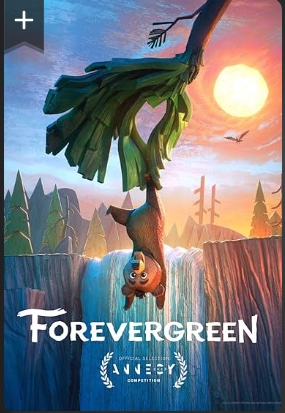
The Academy Award-nominated animated short film Forevergreen has generated significant buzz in Christian circles. It is praised, especially by evangelicals, as “bring[ing] the gospel to the Oscars.”
Through crisp visual effects that combine the feel of claymation and woodcarving, and wordless musical narration that swells at all the right moments to drive the plot forward, the film offers a touching story of an orphaned bear who comes under the care of a wizened evergreen tree. It follows a familiar arc from an edenic communal relationship to the bear’s rebellion to the tree’s self-sacrificial act of redemption — the tree bridges a literal chasm from the bear’s certain fiery death back to safety.
In the aftermath, the bear discovers a remnant pinecone that carries the seed of new life. When planted and tended, the sapling grows to a mature tree that offers an enduring home for the bear’s family. All is restored as the music swells into the only sung words of the film, “Forevergreen. My love will always be. Forevergreen.”
The film’s closing frame directly names its guiding inspiration with the written words of John 15:13, “Greater love has no one than this, that one lay down his life for his friend.”
As I dug into the story of the film’s creation, I was unsurprised to find that one of the film’s creators describes himself as Reformed as well as evangelical. The bear is clearly undeserving of the grace it receives and unable to take any action toward its own salvation. Though the wayward bear does eventually drop its burden (of campsite refuse) and reach outward, the tree is the one who closes the distance, hoisting the bear onto its broad trunk. Even then, the bear doesn’t move on its own but must be pushed to safety by the tree as it breaks and falls into the chasm.
Another deeply Reformed theme is divine providence. The tree nurtures the young bear, providing for all its needs. It feeds the bear with seeds from its pine cones; it plays with the bear, lifting it again and again so it can tumble tail over head down a sun-bathed hill. It provides a sheltered nest in its soft needles and comfort when the bear noses up to a wandering porcupine.
I couldn’t help thinking of Belgic Confession Article 13’s description of “our gracious heavenly Father,”
who watches over us with fatherly care,
sustaining all creatures under his lordship,
so that not one of the hairs on our heads
(for they are all numbered)
nor even a little bird
can fall to the ground
without the will of our Father.
Of course, the bear is unaware of the fullness of the gift it has been given, and when it encounters a stray bag of “irresistibly delicious” potato chips, it comes to see its quaint forest life as restrictive; the tree’s efforts to hold it back as unfair.
While the intended gospel connections may be too subtle for the youngest viewers and may strike some more seasoned believers as too “on the nose,” and the resurrection metaphor strikes me as too simplistic to signify the inbreaking of God’s kingdom, Forevergreen is artfully created and surely worth the 13-minute watch time.
The lack of dialogue draws the viewer in to the other details — texture, color, movement, sound. In this way, it’s embodied. We notice that the animation style gives the bear an almost wood-like quality; its head is not dissimilar to the tree’s own pinecones. They belong together, unlike the potato chip bag with its garish red and gold plastic sheen.
As I reflect on the film now, I find myself wondering, what is the true moment of salvation in this story? A classic evangelical perspective would point to the climactic moment with the bear separated from the tree by a deep canyon. Flames rise and choking smoke billows above the bear’s head when, suddenly, the tree tears itself from the ground at the roots, crashes across the giant gulf, and reaches its branchy arms down to rescue the bear from the consequence of its own rebellion. As it pulls the bear upward to safety, its bushy top catches fire, its trunk cracks under the weight, and even as it shoves the bear onward toward its original home, the tree’s own broken body plummets to the watery grave below. This is surely the picture of self-sacrificing redemption that John 15:13 commends.
However, the more I think about it, the more I wonder if another moment of salvation happens right at the beginning of the film. In the opening frames, we see the baby bear wandering alone in the winter wilderness. It’s clearly lost and cries out repeatedly. Seeing a scraggly berry bush on the cliff precipice, it reaches out beyond a point of stability, the rock edge crumbles, and the bear slips, clinging to the cliff’s edge. As its very first action, the tree reaches its branches down, plucks up the baby bear from certain death, and cradles it in the safety of its hand. As snow is brushed from the bear’s head, it is adopted into a new family, though it knows nothing of it yet.
We love because Christ first loved us.

2 Responses
What a gift you give to point us to this short film via the pages of the RJ.
Reading your comments again after watching the film gave me a whole new appreciation for what I saw.
I’m reminded of the phrase “Preach the gospel at all times, when necessary use words”
Thanks for giving me a warm reminder of God’s love for all.
Yes, thank you for alerting us to this engaging short filmic parable!