
I won’t lie: I’ve been having a bit of writer’s block this week.
This is my last entry in the Reformed Journal blog for a while after a four-week guest stint. It has been an honor and a pleasure to do this, but I need to do one more. With no immediate thoughts about this week’s lections that won’t be in my sermon—which is where my last few entries began—I will look ahead a bit.
In just eleven weeks, I’ll be speaking on the last day of the International Summer School of Theology, held at the Vrieje Universiteit Amsterdam—the Free University in Amsterdam, the Netherlands. A few faculty from New Brunswick Theological Seminary (NBTS) will be speaking with faculty from the Protestantse Theologische Universiteit (PThU) and from schools in eastern Europe and South Africa, all discussing “Being Reformed in the Twenty-first Century.”
As the world is confronted by Christian Nationalism, authoritarianism, racism, and economic and environmental crises, how does Reformed theology respond?
I plan to be listening carefully all week, tying together the loose threads. I also intend to give everyone a report from the field. As it turns out, for all the struggles we have paying bills, repairing aging buildings, dealing with consistory meetings, session meetings, council meetings, classis and presbytery meetings, finding candidates for professional ministry, and dealing with the dwindling numbers of people and dwindling finances, I am bullish on Reformed churches. For all our arguments over sexuality and gender and what God thinks of them, for all our institutional racism and discrimination and all the resulting dysfunction of our synods and assemblies, for all of our ridiculous discussions of required plans for grace-filled actions—once something is required, it cannot be grace—I still see bright lights of Reformed ministry.
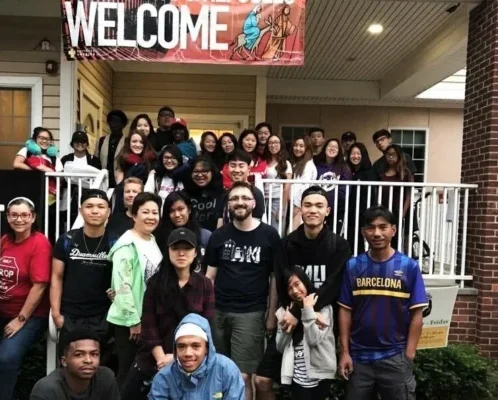
Let me tell you about just a few of these, sure that all of you know at least some yourselves. The Reformed Church of Highland Park, New Jersey, is celebrating twenty years of its Affordable Housing Corporation. This congregation also has a busy ministry supporting immigrants, keeping families together, standing up to the government, and helping those immigrants develop skills, finding jobs and a place in society. Less than a mile away, a historic Reformed congregation remade its massive sanctuary into a much more useful sanctuary and several apartments, starting a 501(c)(3 ) to provide supportive housing. Less than half a mile from that church is a Suydam Street Reformed Church, nurtured by its classis from a dwindling German ethnic ministry to a thriving bilingual Hispanic and English ministry.
I know, off the top of my head, about vital social service ministries started in local Reformed congregations, including congregations that were near death before beginning to reach out. I know of clusters of small churches in upstate New York that, in the days before online classes, created training programs for non-professional leaders in small churches—they’re not all lay leaders, because many are ordained as deacons and elders.
I know a small church in Harlem that has confronted a racist past by redeveloping an ancient African burial ground, and another that has developed a ministry that gives hope to the children of incarcerated people. In Los Angeles, one congregation’s ministry keeps youths out of gang life. In Oakland, a congregation with a pastor who was once hurt by the church has a ministry to other wounded believers. Across the globe, the Al-Amana Center in Oman opens up dialogues between Christians and Muslims, working for peace, justice, and understanding.
None of these ministries are part of megachurches. None of these are the direct result of denominational initiatives. A few are ministries with pasts that we must confess and lament. But each day, people wrestle with Scripture and historic doctrinal standards, trying to live into the challenges of Matthew 25, Micah 6, Joel 2, and any number of other divine challenges.
From my vantage point at NBTS and at the Reformed Church Center, I see new generations of faithful pastors making historic doctrine and liturgy relevant rather them ignoring them, leading small, struggling congregations to become beacons of God’s justice and wholeness, every day.
And it seems all this does tie into my lectionary passage for this week:
They devoted themselves to the apostles’ teaching and fellowship, to the breaking of bread and the prayers . . .
All who believed were together and had all things in common; they would sell their possessions and goods and distribute the proceeds to all, as any had need. Day by day, as they spent much time together in the temple, they broke bread at home and ate their food with glad and generous hearts, praising God and having the goodwill of all the people. And day by day the Lord added to their number those who were being saved (Acts 2:42, 44-47).
As I said, I have eleven weeks, and I only know some of these stories. If you know another one, please be in touch with me at jbrumm@nbts.edu.

4 Responses
Thank you for your posts to the Reformed Journal. I am sorry about it being your last. I hope to hear your voice again here at some future time. Today’s post was enlightening and hopeful in light of the ongoing barrage of daily negative news. I know it’s said good news doesn’t sell but we need to hear it to put hope back in our hearts.
You asked for other examples. I just attended a panel discussion put on by Hope Academy for Senior Professionals (HASP) with representatives from Hope College, Western Theological Seminary and Hanlon Prison in Muskegon MI about the Hope-Western-Prison Academy. I was impressed with their success rate (the 1st PHd graduate) and the good news/bad news of 3000 on waiting list. I’m not good with details so I hope I got those facts correct. The taped testimonies of the prisoners taking the classes was heart warming. I believe these programs offer a better answer to the revolving door of repeated incarcerations:Restoring the “created in God’s image” in ALL humanity.
Thank you, Joyce! I am aware of this program, which I have been following with interest. There are also terrific things happening at NBTS and Calvin and Princeton and Fuller and other places. At the moment, however, I’m really hoping to concentrate on what is happening in local congregations, rather than the bigger institutions we always expect.
Thank you for sharing these stories, James.
I am grateful to hear of your participation with PThU! Another gift that keeps on giving is the heart for ecumenism our little RCA has lived out over the decades. That brought me into a wonderful friendship and co-academic in youth ministry with a professor of PThU Ronelle Sonnenberg! She is a fabulous academic and friend. May God continue to enrich communities of faith around the world through this mutual work, understanding, insight and fellowship.