
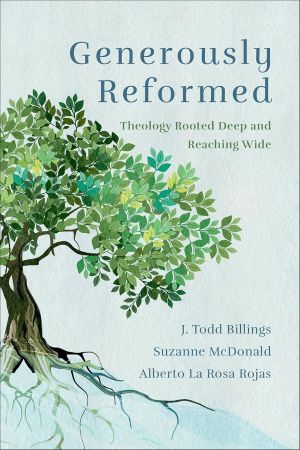
Editor’s Note: Following is an excerpt from chapter one, “A Reformed Theology Primer: Misconceptions and Realities,” from Generously Reformed: Theology Rooted Deep and Wide.
Slow Thinking in the Center and the End: The Triune God’s Glory and Creation’s Restoration
Reformed theology is theocentric, focused first and foremost on God. This is a deeply countercultural emphasis. Sociological studies in the United States have shown how the “self” is central for many, with the vast majority of Americans claiming that “enjoying yourself is the highest goal of life.” Sadly, this is true also among many Christians, who tend to see God as a butler who serves our own interests—namely, to pursue “the central goal of life [which] is to be happy and to feel good about oneself.”
In contrast, Reformed theology finds its central delight in the beauty, majesty, and glory of God as displayed to us in Jesus Christ. For many, this is a refreshing emphasis, leading to prayer and worship and lives of gratitude and thankfulness. In contrast to the endless quest to “discover oneself,” the Reformed confessions clearly testify to God as the source of our hope and life. This theocentric focus is displayed elegantly and simply in the opening of the Westminster Shorter Catechism, which declares that the human purpose is “to glorify God, and enjoy him forever.” Human beings were not created for the purpose of being happy in themselves. God created humans to delight and enjoy, to find their purpose in bringing glory to God, living in testimony to his beauty, honor, and love.
This theocentric emphasis certainly invites us to transcend an obsession with ourselves, but it is also deeply existential and even personal in its implications. The opening section of the Heidelberg Catechism displays how this theocentric focus has deeply experiential implications in how we view ourselves:
Q. What is your only comfort in life and in death?
A. That I am not my own, but belong—body and soul, in life and in death—to my faithful Savior, Jesus Christ.
Echoing the apostle Paul in 1 Corinthians 6:6–20, the catechism begins with the basic reality that we do not belong even to ourselves. In each day of life and as we face death, our hope is not in our success or accomplishments; it is not even based on the goodness of our acts of love toward God and others. Our only true and final hope and consolation is extrinsic, coming from outside of ourselves. It is the new identity we receive through the Spirit: We belong—“body and soul, in life and in death”—to Jesus Christ, our faithful Savior.
As the Heidelberg Catechism continues in its answer to this first question, the trinitarian framing for Christian identity is accented. One’s comfort in life and in death is found in belonging to Christ, who has delivered believers from the penalty of sin and the “tyranny” of the devil. Because we belong to Christ, the Father of Jesus is now our Father, active in providential care. And as we are in union with Christ, the Spirit “assures [us] of eternal life,” generating signs of the new creation now and making us “wholeheartedly willing and ready from now on to live for him.”
Thus, although Reformed theology is theocentric, accenting God’s sovereign transcendence, it is deeply Christ-centered and profoundly personal in its implications, with the Spirit mediating both forgiveness and new life through Christ. Crucially, this new life also reflects a high theology of creation because salvation itself is approached not as a deliverance from the created world but as a restoration of creation’s goodness through the work of the triune God. Stated differently, God’s grace does not destroy creation’s nature; it restores it. The enemy that is conquered in Christ is not creation or human culture; it is sin.
In its focus, Reformed theology is theocentric and Christocentric, yet it is also deeply personal in its doctrine of the Spirit and the Christian life. Bavinck frames the restoration of God’s good creation through grace as foundational to his theological approach and to discerning the Spirit’s ongoing work: “The reality [is] that the creation of the Father, ruined by sin, is restored in the death of the Son of God and re-created by the grace of the Holy Spirit into a kingdom of God.” The problem is not with creation, but its corruption. Christians of all occupations and vocations are called to bear witness to Christ’s kingdom, his reign, which has implications for all spheres and areas of life. Thus, in the words of Bavinck, Reformed theology “shows us how God, who is all-sufficient in himself, nevertheless glorifies himself in his creation, which, even when it is torn apart by sin, is gathered up again in Christ.” By the Spirit, those who have been adopted into the household of the Father are called and enlivened to gather up that which sin has torn, and continues to tear, apart.
Theology in a Reformed key is not only theocentric, trinitarian, Christocentric, and personal; it is also a Spirit-enabled pilgrimage in Christ. We rejoice that the Spirit enables us to receive and abide in the Word, bringing us into the household of God not simply as servants but as adopted sons and daughters. For “when we cry, ‘Abba! Father!’ it is that very Spirit bearing witness with our spirit that we are children of God” (Rom. 8:15b–16). The joy of this adoption and the new household that we have been adopted into (the church) are gifts we do not achieve. We were graciously incorporated into this people and this inheritance by the Spirit. It is a present reality, but it is also bent forward, in trust, in ache, and in hope. We “groan inwardly while we wait for adoption, the redemption of our bodies. For in hope we were saved. Now hope that is seen is not hope. For who hopes for what is seen? But if we hope for what we do not see, we wait for it with patience” (Rom. 8:23–25).
We have been adopted, yet we groan as we await adoption. We are on a journey. Through the Spirit, we have been incorporated into Christ, the Word of the Father. Yet, we look forward to the hope we have not yet seen, when Christ, who is our life, comes again in his second advent. “When Christ who is your life is revealed, then you also will be revealed with him in glory” (Col. 3:4). We know that there is much we don’t understand; there is much that we cannot see now, “For now we see in a mirror, dimly, but then we will see face to face. Now I know only in part; then I will know fully, even as I have been fully known” (1 Cor. 13:12). But we are not looking for an end beyond encountering God’s glory face-to-face with Jesus Christ. “For it is the God who said, ‘Let light shine out of darkness,’ who has shone in our hearts to give the light of the knowledge of the glory of God in the face of Jesus Christ” (2 Cor. 4:6).
How do we think theologically about the fact that our own knowledge is incomplete, in process, on a journey? Reformed theologian Franciscus Junius (1545–1602) can help us here. He developed a theocentric, Christ-centered, Spirit-enabled way to speak about the reality that we have genuine knowledge of God on this journey, even as it is indirect and partial. He makes two levels of distinctions to help clarify our situation. First, he distinguishes between archetypal knowledge of God (God’s knowledge of himself) and ectypal knowledge (a mediated, accommodated, human knowledge of God). God truly makes himself known to us through Scripture, but he does not thereby convey archetypal knowledge of himself. Instead, through Scripture, God graciously gives us ectypal knowledge—knowledge born of a relational way
of knowing God that is appropriate for small, mortal creatures like us.
Within this indirect, accommodated knowledge of God, Junius introduces three further distinctions to help give us proper perspective about our cur-rent pilgrim knowledge of God in Christ. The highest creaturely form of the knowledge of God is present within a mystery at the center of the universe—the Word made flesh, the union of God and humanity in Jesus Christ, the covenant Lord and Servant in one person. This is a theology of union, for “it exists in Christ according to his humanity.”45 As John 1:18 testifies, “No one has ever seen God. It is God the only Son, who is close to the Father’s heart, who has made him known.” Thus, according to Junius, all creaturely knowledge of God stems from this theology of union, for Christ, as the “prototype and essential wisdom of God,” is the source of every other level of knowing God.
The second-highest knowledge of God is a theology of vision. It is a knowledge of God afforded to the redeemed at the beatific vision, the final face-to-face vision of our Lord when Christ “will come again in glory to judge the living and the dead, and his kingdom will have no end.” We look forward in hope to this vision because we don’t yet see face-to-face. But on that day, we will “acquire in the heavens the glorious vision of God and by which we ourselves will, in the same ways, see God.”
Finally, we come to the most modest form of theology, the theology of pilgrims. It is a humble type of theology, for this theological vision is “indiscriminate, vague, and incomplete”; it is imperfect compared to a theology of vision. Even our best theological reflection now falls short, for it is “mixed with our weakness and imperfection.” But Junius insists that it has dignity as well. Through divine revelation, our pilgrim theology is sufficient for its purpose on our sojourn. Moreover, along with vision theology, pilgrim theology is a gift established in Christ himself: “Christ sanctified both these types of theology in His own person, since He both experienced the humble theology in the humiliation of the flesh, and now enjoys the exalted type in that very exaltation by which He now has been exalted above every name, evidently so that He might show that the common principle of each theology resides in Himself.”
In this way, a Reformed vision of our theological journey and end is both modest and audacious. In modesty, we can openly admit that our knowledge of God is incomplete and indirect, for “we see in a mirror, dimly” (1 Cor. 13:12), giving testimony to our hope as we cry out, “Come, Lord Jesus!” (Rev. 22:20). Audaciously, we can do theology as children of God in Christ who have been graciously adopted into God’s covenant household and inheritance. As ones united to Christ and his body, we are gifted a genuine, relational knowledge of God, as the Spirit cries “Abba! Father!” in our hearts. We belong to God, in life and in death. We are not masters of “the way, the truth, and the life.” Rather, we belong to the one who is himself “the way, the truth, and the life.” And by the Spirit, we seek to grow into maturity in him.
Content taken from Generously Reformed by J. Todd Billings, Suzanne McDonald and Alberto La Rosa Rojas, ©2026. Used by permission of Baker Academic.

4 Responses
Hmmmmmm…
Nicely stated. But what makes this “Reformed” rather than simply biblical?
And why the polarization between fulfillment of our God-created selves and mystical adoration/contemplation?
And how do we think of Abraham and David and Isaiah having a meaningful expression of true human/spiritual life if they did not know Jesus? Sometimes I ask my students what the purpose of parents and grandparents is. This is a trick question. I then facetiously say, “To create us, right?! Their importance is only to bring us into the world! They have no intrinsic value beyond that, because WE are/I am the center of all meaning!” Of course this is wrong! Of course I am joking! But it gets us into a discussion about what meaning there is in the Old Testament and the interactions of God with our ancestors there. We tend to treat them like parents or grandparents whose only meaning for existence was to bring us into being, because life NOW has purpose that they could not imagine.
So too, it seems, with these theological definitions of “Reformed theology.” WE see and know and experience TRUTH differently and better than others did. And TRUTHFUL contemplation of God is the beginning and end of all human living.
Except it isn’t.
Just as the best of parents do not constantly cudgel their daughters and sons to praise them as parents, even Jesus, when praising our Father, did not make this an end in itself. To have this at the center of our theology would be myopically unhealthy. Think again of the manner in which Jesus taught his disciples to pray. Yes, there is necessary affirmation of our Father. Because only when we know our ultimate parent in all goodness will our daily lives, which are not lost in beatific contemplation, be meaningful, as our great Parent wished for us.
I just started your excellent book this weekend, so thank you for sharing it with the world in this medium too.
I had several occasions, in my career, where I was privileged to interview prospective teachers. They were applying for a position in the Bible department so it was deemed important to ask about “Reformed Faith.” I remember very clearly a discussion between two colleagues, it began with the question, “what do you mean by “reformed faith.” After almost every answer the young colleague (who was raised outside the reformed community) responded, “all Christ followers believe that, don’t they?” I think there are many in the Reformed. Camp who really believe they are more unique than they actually are, in Nigeria we lived with and ministered with Christ followers from eight different denominations, we are all on the same team. We can keep telling the next generation that being Reformed is somehow special, I am with Wayne, I prefer being Biblical.
I am a bit surprised there is not a host of responses here. This is a very useful and articulate summary. Thank you.
One of my reactions is related to the experience I have had with the “Reformed” question. Most people I know ( mostly lay people) immediately jump to the TULIP summarization, which I find misleading and even off-putting. To be blunt, this simplification feels exclusive. “We” are chosen and you are not. God’s irresistible grace is either not that powerful or not that irresistible because my child or parent or spouse or friend has “fallen away.” And what kind of God elects some and reprobates others? A sovereign God has the “right” to select, but it does not logically follow that God does.
When we focus so much on individual salvation ( salvation from hell) we under-appreciate and understate both the gospel and the kingdom.