
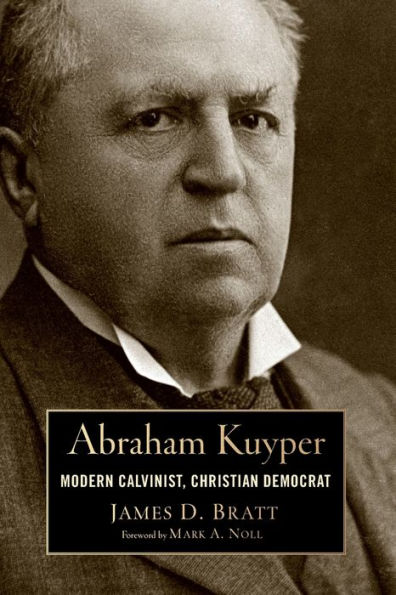
The single most quoted line in my biography of Abraham Kuyper comes in the Introduction: “Kuyper was a great man but not a nice one.” Should my book ever appear in a second edition (ha!), I’d have to modify that estimate because of a brilliant new study of the man.
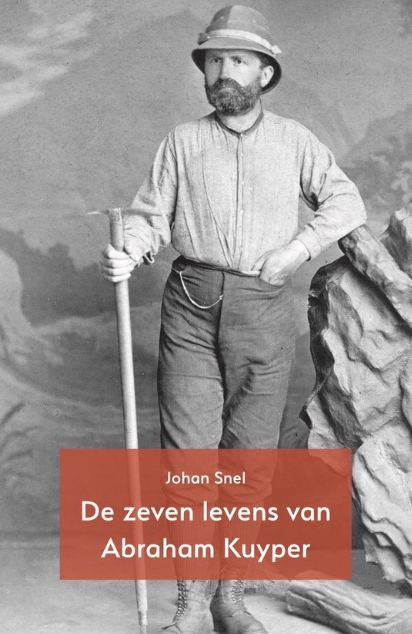
Johan Snel’s De zeven levens [seven lives] van Abraham Kuyper (Amsterdam, 2020), soon to appear in English translation, gives a fascinating look at a Kuyper we’ve never seen before—the Kuyper of everyday life and close personal interactions in a remarkably wide range of settings. The genius remains, the gruff combatant still rides forth endlessly to battle, the rigid schedule, the titanic labors, the boundless energy, the ever-flowing pen—they’re all here. But so is a deep dive into the private man’s moods, his informal conversations, his genial repartee and cordial interactions with all types of men—and women—in the street. Well, not that kind of woman in the street but every other sort, from factory worker to socialite to royalty to clubwoman, be they Dutch, Turkish, Spanish, or American.
Sources
Most studies of Kuyper, especially those in English, are based on his 200+ books, with added spice from the thousand cartoons drawn of him, mostly by opponents, mild or harsh. Snel’s book includes some fine examples of the latter but breaks new ground by using digital technology to plumb the 9000+ letters that Kuyper left and the 13,000+ articles he wrote in his newspaper and magazine.

Then there are the 16,800 “three stars” (think turn-of-the-century tweets) from his daily paper, zingers directed at current personalities and events. He composed them daily between noon and 12:30 lunch, after the day’s heavy writing was done and before the afternoon’s teaching or political consultations. This was his favorite genre except for his weekly biblical meditation, written Sunday mornings in lieu of going to church.
Four of Kuyper’s “seven lives” are well known to English readers: the scholar, the organizer, the politician, the public speaker. On the fifth, the journalist, Snel offers many new insights, journalism being the field he teaches, and Kuyper’s journalism having been the subject of his doctoral dissertation. More on that later. For me the book’s most intriguing contributions lie in Kuyper’s two other, largely private, lives: as world traveler and mountaineer.
Mountaineer
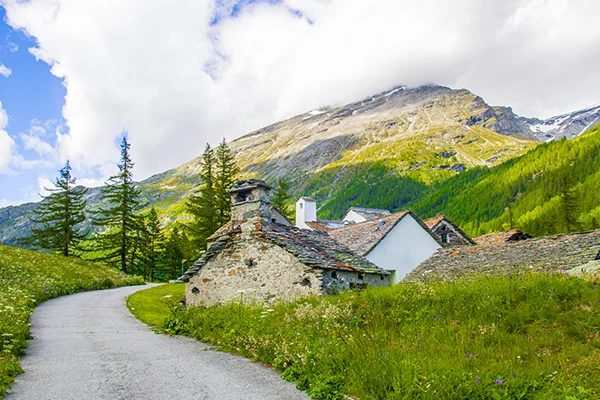
Kuyper kept such a frantically full schedule that he had to take long summer vacations—six weeks at a minimum, sometimes more. These typically involved scaling mountains, every range from Norway and Scotland to the Tatras, Pyrenees, Adirondacks, and especially — 35 times! — the Alps. South Tyrol (today the northernmost part of Italy, back then part of the Austro-Hungarian Empire) was his favorite place on earth.
Kuyper would not seem to have fit the mountain-climbing bill, what with his 5’ 6” frame carrying at least 200 lbs. But here we watch him up there six to twelve hours a day, clambering up the ashy slope of Mt. Vesuvius (4200’), sliding down an Alpine glacier, taking six-day treks, ascending 10,000-13,000’ peaks, sometimes with a guide, sometimes with a companion, most often by himself. Summer after summer, this was his happy time and place. Yet, Snel notes, Kuyper—so typically—cast these feats “in terms of duty and calling….” He “enjoyed himself only when he wore himself out completely.” [49]
World Traveler
Mountaineering opened up Kuyper’s second life, the globetrotter. As the several packed passports in his archive attest, he might have been the most traveled Hollander of the age. Two journeys stand out. The first took him around the northeast quadrant of the United States in 1898 after he gave his famous Stone Lectures at Princeton. Pella, Iowa he found “sleepy,” Orange City, bustling, New York City so adrift with December snow that he could get in a mountain-worthy hike just getting back to his hotel.
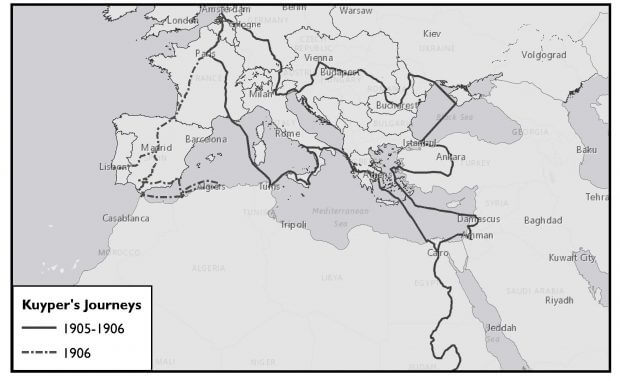
The second was a genuine pilgrimage, a nine-month tour around the Mediterranean Sea in 1905-06. Trains everywhere, a boat down the Nile all the way to Khartoum, a camel ride, then a harrowing automobile over the mountains of Morocco. Along the way he wanted to get to Kyiv but was thwarted by that year’s revolutionary uprising in Russia, so he had to content himself with dodging riots in the streets of Odessa and dropping by a couple meetings of dissidents.
Less known are Kuyper’s constant treks to Brussels and Paris, quick getaways from the pressures of the week. The big city was the only locale where he felt as happy as in the mountains, he confessed. So there was London in 1867 when he might have glimpsed Karl Marx writing Das Kapital across the reading room in the British Library as he himself did research on sixteenth-century Dutch exile churches. There was Budapest in 1916 on a visit to one of his daughters working at a hospital for wounded Hungarian soldiers. Now and then there were secret diplomatic missions to Berlin and Paris and London again. There was Rome in 1876 as he tried to recover from one of his total collapses. The next breakdown, in 1894, saw him land in Tunis to cure his lungs. Summer after summer he was in the Pyrenees where he could combine his annual water cure—blasts hot and cold in the morning—with mountain hiking in the afternoon.
Meetings
Perhaps the most intriguing coincidence in all these travels came on an August day in 1879 when, Snel calculates, Kuyper probably shared an Alpine mountain shelter with Friedrich Nietzsche. What could they talk about but the weather? Nietzsche would start on Also Sprach Zarathustra in these parts a couple years later; Kuyper would introduce Nietzsche to the Netherlands a decade after that. In the Alps, Nietzsche peered into the abyss; Kuyper gazed up at the peaks with deep spiritual insight as in his magnificent meditation on Psalm 42.
Perhaps Marx and Nietzsche, certainly the Archbishop of Canterbury, the kings and queens of Portugal, Spain, and Romania, the Grand Vizier of the Ottoman Empire, President William McKinley, Kaiser Wilhelm II, imperial movers and shakers across North Africa—Kuyper was at ease in elite company and relished the honor thereof. But he liked to hang out with ordinary folks even more. He milled around anonymously in big-city throngs; he raised eyebrows by giving distinguished service awards to commoners; he went out of his way to interview line workers while investigating corporate labor abuses.
Character
Kuyper was ever curious, his notebook and folders ready to collect vital statistics at every spot on his travels. He was cordial with hotel and railroad staff, mountain guides, and spa workers. He exuded bonhomie in everyday interactions. He had fun with his three-star comments, and however much he might dig at his opponents therein, he rarely treated them with disrespect and never with contempt. Snel characterizes this commentary as “cabaret,” a series of cracks and quips that could “be mean to the bone” but struck “the reader … [as] clever and hilarious.” (31) Stephen Colbert, only Calvinist instead of Catholic.
This was certainly not one of the Kuypers traditionally perceived in North America. There he has typically be received as a hero crossing swords with deadly enemies of the Christian faith, or the earnest model of institutional formation, or the racist architect of South African apartheid, or—the one I first picked up—“the rigid Calvinist, determined and inflexible. . . the systematic theologian, a close minded thinker.” (27)
There is something—sometimes much—in Kuyper to leave such impressions. Snel points out the huge difference, often intentional, between the public and private man, between the droll walker in the city, scaler of mountain peaks, inveterate reporter on the one hand, and the captain of a complete system demanding allegiance in the great conflict of the ages on the other.
We’re probably drawn to the first figure more than to the second. Yet, there is great value in that system and in the (Hegelian) habit of systematic diagnosis and prescription behind it. In fact, this “architectonic critique” might be the very thing that makes Kuyper worth remembering. We’ll try to unpack that paradox next time.

6 Responses
Splendid.
Thanks, Jim, for this fascinating look into a man many of us interact with regularly and yet also don’t know fully.
Even to us educated and living in the Netherlands into our twenties, quite a different picture. Much appreciated.
Great fun—Kuyper clambering over more square inches than we knew!
I wonder sometimes if Abraham Kuyper would have been comfortable joining the discussion at the lever of the Frankfort School of sociology. They were comfortable analyzing larger movements that seem to energize social issues and conditions. Habermas still paints with a broad brush as he sweeps through the idols of the age. I can imagine that Kuyper might just enjoy engaging at the level of social analysis of a Marx or even of a Nietzsche.
Thank you for this great article.