
Imagine you wake up in a room. At first, you can’t move or talk, but eventually you realize you are lying in a bed in a cylindrical room, hooked up to IVs and tubes. There are two other beds in the room, each containing a corpse. You cannot remember where you are, how you got here, or even your name. Over time, you start to remember moments from your past. You were a middle school science teacher. You remember finding out that astronomers realized that the sun’s output was decreasing in ways it shouldn’t. You remember when scientists discovered the cause of it. You remember you were recruited into a group of scientists organized by world governments to solve the problem. Eventually, you are strong enough to get out of bed, and you realize that things fall to the floor faster than they should. You do some experiments (after all, you are a middle school science teacher), and you determine that the room with the beds that you are in is experiencing gravity stronger than that on Earth. You are on a spaceship.
Then you remember. This is the Hail Mary, the first spaceship to leave Earth’s solar system – on a desperate mission to save humanity. Your task is to figure out why the star you are approaching is not affected by the solar output decline that is affecting all the other stars near Earth. When you figure that out, you are to send information back to Earth via small probe ships. This is because your mission is one-way. The ship had enough fuel to get you here, but not to get you back. The dead people in the other beds are your friends and crewmates. You are the only crew member to survive the journey, and you are the only human for light-years. You are going to die alone, far from your home.
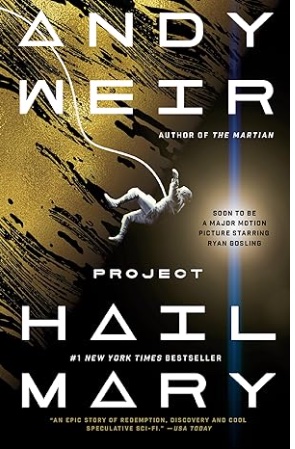
That is the setup for Andy Weir’s remarkable book, Project Hail Mary. Weir, perhaps best known for his novel The Martian, which was made into a blockbuster film starring Matt Damon, seems to write best at the intersection of desperation and hope. As in his earlier novel, Weir’s latest effort, Project Hail Mary, is gripping, funny, moving, remarkably thoughtful, and not nearly as bleak as that summary makes it sound. It is infused with hope. And unfortunately, because of some delightful twists and turns (all the way to the very end of the book), I can’t say much more about the plot without denying you the joy of discovering those moments. That makes it a hard book to review.
But I can tell you some reasons why you need to read this book.
First: If you don’t like science fiction, don’t worry, this book defies that genre. While it has some science in it – the science comes up in a series of problems that the main character, whose name is Ryland Grace, needs to solve to stay alive or carry out his mission. Weir is masterful at telling the reader what is necessary to understand what is going on without it feeling like a lecture. The science helps define each problem, and the reader often ends up guessing about the situations or solutions. Grace’s voice is so entertaining that the science is emotionally charged and gripping. He is consistently funny – for example, because he is a middle school teacher, he seldom swears, instead saying middle school-appropriate substitutes like “fudge,” and “gosh,” then making fun of himself for doing so.
Also, this isn’t the sort of science fiction where humans, aliens, and robots are fighting each other with laser swords and photon torpedoes. This is a story about a human whose technology is no different from ours today. This book is a throwback to when science fiction had real science in it and was really good fiction as well.
Second: If you are worried that you aren’t sure you want to read an entire book about one character, don’t. The book has quite a large cast. After Ryland has woken up from a coma that he was apparently in during the long transit from Earth to Tau Ceti, his memories come back slowly. As they do, we learn how he became an astronaut. Along the way, we meet a Dutch woman named Stratt, in charge of Project Hail Mary, with a no-nonsense attitude and no patience for people who waste her time. Sometimes she crosses a line. At one point, Grace says to her, “You can’t just use ‘I’m saving the world’ as an excuse every time you’re a jerk.” Stratt concedes he is right. She is a delight to read about. We meet other scientists working on the mission, including Grace’s potential crewmates and others, including a Canadian rocket scientist obsessed with the Beatles, a Russian physicist who likes puns, and many others. More importantly, as Grace’s memories return, the story unfolds.
The back story ends up entwined with the story of Grace’s attempts to figure out why Tau Ceti has escaped the fate of the other stars, but, of course, if I explain how, you wouldn’t enjoy the surprises. And there is also another character…who I can’t tell you about. But that character becomes Grace’s best friend. That’s all I can tell you – but this is a friendship you will want to read about. I guarantee it. You’ll be glad you did. So, this is not really a story about one person, but about a community.
Third: Look, I know that no one other than English teachers reads a book for its themes, but I think when we read books, we are looking not only for an entertaining story but also for some Truth with a capital T. That is how general revelation works, after all. God gives us a Creation that reflects God’s Truth, we humans live in it, we make art (in this case, an amazing novel), and somehow, some Truth gets in there. This book is no exception.
Without spoiling anything, I can tell you that this is a book about friendship, responsibility, and sacrifice. It is also a book about hope. What I mean by that is not that this book merely contains all of these things, but that it reveals important Truth about them. Partly, it does that by having such high stakes. Ryland Grace is a regular guy tasked with literally saving the world, and things get so desperate at so many points in the story that each of these truths comes into stark relief. Responsibility in this book refers to fulfilling a mission that will save a world that Grace will never return to. Sacrifice refers to not only giving up life, but everything and everyone that you know. And hope is the sort of hope that is necessarily in only the most desperate situations. Any yet I can’t tell you exactly what Truth it conveys because that isn’t how novels work. You experience the truth by living someone else’s life for a while. The bottom line is, you are just going to have to read this book.
Fourth: This is the sort of book that, as soon as you read it, you’ll be surprised to find that there are a lot of other people you know who have also read it. You’ll be torn and thrilled that you can discuss it with them and mildly irritated that they weren’t more insistent that you read it sooner.
Fifth: Honestly, this book has the greatest ending I have read in at least a decade.
I am sorry that I can’t tell you more about what happens in Andy Weir’s Project Hail Mary. I can’t tell you about several moments of discovery that change the book’s direction. I can’t tell you of several moments when hope is completely justified. And I can’t tell you anything else about the remarkable friendship that defines the second half of the book. There is no way around it. You are going to have to get the book and read it. If you can, get the audiobook. Ray Porter’s reading is masterful. He nails Ryland Grace’s inflections and humor, and manages multiple subtle accents that are never irritating. But it is a great conventional read as well. Once you have read it, let other people know. Get someone you love to read it. You’ll have to. You’ll really want to talk to someone about what it has to say about responsibility, sacrifice, hope, and friendship, and when you do talk to that person, you won’t have to worry about spoilers like I have had to in this review.

8 Responses
Thank you for this review. I listened to the audiobook and loved it. Well worth reading.
You convinced me, Bill – thanks!
But if it isn’t everything you say it is – I’m comin’ after you ☹️. 🙂
Thanks for this review. I appreciate the care you took not to spoil the adventure for others, but this no doubt made your writing job arduous.
Thanks for this great review!
Thanks for the lovely review of what seems a lovely novel. Eager to read and then see film.
This was a great review. I wholeheartedly also endorse the audiobook for [main reason redacted]. Kudos for avoiding spoilers, but also for the great section on Truth that I think applies to so much great literature. Would that more people read excellent books that taught community, empathy, sacrifice, etc.
Love hearing your voice in this review. The height of the pile of books that I need to read has just increased.
I love this book! You have executed an exquisite review.