
“And I have to admit, looking back, I was part of that world,” our friend said, ruefully. We had been chatting for an hour or so, catching up on kids and grandkids, gardens and vacations, when – lowering her voice with a quick glance over her shoulder – she had suddenly re-directed the conversation toward the volatile mix of MAGA politics and evangelical Christianity that had recently roiled Ottawa County, Michigan, where Mary and I were visiting family and old friends.

West Michigan isn’t unique, of course; self-identified evangelicals nationwide had voted in overwhelming numbers for Donald Trump in three consecutive presidential elections. But towns like Holland, Zeeland, Hudsonville, Jenison, and Allendale felt the impact of this alignment in a very local way in 2022, when a slate of candidates for the Ottawa County Board of Supervisors swept into office under the banner of “Ottawa Impact,” representing an aggressive mix of Christian nationalism, homophobia, COVID skepticism, and disruptive governance.
Ottawa Impact receded fairly quickly as a political force, done in by administrative misfeasance, internal conflict, and public exasperation. But its brief ascendancy was indeed impactful. It offered a tantalizing taste of power to its true believers, while demanding a reckoning from many others, like our friend, who saw their churches, schools, libraries, and health clinics swept up in the maelstrom. What virus in evangelical religion had produced these extreme symptoms? How have our own lives been affected by it? And, having seen what we have seen, can we remain “a part of that world”?
These are not just intellectual questions; for many, they are existential. The more deeply rooted one is in the evangelical world – in its congregations, conferences, family and friend networks, schools, publishers, book clubs, social media – the more difficult it is to confront the truth about its sickness. Redefining one’s place in that world, or removing oneself from it and rebuilding a life elsewhere, can be equally daunting – indeed, traumatic. It’s not surprising that this phenomenon has begun to generate its own vocabulary: Religious Deconstruction, Ex-vangelicalism, Post-Evangelical Traumatic Stress Disorder.
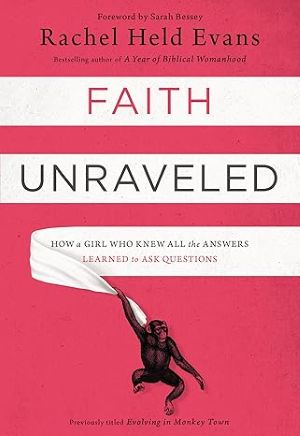
It has also produced a flood of memoirs. Already in the teens we saw Rachel Held Evans publish Faith Unraveled: How a Girl Who Knew All the Answers Learned to Ask Questions (2014), followed by David Gushee’s Still Christian: Following Jesus Out of American Evangelicalism (2018), and Rob Schenck’s Costly Grace: An Evangelical Minister’s Rediscovery of Faith, Hope, and Love (2019). Now there is a flood-tide of books by women: Beth Moore’s All My Knotted-Up Life: A Memoir (2023); Sarah McCammon’s The Exvangelicals: Loving, Living, and Leaving the White Evangelical Church (2024); April Ajoy’s Star-Spangled Jesus: Leaving Christian Nationalism and Finding a True Faith (2025); and Jen Hatmaker’s Awake: A Memoir (2025), to name just a few.
One recent book connects the earlier and later periods: Braving the Truth: Essential Essays for Reckoning with and Reimagining Faith (edited by Sarah Bessey, 2026), which collects posts from Rachel Held Evans’s influential blog, from its beginning in 2007 up to her sudden illness and untimely death in 2019, interspersing them with short reflections by over three dozen of Evans’s family, friends and readers. The timing of the book’s publication, one year after Donald Trump re-won the presidency and dodged accountability with massive support from self-identified evangelicals, is not lost on the contributors. It suggests that the MAGA-fication of evangelicalism is not a short-term illness, but rather a grave, chronic condition.
Evans knew this, even as she argued cogently against MAGA Christianity. Yet, she (mostly) managed to maintain an attitude of resilience, cheerfulness, and open-heartedness toward her erstwhile opponents. She would have asked along with Jen Hatmaker: “So many people gathered under these problematic umbrellas are, to put it succinctly, my beloveds. How do I reject the systems without disparaging the people I love?”
Perhaps Christians in these circumstances are called on to develop and practice the virtue of magnanimity. Not the aristocratic Greek version that haughtily regards one’s opponents as too insignificant to be bothered by, but a Christian version rooted in humility that sees them as fellow fallible humans loved and forgiven by God. As Dietrich Bonhoeffer reminds us, “The only fruitful relation to human beings … is love, that is, the will to enter into and to keep community with them.”
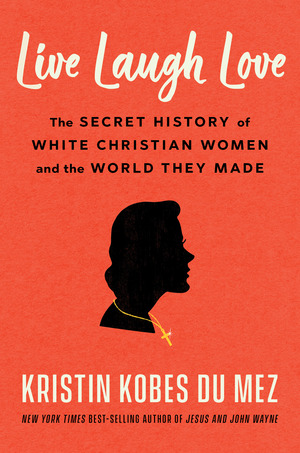
But such loving magnanimity must be grounded in a sober grasp of the reality we are facing; and human social reality is always shaped by history. Hence, we need books like Kristin Kobes Du Mez’s forthcoming Live Laugh Love: The Secret History of White Christian Women and the World They Made (September 2026; available for pre-order), which promises to be a worthy successor to her Jesus and John Wayne: How White Evangelicals Corrupted a Faith and Fractured a Nation (2021).
Above all, of course, we need to represent a winning expression of the Gospel, what Evans would call a “wholehearted faith” – one that is not shackled to prideful nationalism and the politics of resentment, but rather one that is defined by generosity, vulnerability, inclusion, and a commitment to truth and reality – a world of faith that we need not rue being a part of.
12 Responses
What a great piece this is. David. Thank you. I’m loving more book suggestions and will be purchasing, so the writers can thank you. Decades ago, when I was a seminary student, I was drawn to some women writers who helped me down the road of figuring out what I needed to leave behind, or at least question. Kathleen Norris and Anne Lamott come to mind.
But there were others.
Looking across a broader landscape we can find instruction and inspiration from others who model a robust orthodoxy that does not hesitate to unmask and refute the outrageous distortions of Jesus’s teachings that flow incessantly from the lips of preachers and presidents (not to mention Defense Secretaries and VPs). Yes, I’m talking about you, Pope Bob! (Forgive the informality — I live near his Augustinian HS in W Michigan and used to live in Philly.) But when oh when will you hear our Lord whispering in your ear that women and LGBT Catholics should be your helpers at every level of the church? Surprise us all: appoint a lesbian cardinal! (I am assuming that like nearly every thoughtful Christian he reads this blog.)
The church should probably be thinking harder than it does about the theological wisdom of adopting alignment with the Sexual Revolution as the supreme test of its present faithfulness. But if it isn’t going to engage in that (admittedly hard) work, it should at least learn from recent experience. There’s a lot of reasons why Donald Trump has not only been the conservative choice as leader in the last three national elections, but actually increased his voter share across all demographics despite repeated demonstrations of incompetence and downright malignity. One of them is the determination of left-leaning Christians to conform to what one can only wish were the inaccurate stereotypes their opponents conjure about them.
I agree with both Davids, Hoekema and Timmer!
I’m still someone who still thinks it worthwhile to hold on to the evangelical label, even though I’m well-aware that the term is currently being swamped by MAGA-usurpers. I think the periodical “Christianity Today” is doing a find job of trying to hold the fort, as well as many others. Every label has its adherents who end up giving it all kinds of unwelcome connotations. (By the way, this dynamic may be why so many of those who once called themselves “liberals” now refer to themselves as “progressives.”) I have always wondered if the current MAGA-fied crop of evangelicals were influenced by an amateur understanding of Kuyper’s quote (perhaps through Francis Schaeffer) about every square inch belonging to Jesus. They see it as their goal to take over politics, the media, education, the entertainment world, etc. — all in the name of Christ. That could sound like a laudable thing, but unfortunately, they are “waging war according to the flesh” (2 Corinthians 10:3).
And what about the Communion of Reformed Evangelical Churches for usurping every identity moniker?
I think we all know that Donald Trump’s character and actions don’t align well with Christian values. But what he does understand and is willing to protect and promote is the Judeo Christian heritage/teachings/world view of the Western world in general and the USA in particular is worth fighting for. That is why evangelical Christians voted for him.
What I don’t understand is seeing that mature, Biblically literate Christian leaders willing to throw this away to follow new and ever increasing progressive value systems and “creative imaginations”.
Good observation.
I think I get your point about magnanimity. The problem I run into as an uber privileged white cisgender male is the conscience eroding sense that while I am being magnanimous with MAGA folks, I am throwing while communities of people under the bus. People really do die at the hands of MAGA extremists, and so called “sane” MAGA folks enable those deaths. I’m therefore just not sure how far I can follow this path.
Thanks for these thoughtful responses. I disagree with John Haas’s characterization of “left-leaning Christians” as “adopting alignment with the Sexual Revolution as the supreme test of . . . present faithfulness.” The open and affirming Christians I know are in no way proponents of sexual chaos or irresponsibility. Instead, they call on the church to come to terms with certain realities about sexual orientation and expression, and with the harm that exclusion has done, however unintentionally, to real people in our families, churches, and communities. Expanding our moral vision to take account of these realities will indeed require “creative imagination,” as Lena terms it – the same kind that we see the early church employing as they expanded their welcome to include the Gentiles. But such creative imagination can be a more faithful response than retreating behind the walls of a “tradition” that no longer serves real people in real ways.
Well said. Thank you for your blog post and this reply to the postings…
David, thank you for your article. I have no doubt that open and affirming Christians do not intend to advocate sexual chaos or irresponsibility. They mean well, but the truth is that their position is unintentionally another assault on the nuclear family. “Creative imagination” can be destructive as well as instructive. Perhaps progressive Christians should think twice about accommodating a movement which is indistinguishable from the secular culture.