
When I think about the people who shaped me into the man I’ve become, I’m struck by a simple truth: many of the most powerful influencers have been women.
Not powerful in the coercive, authority-wielding way our culture usually measures power. Not in superficial displays that are loud, dominant, or controlling. Their power was subtle, quiet, and deep. It was the kind of power rooted in emotional wisdom, courage, and the ability to nurture life and the potential in others.
These women helped form my character, deepen my encounters with the Spirit, and soften the harder edges of my masculinity. Looking back, I realize how deeply I needed the presence of such women in my life—especially in a society shaped by misogyny, a socioeconomic caste system, and Jim Crow.
Their power transformed me.
The Power of a Sharecropper’s Daughter
My earliest memory of unexpected power came from Cordelia (Cordy) Partridge. Cordelia was a sharecropper’s daughter. When my family ventured from Michigan to Tennessee for summer vacations to visit our wealthy grandparents, she was one of the Black nannies who cared for me. In those days, Southern households like my grandparents’ employed Black domestic workers—a legacy rooted in the long shadow of racism, slavery, and segregation.
But to me as a 3-year old, Cordy was simply someone who loved, fed and protected me.
One memory stands out vividly. My mother was about to spank me for something I had done. Cordy stepped forward and said something that startled her: “Don’t hit that boy, Missus Medema. Hit me instead.” Perhaps it was from her own traumatic upbringing, perhaps as a victim of violence and intimidation in 1950’s Tennessee, but her protective instincts led her to shield me from physical punishment.
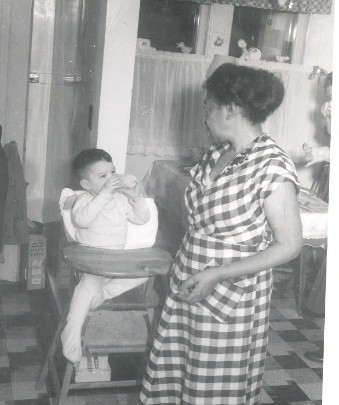
As this story was recounted to me countless times, I experienced an embodied Jesus. Cordy wasn’t preaching theology. She was living a surprisingly powerful and sacrificial love before my eyes.
Sadly, Cordy had her own demons—struggles with mental health and addiction which led her to eventually take her own life. She struggled with homelessness and was barely able to accept the hospitality of my grandparents, who offered her shelter. At best, she would accept a cot in the dark basement instead of a bedroom. She did not see herself as worthy of anything more than being an impoverished sharecropper’s daughter. Yet somehow, through her brokenness, she offered a fierce and protective love that left an imprint on my soul. Looking back, I see her clearly now as a wounded healer. Powerful women often do that. They carry wounds, but instead of passing those wounds forward, they transform them into compassion.
The Gift of Presence
Another early influence in my life was a second Black nanny in my grandparents’ home, Jessie May Bivins. While Cordy’s strength was fierce and protective, Jessie’s was warmth, affection, and dignity. She expressed love freely—through touch, laughter, smooches, and joyful presence.
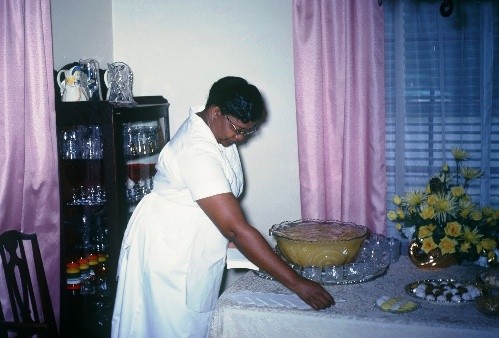
For many boys growing up in the 60’s, emotional warmth was rare. I was well on my way to learning the cultural lessons of suppressing tenderness and vulnerability. Jessie joyfully resisted that script. She modeled something different: that affection is not weakness, but a contagious strength. Through her, I learned that relationships matter more than the appearance of toughness. She too, like Cordy, suffered the indignities of being a 1950’s Tennessee Black servant, but she had the resources of her faith, even though it was with the stigma (in my Reformed family’s eyes) of being a Jehovah’s Witness. She had the gift of an effervescent presence.
Integrating Faith and Action
Later in life I encountered another powerful woman: Marchiene Rienstra, who in 1978 became the first woman to graduate with a Master of Divinity degree from Calvin Theological Seminary. As my pastor, she fulfilled roles as both prophet and priest, speaking with clarity and courage about the obsolescence of male dominance and top-down hierarchies. She spoke boldly about the oppression of the marginalized and the necessity of a heart-centered inner life. As my spiritual director, Marchiene embodied something I had rarely seen integrated—contemplative spiritual discipline with social engagement. She prayed deeply and acted bravely, grounded in a deep knowledge of herself, defining herself beyond the restrictions of culture and theology.
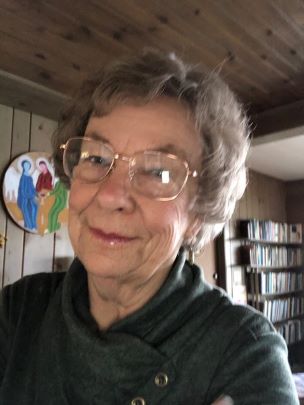
From her I learned that faith isn’t meant to live only in the mind or inside church walls. True spirituality moves from the heart outward into the world, seeking justice and healing. She showed me that the most grounded people carry both deep stillness and courageous action within them, an integration of heart and head.
Leadership from an Inclusive Circle
The Community Relations Commission was an advisory body to the Grand Rapids City Commission. We were a diverse group of nine community activists charged with strengthening relations between city government and its many minority communities. I was the only straight white male on this body and honored to be its elected chair. Among our members was Debra Muller, a member and leader of the Nottawaseppi Huron Potawatomi Nation.
As meeting facilitator, I failed to lead with a style that addressed the needs, preferences, and traditions of our diverse membership. I led with too much efficiency, insisting on ending meetings “on time,” and was tone deaf to the needs of all members. Debra challenged my unconscious assumptions of leadership, which were top-down and linear. With her mentoring, I developed cultural competency in guiding decision-making and meeting processes among diverse members.
Debra taught me how to facilitate circular dialogue in, and tolerate a level of, what seemed to be meandering inefficiency. Her mentorship led to greater in-depth engagement and inclusion of every voice. When she died, I was honored when tribal elders asked me to be a eulogist at her funeral
Why Men Need Powerful Women
When I look across the landscape of these relationships, patterns emerge. Many of the qualities these women embody stand in vivid contrast to the cultural scripts often handed to men. In my life experience, women are more likely than men to possess such qualities as:
- Emotional awareness
- Empathy and attentiveness
- A collaborative (instead of competitive) spirit
- Relational grounding (not performance-driven)
- An ability to develop intimate relationships
Despite the insistence of some evangelical voices, these qualities are not weakness. They are essential human capacities that men must cultivate to live a balanced existence. The crisis of masculinity is not that men are becoming too soft. It is that too many have been formed in systems that reward disconnection, domination, and control—and have mistaken those traits for strength.
Those same traits do not stay confined to individual lives. They scale. They become corporate exploitation.
They become racial hierarchy. They become militarism. They become environmental destruction. A masculinity that cannot feel will not grieve. A masculinity that cannot grieve will not change.
The influence of these women revealed another way: healed masculinity that:
- Protects without violence
- Is vulnerable, feeling and expressing emotions without embarrassment
- Leads without dominating
- Humbly admits failure when harm is done to others
- Recognizes when power and authority is misused or abused
This is not a rejection of masculinity. It is its restoration.

Strong women help restore that balance. They remind men that strength is not only about asserting power but must include compassion.
Becoming Fully Human
What these women offered me was not correction from the outside but transformation from the inside. They offered invitation—an invitation to become someone I did not yet know how to be. More self-aware. More centered. More vulnerable.
They helped me see that the goal was never to become a “better man” by the world’s standards. It was to become a more whole human being. And that wholeness required something I had been taught to avoid: the integration of the feminine.
Not as something external to admire from a distance—but as something internal to receive, learn from, and embody. Without that integration, masculinity becomes brittle. Defensive. Isolated. With it, something else becomes possible, a life marked not by control, but by connection. Not by dominance, but by depth. Not by certainty, but by humility and growth.
If I have become a more loving man, a more faithful partner, a more grounded presence in the world—it is, in large part, because I allowed myself to be shaped by powerful women.
If there is any wisdom I would pass on to other men, it is this: do not fear the influence of women. Do not resist what they reveal. Listen. Because in listening, you may begin to hear parts of yourself you were never taught to value—but cannot become whole without.
The women who shaped my life did more than influence me. They exposed the toxic masculinity that I’d inherited. They showed me that what I had been taught to call strength was often fear—fear of vulnerability, fear of losing control, fear of being seen, warts and all.
And they invited me into something more demanding than dominance: love that is accountable. Accountable to truth, to relationship, to the suffering of others. This kind of love is not passive. It resists and refuses to cooperate with systems that dehumanize.
This love calls us to examine not only how we live—but who benefits from the way we live. I am still learning. Still unlearning and being reshaped.
But I know this now: men do not become whole by holding onto power. Men become whole by surrendering the parts of ourselves that were formed by unjust power—and allowing something truer to take root. And often—if we are willing to listen—it is women who show us the way.

12 Responses
Thank you for recognizing the powerful women around you and learning from them!
Dear Dave,
Thank you, thank you for putting words to paper and sharing. It isn’t often that white males are willing to reveal their inner selves like you did in this essay. Back in 1988, Norm was asked to preach on Mother’s Day in his home church in South Holland, Illinois. Using a text from Matthew 26.13, he preached a sermon titled “In Memory of Her.” It provided him with the opportunity to remind the home folks just how much power and influence some of the women church members had in his life and the lives other young males, especially. We need to remember your essay and Norm’s sermon for showing that kind of honesty, and for daring to be so brave as to reveal how oftentimes mountains are moved. Thanks again for your bravery and your story.
I am humbled by your kindness and gratitude…
Thanks Dave,
As I read, I was forced as well as challenged to reflect on an immigrant wife and mother, mine, and the strength she displayed as a wife and mother to three sons and three daughters. I’m not done reflecting, but will re-read your observations and challenge, and possibly draw some conclusions….Even after eighty, it’s not too late!
Just wondering what we mean by a “strong” woman? This word seems to imply power. Do some of us fit a classification of not strong (weak?) and what would that imply?
By “power”, I refer to the ability to influence others. Power is neutral. It can be used to serve or harm others. So yes, women have power, and as I indicate, it need not be domineering, compelling, or coercive. Power can be underused to one’s own harm. The women I refer to had inner knowledge and strength to use their power in service to others.
Marchiene Rienstra has written several wonderful books. One of them is “Swallow’s Nest: a Feminine Reading of the Psalms.” One of her other books is “Flowers From the Gardens of Faith” offers beauty and wisdom . . .. a resource for many people to use of seven of the most ancient and universal of the world’s traditions”. One of its chapters is titled “What are Friends For?” to seek friends who can be worthy, helpful companions on the spiritual journey.” I am one of those friends. Marchiene inspired our friend Ghazala Munir and me to create “The Interfaith Dialogue Organization of Grand Rapids, Michigan.
This essay is putting a toe in to some waters that are ready for more troubling. Thank you.
It does not seem likely that a few brief encounters with Black domestic laborers on family vacation would shape you more than your relationships with your mother and grandmother shaped you.
It also sounds like your spanking intervention memory of Ms. Partridge was not directly remembered by you, but passed along to you by a relative who repeated narratives about her that conformed to the loving selfless mammy caricature.
I think that idealization/demonization of Black and indigenous women can operate as an avoidance of the work we need to do as white adults to humanize the immediate relatives who shaped us. Most of us have been formed to become Christians who are deeply suspicious of strident and powerful women as well as deeply paternalistic toward oppressed and defeated women.
I think in addition to hearing about the women you named, we might hear more about the women you mentioned in passing but did not name. How did your mother, who supported beating children, and your grandmother, who supported a caste society, use their power to shape your understanding of the world? In what ways was your own boyhood marked by violence and intimidation? What demons are tormenting your own access to a rest in healthy selfhood, due to the trauma that vulnerable little boys endure to be turned into tough leading executives? How does it affect little ones for a lifetime to be cared for in their earliest years by Christian women who have conditional social power, when the condition is that these women must cooperate under the standard of white male sovereignty in family, church, and civil society?
You offer some fair questions, yes. But your tone lands as harsh, and you make big assumptions about me, the nature of my inner work, other interactions with my nannies, and my family. Be careful.
Thanks Dave, for putting your experiences and thoughts into writing. You identify what was and still is in too many places and ways. Interesting that the majority of responses are from women.
Perhaps to my point…
Dave, I remember Cordie ! She fascinated me . When Pop and Nannie would come to GR with her riding in the back seat it opened a world to me. I loved them and your dear southern mother as well. Best , Micki DeYoung