
In October 2022, with the worst of the COVID epidemic behind us, my wife Cindi and I went ahead with a previously postponed road trip from Michigan to upstate New York to visit friends and do some sightseeing along the way. When I proposed a return visit to the National Baseball Hall of Fame in Cooperstown, New York, Cindi agreed, but on the condition that we also spend time in Seneca Falls, New York, to explore the historic sites related to women’s rights.
I said yes, and clearly got the better end of the arrangement. Seneca Falls turned out to be great experience for both of us, while Cindi graciously put up with our return to Cooperstown.
During 2 ½ days in and around Seneca Falls, we did a lot—touring the Women’s Rights National Historical Park Visitor Center, Wesleyan Chapel, the Elizabeth Cady Stanton House, and the Harriet Tubman National Historical Park in nearby Auburn.
A handful of national park rangers moved between various sites. They were knowledgeable, accessible, patient, and passionate about their work. From these rangers I realized that national parks in the United States do not focus solely on spectacular landscapes of uncommon beauty, unique geology, and rugged wilderness—think Yellowstone, Grand Canyon, Yosemite, etc. National parks also are dedicated to places of historical and cultural significance.
History-oriented national parks are straightforward and honest in their presentation of painful events in U. S. history. Their value is essential in this political moment when history is under threat of being rewritten.
Last month I was reminded of the diverse historical and cultural range of the 443 NPS sites while on a road trip. The reason for my trip was to relocate a vehicle from Arizona to Michigan. However, since I’m retired and had time on my side, I decided to extend the trip with several stops, including two cities that were significant during the Civil Rights movement: Little Rock and Memphis.
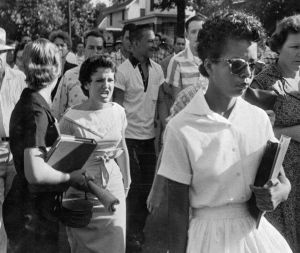
The 1954 U. S. Supreme Court decision of Brown v. Topeka Board of Education mandated an end to the segregation of public schools. In September 1957, nine African American students, the “Little Rock Nine,” were admitted to Little Rock Central High School, but not without great resistance from screaming mobs of white citizens, the Little Rock school board, and Arkansas Governor Orval Faubus. On the first day of school, the nine African American students were turned away by Arkansas National Guard troops, under order from Faubus. Eight of the students arrived together, with an adult to support them. But one, Elizabeth Eckford, arrived separately and encountered the angry mobs alone.
It would be weeks before the nine African American students were allowed inside the school, thanks to intervention from President Dwight Eisenhower, who deployed more than 1,000 members of the 101st Airborne Division of the United States Army to ensure the safety of the Little Rock Nine. He became the first president since the post-Civil War Reconstruction period to use federal troops in support of African American civil rights.
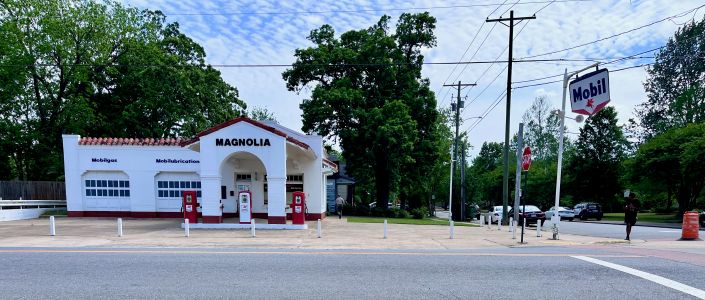
The saga of the Little Rock Nine happened when news coverage was entering a new era. As events unfolded, the Magnolia Mobil gas station, located across the street from the high school, became an impromptu press headquarters for print and broadcast journalists. The story went viral across Arkansas, the United States, and the watching world.
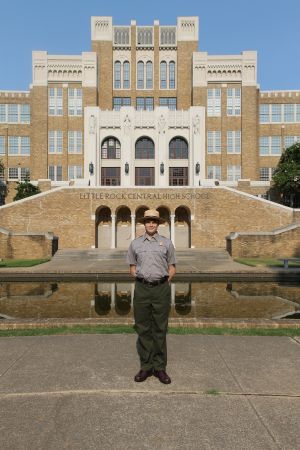
Today, the NPS operates the Little Rock Central High School National Historic Site across the street, telling the painful history of the times with clarity and directness. In addition to indoor exhibits, it offers a daily, 90-minute guided tour by an NPS ranger. On the day I was there, our guide, Ranger Alex Crawford, was excellent—candid, knowledgeable, comprehensive. At one point during his presentation, he mentioned that he graduated from Central High School about 10 years earlier. This enhanced his own credibility and perspective and led to questions from our group about the current generation of students. Ranger Alex was frank but also measured in his responses.
This kind of unvarnished, honest history is something the current Presidential administration is trying to dismantle, if not erase. In preparing to write this blog, I reached out to the NPS visitor center and was able to talk again with Ranger Alex. I was curious about what led him to this vocation, and what it means to him personally to serve in this interpretive role, particularly considering today’s political climate. As expected, he was careful with his words.
“In 1998, Congress passed a law* establishing this site,” he said. “Unless Congress changes the text of that enabling legislation, we will continue to do what we’re doing. I appreciate knowing we have that text as a guideline.
“I am aware that I have a relatively unique perspective. This (NPS) site is two years older than me, and my connection to Central High School runs deep. My grandfather went to school there, and my grandparents had been married for four or five years during the time of the Little Rock Nine. My grandmother was part of the Women’s Emergency Committee that was established during the (1958-59) ‘Lost Year,’ when the Little Rock public schools were closed, and it was that group that organized a recall election that changed the makeup of the school board.”
During a captivating 2026 January Series talk at Calvin University (“America at 250: How Our National Parks Inspire a More Perfect Union”), former NPS associate director for interpretation and education Tom Medema referenced the delicate balance facing national parks.
“The National Park Service is part of the executive branch, so you bend and sway with the preferences of any administration,” Medema said. “You would see periods of ‘don’t talk about climate change,’ for example, and then periods of ‘all we’re going to talk about is climate change.’ With that moving goalpost, as an interpreter you must be willing to do your job within the space of the executive authority that you work for. If you don’t like that or can’t do that, then you must move into an area where you can be more of an advocate for your particular thing and not feel like you are selling out your values to do something.”
I’ve visited dozens of national parks in my lifetime, but only in recent years have I grown to recognize and value what Medema calls the “deferred storytelling” and “moral ecology” of the National Park Service, which has never felt more important.
*From Public Law 105-356, 105th Congress: “…the designation of Little Rock Central High School as a unit of the National Park System will recognize the significant role the school played in the desegregation of public schools in the South and will interpret for future generations the events associated with early desegregation of southern schools.”
7 Responses
What a marvelous and moving post.
Thanks for a very informative and thoughtful blog, Terry. Our national Parks and their staff are one of America’s greatest treasures.
Thank you Terry, for this heartfelt and very important information. I was not aware our National Parks aren’t just about our country’s beautiful geology. And additionally, thank you for the link to Tom Medema’s address at Calvin recently. I wasn’t able to make that one but am reminded I can find it online…which I will do.
You are so right about what a priceless jewel our national parks are. We have been blessed to visit so many of them in travels around the country and, although our big parks are stunning and magnificent, it is the myriad of small ones that can be so impactful and educational by telling the stories of land, people, and events.
Thank you Terry,
Visiting each National Park is on our bucket list (Jen and me), and we have made an effort to include as many historical sites as well. I’m not sure we will make it to all 443. That number feels more daunting than the 62 more well known National Parks. I can say this much, we never left empty handed or disappointed in seeing the grandeur of our country or learning something about the history of who we are as a nation. Sometimes through tears, sometimes with joy, but never empty.
Thank you so much Terry for sharing your journey. So agreed about the value of NPS and so appreciated learning more about Little Rock and personal connection/ history of ranger.
Thank you, Terry. While I have enjoyed a number of the National Parks, this piece inspires me to expand my experience and to see them through new eyes.