
One of the perks of being married to someone getting a PhD in religious studies is that often, when Josh returns home from conferences, he brings back a book or two that he knows I’ll enjoy.
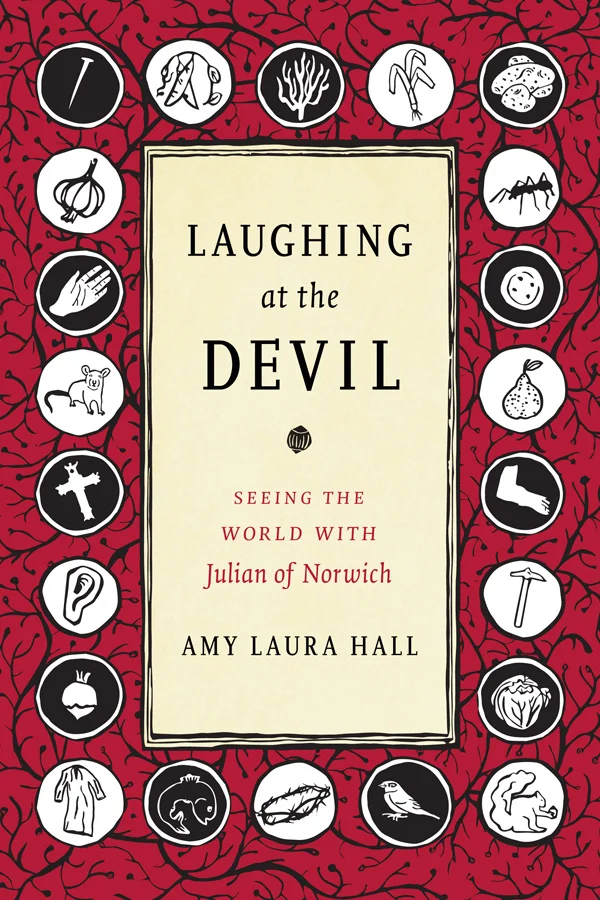
Last time he went to the American Academy of Religion Annual Meeting, he brought back Laughing at the Devil: Seeing the World with Julian of Norwich by Amy Laura Hall, an Associate Professor of Christian Ethics at Duke Divinity School.
This wasn’t an entirely random choice. We’ve both loved Julian’s writings for a while, and one of the readings at our wedding was a passage from her “Revelations of Divine Love.”
But I’ll admit to waiting several months to pick up Hall’s book after receiving it, mostly because I couldn’t find the energy to do any extra reading that seemed academic or theological, outside of what I was already reading for my church work and sermon preparation.
When I finally found the time to crack it open, I was delighted to find that it was not just a close examination of some of Julian’s writings, but also part historical text, part memoir, part invitation, with allusions to everyone from rapper and singer-songwriter Nicki Minaj to poet Denise Levertov woven throughout the text. Hall reads Julian in her own historical context, a 14th century anchorite living in St. Julian’s Church in Norwich who received visions and at least some outside visitors. But Hall reads Julian, too, in our own historical context, asking how we might “see the world” alongside her today.



Hall elaborates on perhaps one of the most well-known passages from Julian’s “Revelations,” the love of God and something like a hazelnut, in her chapter on Julian’s writings and her understanding of time.
And in this [God] showed me something small, no bigger than a hazelnut, lying in the palm of my hand, as it seemed to me, and it was as round as a ball. I looked at it and thought: What can this be? I was amazed that it could last, for I thought that because of its littleness it would suddenly have fallen away into nothing. And I was answered in my understanding: It lasts and always will, because God loves it; and thus everything has being through the love of God.

I have always loved this passage, but I’ll admit that when I first read it, I had no idea of the context in which Julian saw this vision. But something about it feels captivating: that the world, with all its sorrow and joy and fear and hope, might be cradled in the palm of a hand, not merely created by the love of God but sustained each moment by that love.
But reading this passage with Hall, and learning more about the historical context in which Julian lived, makes this vision feel both more timeless and more particular. Julian’s time was marked by strict hierarchy and social stratification in English, as well as by the aftereffects of a major outbreak of the plague in 1349 that likely killed a third of the people in Norwich, and half the priests. Hall identifies this as a time not just of famine but of spiritual crisis.
And Hall sees understanding the crisis and despair of those years as adding depth to our own readings of Julian: “The particular material crises of Julian’s time mattered for how people saw the significance or insignificance of their own matter. I have found that her words from within these crises resonate with people going through their own particular misery and during a time of economic and social upheaval that have left neighbors and loved ones uncertain, despondent, anxious, or confounded. Julian saw all that is and was and will be as held by God, and this matters for our bodies and our hope that every aspect of our lives will be redeemed” (33).
It is one thing to say everything has being through the love of God in time of peace, prosperity, and plenty. But Julian sees this vision in a time of crisis and despair, and dares to record it from within the crisis.
The crises of our times may not be the same. But we are no strangers to despair and grief and fear. We know too well that our lives can change in an instant, that much of what we hold is fragile, that too often injustice seems to have the final say. As we are invited to see the world with Julian, perhaps we are invited to tell the truth, about joy and hope but also about pain and despair, in a world somehow still held and sustained by the love of God.

2 Responses
What a beautiful and timely word. An image I need today. Thank you, Bethany.
Thank you for bringing Julian of Norwich to the Reformed Journal. No matter how small the hazelnut is, or how small we are, God loves us.
“and all shall be well.”