
The street is thronged. Exuberant kids grab Tootsie Rolls thrown their way. Moms and dads corral them. Senior citizens wave small flags. Teens sport patriotic garb. Dogs strain their leashes. It’s the Fourth of July parade. The high school band marches in call-time. Cambodian women twirl in brilliant silk sampots. Harley owners roll by on tricked-out machines. Hispanic horsemen promenade. Shriners in red fezzes zoom mini-cars. Military veterans carry the flag. Scout troops pass in review. Tumblers soar through the air. Mexican lasses swirl their eye-popping ribbon dresses.
Standing room only for my neighbors and me. Every race. Every color. Every gender. Every creed. Every sexual orientation. Every political persuasion. There’s joy. Laughter. Greetings. Hugs and high-fives and handshakes. It’s unity across diversity, diversity within unity.
Call it shalom. Or the Kingdom of God. Or Beloved Community. Better yet, call it Trinity-on-display.
Tomorrow is Trinity Sunday. This church feast celebrates the doctrine of one God in Three Persons—Father, Son, Spirit. Creator, Redeemer, Sustainer.
In seminary I heard different explanations. Immanent theories describe what the Trinity is internally—its shared ontological essence. Economic theories describe how the Trinity acts externally—its distinct functional roles. Equal divinity. Separate operations. Who God is. How God works. Conservatives take the Trinity as a metaphysical reality. Liberals as a metaphorical symbol. In either case, it’s about relational love.
Today, seminary long past, my question is: “so what?” I’m less concerned with tidy beliefs. I’m more interested in practical consequences. What concrete difference does the abstract doctrine of the Trinity make? What is its public meaning? On that score, I’ve been helped by Greg Okesson’s A Public Missiology.
Charles Taylor defines a “social imaginary” as “the ways in which people imagine their social existence, how they fit together with others, how things go on between them and their fellows.” It’s a collective vision of a desirable and feasible future. The dominant Western social imaginary is individualistic. Hierarchical. Authoritarian. The doctrine of the Trinity is anything but.
An individualist imaginary asserts that we are separate autonomous beings each seeking our own good. It views our lives as unconnected. It prioritizes personal comfort and affluence over collective interests. It values independence and self-reliance. Standing on our own two feet. Achieving happiness by our own hard work. Not needing help from others, who only get in our way. The Hollywood hero is John Wayne or Jason Momoa: the strong, solitary savior who goes it alone.
Not so the Trinity. God isn’t unitary—an absolute unmoved mover. God isn’t solitary—separate individuals, each existing alone. God isn’t static—passively blissing out in seclusion. Instead, God is Trinity—a network of relationships, a community of interdependent Persons in eternal mutual love. Reciprocal giving and receiving binds them together. The Greek Fathers used the word perichoresis—”cyclical movement” or “reciprocity”—to explain the Trinity’s intermingling flow of shared life. C.S. Lewis puts it well: “the living, dynamic activity of love has been going on in God forever.”

1926-2024
Humankind, made in the image of the Triune God, are deeply interconnected. That’s why isolation harms well-being. Why loneliness is a public health crisis. We’re not connecting with other people—instead, we silo ourselves off. But we can’t flourish in detached isolation. Instead, Jürgen Moltmann says, “we relate to each other not as solitary human subjects but as one human community.” A trinitarian society balances individual flourishing and the common good. It rejects liberalism’s myth of the autonomous, independent person. It honors human interdependency. We need other people. And so the Church is one body made up of many parts. So is society. Other people—especially the poor, the homeless, the hungry, the stranger—need us. And we need them!
A hierarchical imaginary divides the world into two groups: men and women, white and black, straight and gay, Christian and non-Christian, rich and poor, abled and disabled. Then it prioritizes the first group, which is superior, over the second, which is inferior. Difference becomes division. Caste systems perpetuate privilege and disadvantage. Social pyramids keep people separate and unequal.
Not so the Trinity. Father, Son, and Spirit aren’t uniform, the same, homogenous. They’re diverse, particular, heterogenous. Each one, Okesson says, is different from the others. Father isn’t Son or Spirit; Son isn’t Father or Spirit; Spirit isn’t Father or Son. Yet each is equal to the others. None exists in isolation. Each finds their distinct identity in relation to the others. It’s what Steve Seamands calls ‘tri-unity.’ Diversity without hierarchy.

The Trinity subverts white, patriarchal, heterosexual, Christian nationalism. It rejects “me first.” And America First. A trinitarian society celebrates diversity. Ensures equality. Practices liberty and justice for all—without exception.
An authoritarian imaginary centralizes power. In authoritarian political systems a single person or party holds control. Checks and balances are gone. In authoritarian economic systems wealth and power concentrate in colossal corporations. Extractive capitalism thrives on deregulated markets and weak labor and environmental protections. In authoritarian religious systems one faith is privileged in public life. Christian nationalism rejects pluralism and seeks dominance—inscribing its values and symbols into laws and social norms. Authoritarian practices crush the vulnerable and buttress the powerful.
Not so the Trinity. As Moltmann says, each Person relates to the others “not through domination and subjugation but through community and relationships.” The Arian mistake: subordinationism. Making the Son subservient to the Father. A created being with a lower nature. The Nicene affirmation is that Jesus is a ‘co-eternal and consubstantial’ equal: “true God from true God, of one being with the Father.” It overturns authoritarianism within God—and within human relationships.
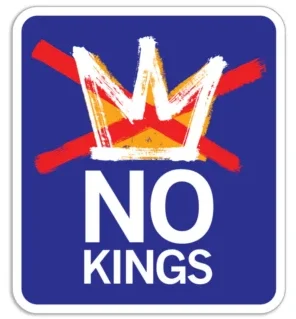
The Trinity indicts what Marcus Borg calls “domination systems”—powerful and wealthy forces that are politically oppressive, economically exploitative and religiously legitimated. A trinitarian society has No Kings—political, economic, religious.
The starting point of Christian faith is the warm friendship shared by the Three Persons from all eternity. Because “God is Life Together,” as Dorothy and Gabriel Fackre put it, individualism, hierarchy, and authoritarianism are heresies.
It’s time—past time—to orient our public life to God’s triune nature. Interdependence. Diversity. Equality. The God reflected in an all-embracing, pulsating, joyful community parade.

3 Responses
Given the current state of the church, I often ponder what will be the biblical theme of the next reformation and the corresponding doctrines that will provide a foundation for a vital Christian community. Your thoughts on the trinity would be the place to start. Thank you.
Thanks Jim. Profound and pertinent. Past seminary experiences struggled explaining the Trinity. You cut through it making it lived. T
Thank you for this timely, insightful, liberative, and joyful reflection! My own thinking on the subversively salvific significance of the doctrine of the Trinity has been immeasurably enriched by reading and discussing Tim Gorringe’s Word, Silence, and the Climate Emergency: God, Ekklesia, and Christian Doctrine. In an especially illuminating and relevant chapter on the scriptural and theological grounds of the Trinity in relation to the cross, kingdom, and eschatological hope, he writes: “I understand the beauty of the Trinity…partly in terms of its summing up the relationships of love as the heart of all reality and as the destiny of all reality which is the heart of the good news, and partly…as springing from the revelation of God in Christ, as based on his story, and speaking of his presence in the fundamentals of daily life.” Such a life surely includes both courageous witness against all that diminishes and destroys the fullness of life intended by God as well as joyful conviviality amidst the wild diversity of God’s beloved creation, including a great parade. Thanks again!